Among the Nordic mountains and high plains, humans have since the dawn of time entered into something deeper than trade – a mythical and spiritual conversation with other animal species. These understandings, which we may call "contracts," are not written agreements but living traditional knowledge that has structured entire civilisations. The Sami and the reindeer are the best-known example, but other cultures around the world have their own stories of so-called pacts with birds, wolves, and other beings. These tales tell us something important about how humans once understood their relationship with nature. Not as masters over it, but as participants in a greater ecological and spiritual fellowship.
The Sami's Contract with the Reindeer
In Sami cultural heritage – preserved through oral tradition and documented by scholars such as the South Sami priest Anders Fjellner in the 1800s – there is a foundational story: the reindeer was not always the Sami's animal; it was given to them as a gift from the Sun, the sun goddess.
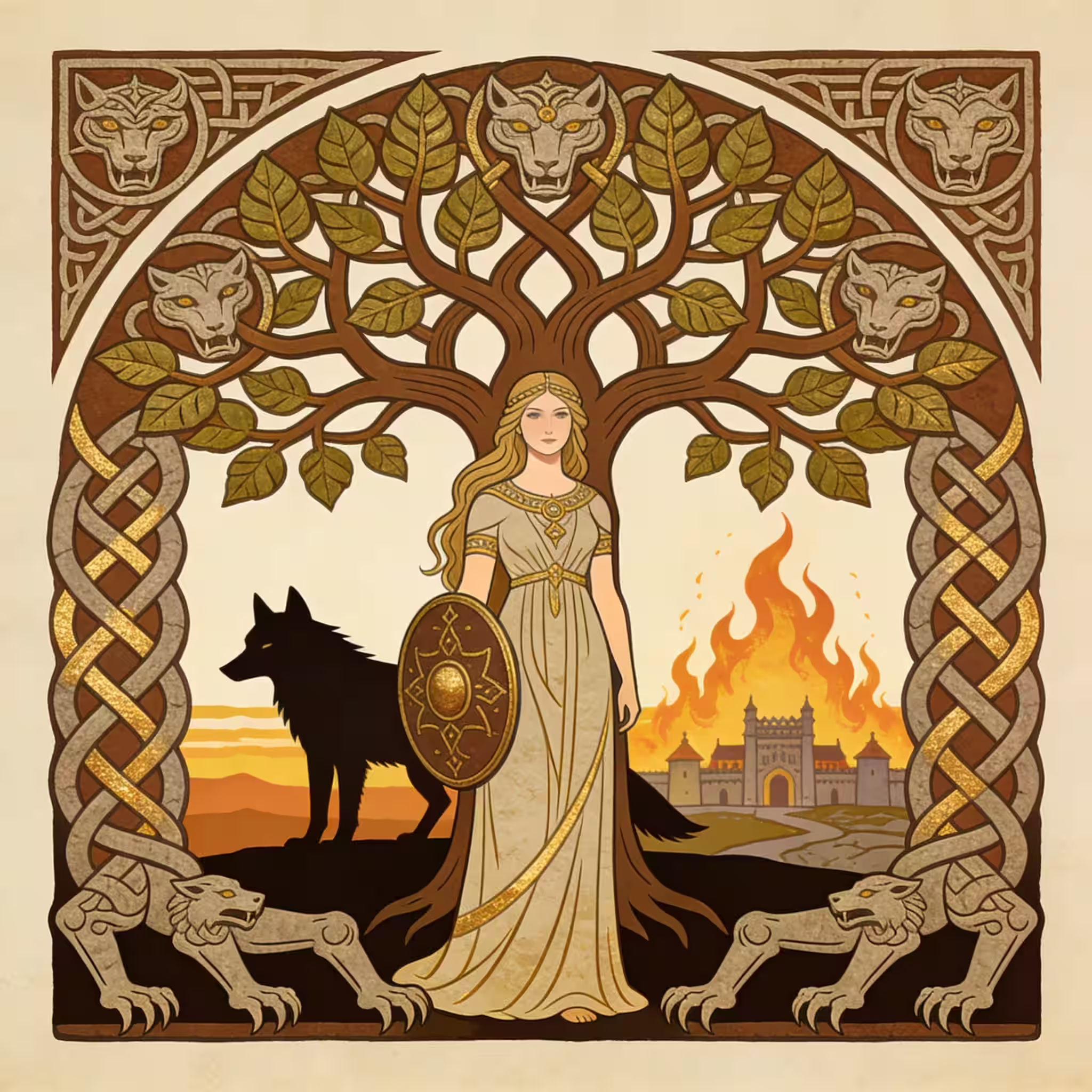
According to Sami tradition, it was the Daughter of the Sun who carried the Sami's cause before her father. She saw the Sami's suffering in the cold north and asked for a blessing. The Sun listened, and gave her people the reindeer. But this gift came with obligations. The Daughter of the Sun taught the Sami how to tame the wild animal – not through force, but through joik, the distinctive Sami form of song that calmed the animal and created a bond between human and animal.
The contract was clear and explicit: the Sami were to protect the reindeer from predators such as wolves and bears, and in return they were to use the whole animal when they brought it down for food and materials. Nothing was to be wasted. The hide became clothing, the sinews thread and cords, the bone tools and weapons, the blood food, and even the hooves were turned into glue. This was not greed – it was an ethical obligation that reflected a deeper respect: full use as a sign of gratitude and honour for the animal's sacrifice.
"We use absolutely everything," as it is expressed in modern Sami traditional teaching. This includes even what seems small in our eyes – the bone that becomes needles; even the blood bears witness that the animal did not give its life in vain.
The connection between the Sami and the reindeer was therefore not merely economic, but spiritual. The Daughter of the Sun had been the Sami's defender before her father. When the reindeer thrived, it was a sign of harmony. When the herds suffered, it was a sign of a broken pact.
The Doves
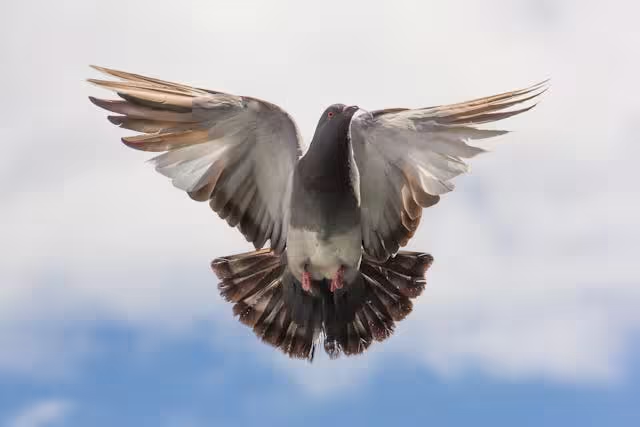
The dove myth is a different story – both because it is less prominent in the Western tradition, and because it concerns an entirely different form of dependence. Doves were domesticated by humans around 10,000 years ago, first in Mesopotamia, later in Egypt and around the Mediterranean.
Unlike the reindeer, which humans had to tame on the open plains, the dove's fate was simpler and more fundamental: complete dependence. The doves could no longer survive without humans. They received their food from humans, and they laid eggs where humans let them nest. In return they gave their meat, their eggs, and – most importantly of all – their ability to find their way home.
This made doves ideal messengers throughout history. In ancient Mesopotamia and Egypt, doves flew between people, and they were sacrificed to the gods as a sign of humility and prayer. The Romans used them in war to send messages over long distances.
But where was the mythology that told of this pact? Here we must be honest: it did not exist in the same way as the reindeer myth. The doves were not given by gods – they were taken. Humans took them from the wild and made them dependent. And without an explicit mythological contract – there was no skilled defender on the doves' behalf before the gods.
The Wolf's Broken Pact
If the reindeer was a gift and the dove a service taken, the wolf was something else entirely: a brother whom humans banished from their own family.
In many Indigenous cultures – among the Lakota, Dakota, Cheyenne, and Inuit – the wolf was a teacher and a companion. North American tribes learned about hunting by observing the wolf pack, and several tribes have traditional stories of how humans and wolves were friends who hunted together. The wolf's devotion to its pack inspired humans' own ideas of loyalty and solidarity.
But when colonisation came to North America, so too came an entirely different relationship: wolf hunting as sport and hatred. The human who had once seen the wolf as teacher and brother began to hunt it for its fur, for bounties, to "protect" herds. The wolf was no longer the brother – it became the enemy that must be exterminated. In Europe something similar happened. The wolves disappeared from Scandinavia. They disappeared from Germany, England, France.
The consequence? A world without balance. When the predators were gone, the deer flourished. The deer ate away all the vegetation. The rivers ran dry. The forests died. It took centuries, but nature showed its wrath.
The Bison's Sacred Gift
Another chapter in these animal stories is the return of the bison. In 1975 the Onondaga Nation in New York entered into an official agreement: bison were "borrowed" from Montana, and a symbolic hide treaty – painted with colours – documented the agreement.
The contract was clear. The bison were to be used fully – meat for rituals and food, hides for drums and clothing, bone for sacred objects.
The reason it was necessary? In the 1800s, American military forces and settlers had massacred around 60 million bison in a deliberate effort to undermine the Indigenous way of life. There was no hunt, no respect – it was annihilation. The bison pact was not merely broken, it was massacred.
The Consequences of Broken Pacts
When the contracts are broken – when humans cease to respect and uphold these agreements – both nature and the spirit respond, according to the traditional tales. For the animals this often has catastrophic consequences (which we choose not to write about here, but which exist for those who wish to look).
On a deeper psychological level, humans who have lost their connection to the animals' spirits – who no longer hear the joik, who no longer respect the full sacrifice of the animals – these people have lost something of themselves. Depression and anxiety are rising in Western societies. We are strangers in our own world.
The Hope
But light breaks through the clouds.
Today we see the old pacts being taken up again.
Sami youth are learning joik again, taking part in reindeer husbandry based on traditional respect, and fighting to preserve the Sami highlands against the pressures of climate and development.
The "honorable harvest" movement teaches people to take the whole animal, not to waste, to honour the sacrifice. This holds true in both traditional hunting and modern animal welfare.
Rewilding movements are reintroducing wolves in Europe and North America, even where there is conflict. The sense of nature is winning, slowly.
The Onondaga's bison herd is growing and thriving. They share their knowledge with other tribes. The bison pact lives again.
Dove centres around the world care for abandoned and poisoned doves. They revive a form of respect for the little bird that was once heaven's messenger. One of Asia's most important Shiva temples – known as "Pashupatinath," meaning "Lord of the Animals" – reflects this. In Hinduism, animals, including doves, are considered sacred and dwellings of the gods. The doves are therefore treated with deep religious respect and fed as a form of devotion and good works (karma). By feeding the doves, pilgrims fulfil a religious duty and reap spiritual merit.
Boudhanath Stupa – one of the world's most important Buddhist temples – has hundreds of doves flying freely about and feeding on grain thrown by visitors. In Buddhism, feeding animals is associated with good works and compassion, two of the most fundamental principles.
The hope lies in the recognition that we cannot live without these contracts. The Daughter of the Sun saw something that humanity today is slowly rediscovering: that we need the animals at least as much as they need us. Without the reindeer's use of the landscape, the highlands become desolate. Without the wolf's hunting, the forests grow sick. Without respect for the dove that was once our faithful friend, the cities fill with sorrow.
Today, when we set foot on the path the reindeer has trodden, when we hear the joik through the northern lights, when we see a dove return home – we are closer to a restoration. It is not too late. The Daughter of the Sun is still waiting for us to keep our promise. And nature, with its quiet and inexhaustible power, is already working towards a new harmony – if only we show respect enough to hear the voice of the previous generation, of the animals' spirit, of the earth that still beats a heart beneath all the dust.
Let us do it. Let us honour the contracts again.
Sources
Samiske Veivisere – Sami mythical tales
https://samiskeveivisere.no/article/samiske-mytiske-fortellinger/
Beneath Northern Lights – The Agreement Between the Sami and the Reindeer
https://www.beneathnorthernlights.com/the-sami-and-the-reindeer/
Central Current – A Herd, A Hide, and A 50-Year Friendship: How the Onondaga Nation Brought the Buffalo Back
Wikipedia – Wolves in folklore, religion and mythology
https://en.wikipedia.org/wiki/Wolves_in_folklore,_religion_and_mythology
Wysinfo – Doves and Pigeons in History
-1.avif)
-1.avif)