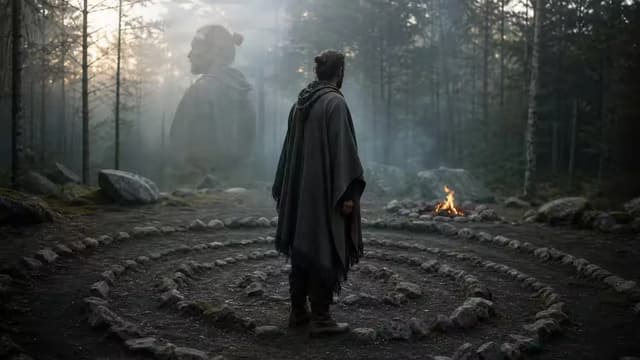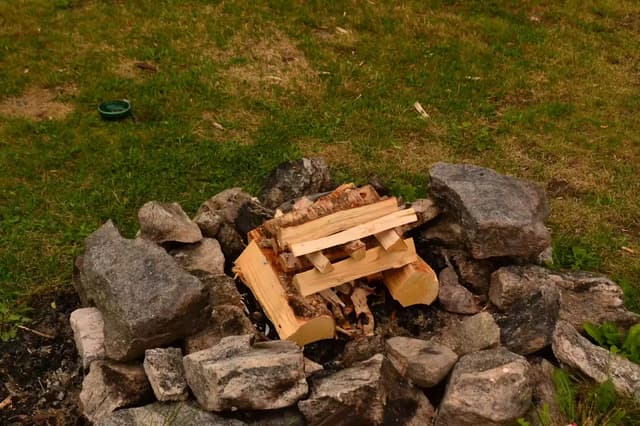
It often begins with silence. Not the empty silence that arises when no one knows what to say, but the distinctive silence that arises when a space is about to become something more than just a place. Perhaps the group is already standing in a circle. Perhaps the fire is lit, or soon to be lit. Perhaps the forest lies around them like a living backdrop, with wind in the trees and earth beneath their feet. And then, before the ceremony truly takes shape, something happens that is simple and at the same time great: the directions are called in.
For many who encounter shamanic work for the first time, this can seem mysterious. Why speak to the east, south, west and north? Why mention earth, sky and the heart as if they were guests? The answer is that it is about opening a space, creating orientation and inviting the spiritual whole into the ceremony. It is a way of saying: Now we step out of everyday logic and into a space where everything is connected.
A living map
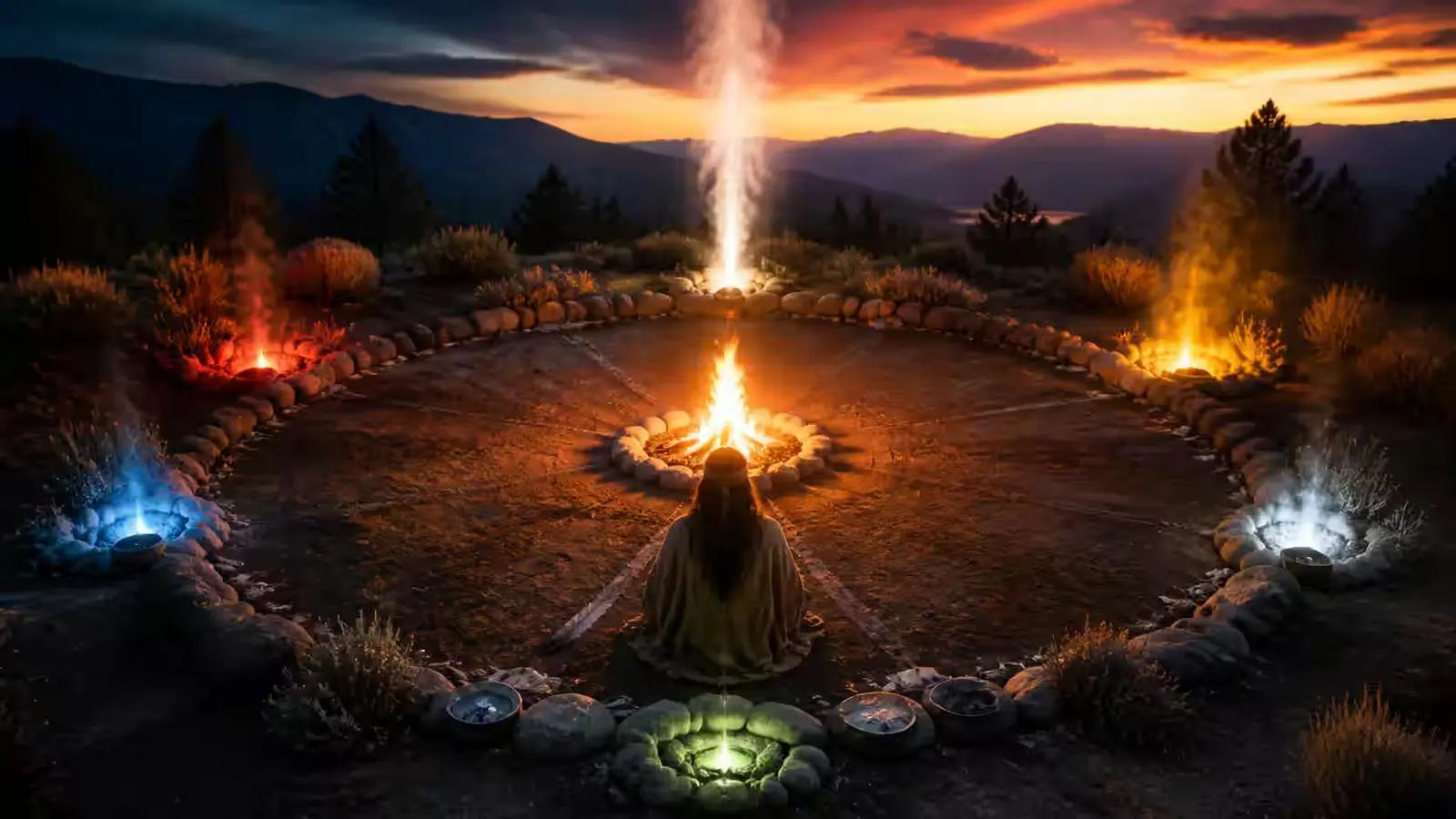
The seven directions can be understood as a living map of the world. In Sjamanistisk Forbund, the four cardinal directions come first: east, south, west and north. Then come Mother Earth and the Creative Force, and finally the center, or the heart. Together they form a whole, a circle that shows not only where we are, but also how everything is connected.
This map is not meant as geography in the ordinary sense. It is a symbolic and experiential map, a language for understanding the movements of life. East points toward beginning and clarity. South carries energy, life force and ripening. West is experience, reflection and transformation. North stands for calm, wisdom and endurance. Beneath us we find Mother Earth, who carries and nourishes. Above us we find the Creative Force, or the dimension of the sky, which points toward the greater. And in the center is the heart, the place where everything gathers and finds meaning.
When these directions are called in during a ceremony, it is like setting a compass. One reminds oneself and the group that the human being does not stand alone. We always stand in relation to something greater, something above us, beneath us, before us, behind us and within us. This is what the calling-in helps us to feel.
East and the morning
East is often the first point. This is not by chance. The sun rises in the east, and therefore this direction is associated with beginning, awakening and new light. In Sjamanistisk Forbund we link east to the child, to the sun that starts there, and to the fire that is lit in the east.
Symbolically one can say that east reminds us of what is still young, fresh and open. It is the direction where the day begins and where consciousness awakens. When the ceremony leader turns toward the east, it is like saying: Let us enter into this with clarity, with curiosity and with the will to begin.
In many ceremonies, east is also used as the first direction because it sets a tone for the rest of the space. It is here the light comes in first. It is here one often seeks inspiration, vision and clarity. In a modern explanation one can say that east represents the fresh gaze, the ability to see something for the first time.
South and growth
South is often associated with warmth, ripening and life force. In Sjamanistisk Forbund, south is the direction of youth. It is where the energy is strong, warm and in motion.
If east is the morning, south is perhaps the late morning or the midday sun. It is the time when the force is clear, when it is easy to act and build. In a ceremonial context, south can therefore represent courage, creation and the part of life where one truly steps forth and begins to work in the world.
This direction also reminds us that power must be used with wisdom. Youthful energy is valuable, but it must have form, otherwise it becomes restless. South therefore gives not only warmth, but also responsibility. It asks: How do you use your power? How do you let passion serve what is true?
West and what matures
West is the direction of sunset, reflection and experience. In Sjamanistisk Forbund, west is linked to adulthood. It is here that we have lived for a while, seen something, lost something and learned something.
West often carries a different kind of calm than east and south. Where the first directions can be about beginning and power, west is more about understanding what the power has done to us. It is the direction for looking back without becoming stuck. It reminds us that life is not only forward motion, but also insight.
In a ceremonial context, west is often the place for emotions, transformation and the inner work that comes with experience. It is here that we can meet what must be released, what must be worked through, and what has matured in silence. West teaches us that transformation is not always dramatic; sometimes it happens in quiet recognition.
North and wisdom
North is the last of the four main directions, and in many traditions it is associated with winter, calm, stillness and wisdom. In Sjamanistisk Forbund, north is the direction of old age and wisdom.
North is not weakness. It is the kind of strength that has been tested over time. It is the part of the year and of life that knows that not everything must be said, and that not everything must happen now. North carries patience, structure and the ability to endure.
When north is called in, it is often as a reminder to stand firm. That direction gives depth and grounding. It does not ask first for speed, but for meaning. Not first for action, but for understanding. North teaches us that wisdom often comes when we dare to be quiet enough to hear it.
Mother Earth and the sky
The four directions are important, but the whole only becomes complete when the remaining directions are also included. In Sjamanistisk Forbund, Mother Earth and Father Sky, or the Creative Force, are two of the seven directions.
Mother Earth represents what we stand on and what we live from. She is nourishment, body, matter, care and carrying. When she is called in, the ceremony reminds us that we cannot be lifted out of the earth from which we come. We are body, we are breath, we are nature.
The Creative Force, the sky or the divine points upward. It refers to the greater perspective, that which cannot be owned, but only received. That direction can be understood as inspiration, vision, spiritual contact or the deeper order that the ceremony tries to attune itself to.
Together, these two directions create a vertical dimension in the wheel. What is beneath us and what is above us become part of the same whole. It is as if the human being stands midway between earth and sky, between the earthly and the spiritual.
The heart in the center
The center, or the heart, is perhaps the most personal of the directions. It is not outside us, but within us. One can describe the heart as a central and significant direction, because it is there that compassion, openness, love and understanding dwell.
The heart is the place where everything gathers. If the other directions are the world around us, the heart is the inner place where we can hold them all together. It is not just a place of feeling, but a point of orientation. When the heart is included, the calling-in becomes more than an outer act; it becomes an inner gathering.
In a simple explanation, one can say that the heart is the part of us that asks: Are we truly present? Are we open? Are we in contact with what we are doing? Without the heart, the other directions become mere structure. With the heart, they become alive.
Why call in
Calling in is not just a ritual habit. It is a way of making the space clear. When the directions are called in, one creates a framework that means the ceremony does not drift randomly, but is given a direction and an order. It is a form of sacred orientation.
One can compare it to opening windows in a room. Before the calling-in, the room is perhaps just an ordinary place. After the calling-in, it is as if several layers of meaning have entered. The participants know that they are now in a kind of transitional state, where attention gathers and the intention becomes clear.
Calling in can also give safety. When one clearly names which forces one wishes to invite, the ceremony becomes more defined. One knows what the space is for, and what it is not for. This creates calm. In many ceremonies one therefore starts by cleansing, opening and then calling in. In this way one moves gradually from the everyday to the sacred.
An old and living practice
Even though the language around the directions can vary between traditions, the idea of orienting oneself according to the forces of the world is very old. For us it would be natural to point to the Sami understanding of the four winds and the Norse tradition with the four dwarves Austri, Vestri, Nordri and Sydri.
What makes this practice living is that it is not only about the past. It is used today, in ceremonies where people seek contact with nature, themselves and the sacred. It is not a museum language, but a practice language. The calling-in thus becomes a way of building a bridge between heritage and the present.
The directions as lifelong learning
The learning about the directions is a lifelong path. This means that one does not simply "learn them once" and then is finished. One learns them by using them, knowing them, making mistakes, discovering nuances and seeing how they work in different contexts.
For example, east can mean something slightly different in a spring ceremony than in a winter ceremony. North can be experienced differently in a grief ceremony and in a full moon ceremony. The heart can be quiet in one context and burning in another. The directions are therefore not rigid boxes, but living qualities.
This lifelong learning also does something to the ceremony leader themselves. One becomes more attentive, more humble and more listening. One gradually understands that it is not about mastering a script, but about being in relationship with the forces that are called in.
A simple practice
For those who wish to understand calling in in practice, it can be helpful to imagine a calm and clear order. One usually starts by cleansing the space and the participants. Then one turns toward the east, then south, west and north. Then one can turn toward Mother Earth, the Creative Force and finally the heart.
In many traditions, words, song, drum or rattle are used to mark the directions. The most important thing is not that the wording is identical every time, but that it is meaningful and wholehearted. The one who calls in should know what they are asking for and why.
A good example of this is that the calling-in can mirror the purpose of the ceremony. In a healing ceremony, the words will carry care. In a transition ceremony, they will carry support. In a thanksgiving ceremony, they will carry gratitude. In this way the calling-in becomes a bridge between intention and action.
When everything is connected
The deepest thing about the seven directions is perhaps that they remind us of wholeness. Instead of seeing the world as divided and random, they invite us to understand connection. We stand on earth, beneath sky, in relation to nature's rhythms, with a heart that can hold everything together.
This is why the directions keep returning in shamanic ceremonies. They are not merely ritualistic markers, but a way of saying: We are not alone. We are part of something greater. And when we call in the directions, we really also call in our own place in the whole.
This gives the ceremony a depth that is easy to feel but hard to fully explain. One can stand in a circle and notice that something in the body settles. One can hear the words and feel that the space becomes clearer. One can follow the calling-in and experience that the world somehow falls into place. This is what the directions do when they are used well: They help us find orientation in both the outer and the inner landscape.