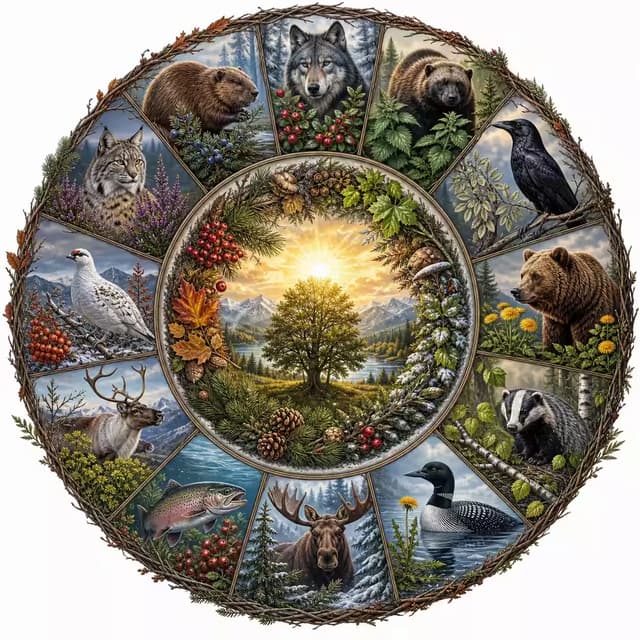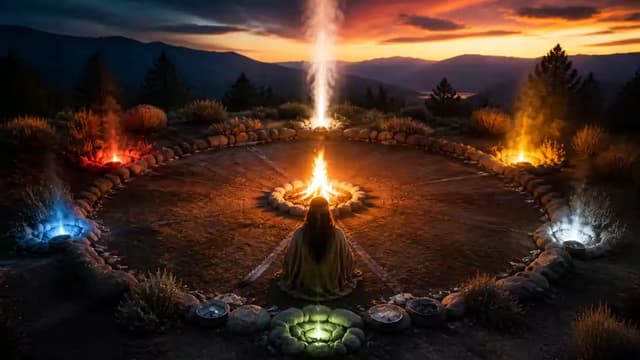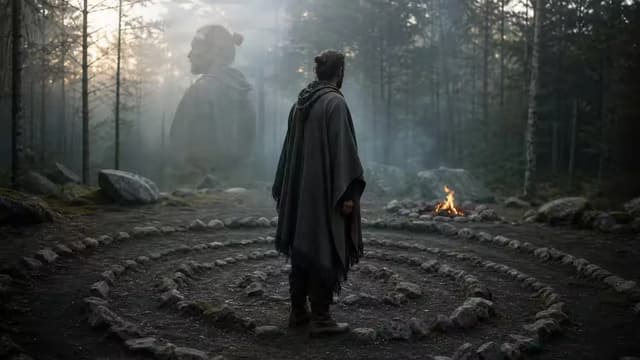
There are moments in a ceremonial space where everything is still, yet full of expectation. People have gathered. Some stand close together in jackets and scarves, others sit calmly and look out across the place. The air may be cold, or sharp with autumn, or saturated with the soft warmth of summer. It has not quite become the ceremony yet. It is still a transition. But everyone senses that something is about to begin. And in the midst of this transition lies the fire, like a promise.
To build a fire in the ceremony is not merely a practical act. It is part of the sacred work. It is a moment where human hands, nature's materials, the rhythm of the season and the symbolic understanding of the world meet in an act that is both concrete and deeply meaningful. A fire is warmth, light, gathering and transformation. But it is also direction, structure and intention. A fire is thus built not only to burn. It is built to carry.
In Sjamanistisk Forbund the fire is part of the ceremonial space. It is a flame that is meant not only to give warmth or light, but that also forms part of a greater whole of acts, symbolism and interplay with nature. When the fire is lit, we step into another state. We open a space where the sacred can find room. That is why everything begins long before the flame arrives. It begins with understanding the place, the materials, the direction and the purpose.
Before the fire is lit
The first thing one learns is that a fire never simply arises. It must be prepared. And the preparation is itself part of the ceremony. One walks out to the place with an awareness that it is not merely a patch in the forest or on the field. It is a space to be received with respect. The ground is assessed, the wind listened to, and the surroundings sensed. Where does the sun stand? Where does the draught come from? What is dry, what is damp, what is safe, and what must be left untouched?
This attentiveness is important because ceremonial work always begins with presence. One does not build a fire on autopilot. One builds it with one's whole self. One notices whether the earth is wet after rain, whether the wind might carry sparks, whether the area is safe for people and nature. One looks for a spot that can hold the fire in a worthy way. In this way the fire site becomes not merely a place one uses, but a place with which one enters into a relationship.
It is also in this phase that one feels the intention. Why is this fire to be built? Is it a prayer, a transition, an opening, a thanksgiving, a gathering? Is it a fire to mark a ceremony, or a fire meant to support a ritual sequence of song, drumming, cleansing or invocation? The intention shapes the whole experience. It is not the same thing to light a practical fire and to build a ceremonial hearth. It may look the same to an untrained eye, but in practice they are two different acts.
One might say that ceremonial fire-keeping begins in thought, but it takes form in the body. When one gathers wood, twigs and kindling, it is already part of the inner preparation. The hands become part of the intention. The eyes begin to read the landscape differently. Everything takes on a purpose.
The fire as a sacred structure
Many see a fire as a pile of logs with flames in the middle. But in the ceremony it is more than that. The fire is a structure. It is built according to an idea of balance, contact and opening. It is meant not only to burn, but to burn in a way that gives room for the ceremonial work.
In traditional and shamanic understanding, fire is one of the most central elements. It is both transformation and presence. It consumes the old, but gives back warmth and light. It is not passive. It responds when it is fed. It can grow, fall quiet, devour, cleanse and carry. That is why it must be met with respect. A fire is not something one controls entirely. It is something one cooperates with.
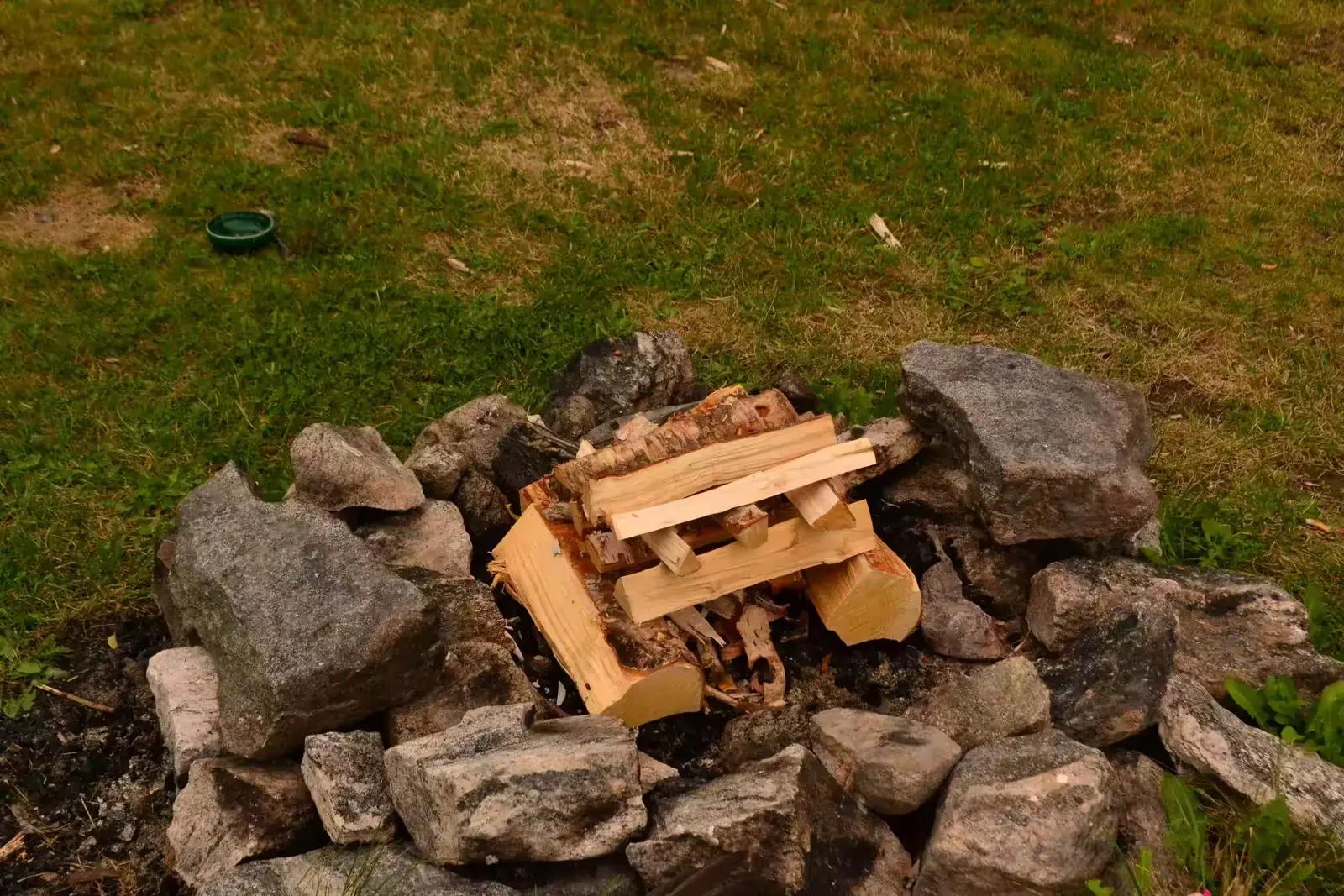
This cooperation begins in the way the fire is built. One does not simply lay random sticks on top of one another. One thinks of air, gaps and movement. The fire needs oxygen. It needs space. It needs a form that allows it to come to life without being smothered. At the same time it must be gathered enough to become a clear, stable flame. This is the very paradox of the fire: it must be both open and gathered.
Ceremonially, therefore, the fire is often built with a sense of order. One might imagine that each stick has a role. The largest logs bear the structure. The smaller twigs fill the gaps. The kindling is the path of the sparks into the wood. Everything is part of the same movement. When it is done rightly, a fire arises that becomes not merely flame, but a living focal point in the space.
The role of the wood
There is something almost meditative in gathering wood for a ceremonial fire. One goes out into nature and looks for materials already lying ready to be used. Twigs, branches, dry pieces of wood, bark and small bits of kindling. One learns to tell the difference between damp and dry, between soft and hard, between what will give a quick flame and what will burn longer.
Wood in the ceremony is not random material. It is chosen. And this choosing is part of the care. One tends to use wood that suits the purpose and that is in keeping with the place's nature and availability. The most important thing is that one does not take more than one needs, and that what one uses is gathered with respect. This is a fundamental attitude in all ceremonial work: to take part without destroying.
When the wood is laid in the fire, it becomes an image of the old that is to take new form. The tree that once grew in sun and rain, that bore leaves or needles, now becomes part of a new process. It lets go of its old form and turns into warmth, embers and ash. It is a strong reminder that transformation is not merely something abstract. It happens all the time in nature. And in the fire we see it up close.
This makes the wood more than fuel. It becomes a partner in the ceremony. It carries the story of growth, of drying, of time, and finally of surrender. When the wood catches fire, it does not happen as destruction, but as transition. That is why one can stand by a fire and feel both calm and power at the same time.
The first flame
The first light is always special. It is the moment when something that has been still suddenly responds. The little flame that takes hold of dry straw, birch bark or fine twigs is like a sign that the space has been opened. First perhaps only a faint glow. Then a thin, wavering flame. And then suddenly life.
In the ceremony this is a decisive moment. It is here that one sees whether the preparation has been good. Has one given the fire enough air? Are the materials dry enough? Is the structure right? But it is also more than technique. It is a moment of trust. One does not light a fire merely to watch something burn. One lights it because one enters into a relationship with the fire's own will.
Many who have sat around a fire in a ceremonial context know that it is something other than an ordinary campfire experience. When the flame takes hold, the conversation grows quieter. The attention sharper. The faces warmer. It is as if everything that was previously scattered now gathers towards the centre. The fire draws us into a shared rhythm.
That is also why, in the ceremony, one often lets the fire take its time. One does not create a fire in order to rush through it. One lets it develop. One lets the flame find its own strength. This teaches us something important about all sacred work: it cannot be forced. It must be allowed to grow forth at the right pace.
Direction and placement
The fire is not built just in any random corner. The direction matters. In many ceremonial contexts, placement is connected to the four cardinal directions, to the sun, to the wind and to the energy of the space. In some traditions one lights the fire in the east or orients it according to the movement of the sun. This is not about decoration. It is about placing the fire in relation to the order of the world.
When one builds a ceremonial fire, this helps to give the act anchoring. Each placement says something about how we relate to the cosmos. The fire becomes a centre, but a centre that stands in relation to everything around it. It is not isolated. It is a meeting point.
The direction is also practical. One must take account of wind, smoke and safe distance. But in ceremonial work a duality arises: the practical and the symbolic go hand in hand. The wind is not merely a natural condition, but also a force one must listen to. The smoke is not merely a result of combustion, but also part of the visual and sensory experience of the whole ceremony.
A fire that is well placed contributes to calm in the space. A fire that is wrongly placed can create unrest or imbalance. That is why it is an important part of the craft to know the place. One must know where to stand, where the participants are to gather, where safety lies, and how the fire can best do its work without dominating.
The symbolism of fire
Fire is perhaps the most charged element in the ceremony. It is an image of transformation, but also of consciousness. It is light in the darkness, warmth in the cold, movement in the stillness. It draws people together around it, as if something in us recognises the primal memory of gathering around warmth.
Ceremonially, fire is often connected to cleansing, prayer and transition. It can receive what we wish to let go of, or carry with it gratitude and intention. It is not merely a physical phenomenon, but part of a greater symbolic order. When one lays a twig on the fire, it can be a quiet act. When one watches the flame take it, the act is transformed into meaning.
That is also why fire is often spoken of with great respect in traditional contexts. It is not something to be played with. It cannot be treated carelessly. It demands attention, and it rewards the one who meets it with presence. In a ceremony the fire can thus serve as a teacher. It reminds us that what is alive needs nourishment. What is sacred needs care. And what is powerful must be handled with clarity.
The sacred space around the fire
When the fire burns, a space arises around it that is not merely physical, but also ceremonial. It is a space where other rules apply. One slows the pace. One listens more. One speaks differently. Something about the fire makes this natural. It creates a centre that gathers the attention.
In this space people begin to notice their own presence more strongly. They feel the warmth on their faces, the light in their eyes, the smoke in the air. They hear the crackling, see the sparks, follow the small movements of the flames. All the senses are involved. This is one of the reasons fire is so important in ceremonies. It makes us bodily present.
The sacred space around the fire is not merely a symbolic concept. It is a lived reality. One knows that one is gathered around something greater than mere social togetherness. One is in an act where nature's element and human intention meet. It gives a particular kind of calm.
At the same time this space is also flexible. Sometimes the fire is used in silence. Other times for song, drumming, sharing or prayer. But whatever the form, it is the fire that holds the centre. It is the pulsing heart in the frame around it.
When the fire is built by several
A ceremonial fire is often not built by one person alone. Even if one person may have the main responsibility, it is also a work that can be carried out together. When several build a fire together, something interesting happens. Each individual must relate to the same goal, but with their own hands. It requires cooperation, communication and clarity.
This togetherness is not coincidental. In ceremonies much is about creating a shared experience. The fire therefore becomes a point where the community can gather before the word, before the song, before the prayers. It is a shared work that binds the group together even before the ceremony begins.
Some carry wood. Some clear the area. Some prepare the kindling. Some keep watch over safety and placement. When this happens with good leadership and clear intention, the fire becomes an expression of the whole group's gathering. It is not just one person's fire. It is a shared centre.
There is also an important lesson in this. To build a fire together is about bearing each other's pace and seeing the value in different contributions. The one who lays the first twig, and the one who sits still and guards the flame, are both part of the same act.
Keeping the fire alive
Building the fire is only the beginning. Keeping it alive is an art in itself. In the ceremony the fire must often be tended, nourished and adjusted. It may need more air. It may need more wood. It may need calm. It may also need one to draw back a little and let it work on its own.
This is an important part of the ceremonial understanding. One must know the difference between supporting and overriding. The fire often knows itself what it needs, but it needs someone to look after it. It needs attention without a need for control. It is a close image of much of ceremonial work in general.
When the fire is kept alive through a ceremony, it often follows nature's own rhythm. The flame rises, falls, glows and renews itself. It receives new pieces of wood and transforms them. The ash gathers. The warmth holds. The light changes character through the evening. All this mirrors life's own transformation.
That is why a fire can be a teacher of patience. It shows that strength is not always a high flame. Sometimes it is the embers that last the longest. Sometimes it is the quiet warmth that matters most.
The ash afterwards
When the ceremony is over and the flames have fallen quiet, the ash remains as a sign that something has been. It is not emptiness. It is a trace. It is an expression that the fire's work is complete for this time. What burned is not gone without meaning. It has become something else.
The ash also has its place in ceremonial thinking. It reminds us of transition, ending and rest. It shows that even the most powerful fire must come to its end. One cannot keep the fire alive forever. Everything has its time. And precisely for this reason it is important to end with respect.
Clearing up after the fire is also part of the sacred work. No ceremonial fire should leave behind litter or damage. One thanks the place, makes sure the embers are out, and ensures that nature is respected even after the ceremony is finished. This is part of the ethical responsibility. It is not enough to do something sacred in the moment; one must also end in a way that shows one understood what one was part of.
The ash reminds us that everything goes in a circle. Wood became fire. Fire became embers. Embers became ash. Ash becomes earth. Earth bears new life. So the wheel turns.
The fire as teaching
For many who learn to hold ceremonies, fire-building is one of the first great practical exercises. This is no coincidence. The fire teaches much. It teaches about understanding nature, about cooperation, about precision, about symbolism, about responsibility and about presence. One can read about this in theory, but only when one stands there with the wood in one's hands, the wind in one's face and the fire as an answer does one truly understand what it is about.
This makes fire-building a method for learning. Not only how to light a fire, but how to enter a sacred space with body, thought and responsibility. It is an exercise in being human in contact with nature's elements. And that is precisely why it is so important in a ceremonial context.
One also learns that no two fires are exactly alike. Each place, each weather, each season and each group gives its own form. That is why fire-building is never merely a repetition. It is a new conversation each time. One builds with what the place gives, with what the weather allows, and with what the ceremony needs.
This makes the fire a living part of the education. It is not merely a tool. It is a way into understanding.
Building with respect
Perhaps this is the most important thing to say about fire in the ceremony. It must be built with respect. Respect for nature. Respect for safety. Respect for those who are to gather around it. Respect for the tradition and for the meaning of the act.
Respect here does not mean merely being polite. It means understanding that one is not alone in deciding. Nature has its laws. The fire has its needs. The place has its own character. And the people around the fire each have their own boundaries and experiences. To build a ceremonial fire is therefore also to learn humility.
When this is done well, something beautiful arises. Not merely a flame, but a space. Not merely light, but presence. Not merely warmth, but community. And not merely a fire, but an act that carries meaning.