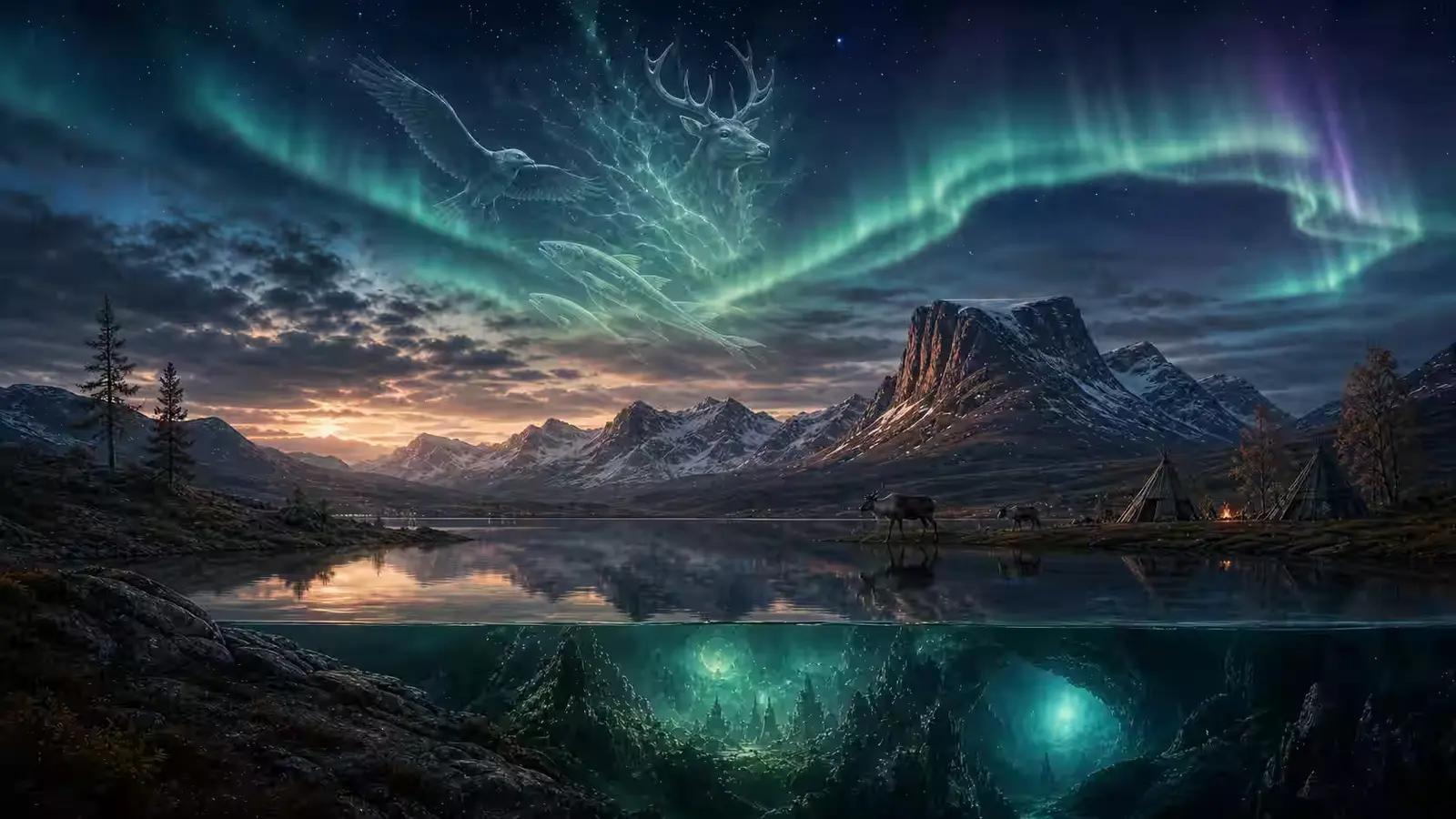
There are worldviews that explain the world with boundaries, categories and sharp divisions. And then there are worldviews that open the world, make it deeper, more living and more saturated with presence. Sami cosmology belongs to the latter type. Here, existence is not divided into closed rooms, but into layers of life, power and consciousness that stand in connection with one another. Sky, earth and underworld are not merely places, but levels in a living cosmos where gods, humans, animals, ancestors and spirits work side by side.
In noaidevuohta, the Sami religious understanding tied to the practice of the noaidi, the world is conceived of as threefold. Above humans is the upper world, beneath them the lower, and between these lies the world humans live in day to day. This middle world is here called máilbmi, and is the sensory, lived world where life, work, birth, death, the seasons and relationships to the landscape take place. But even in this world there dwell gods, goddesses and nature beings. The three worlds are connected by a central axis, a kind of world pillar or world tree, which makes passage between the levels possible for souls, spirits and the specially trained ritual specialist called the noaidi.
When one approaches this cosmos, one does not merely enter a story about old deities. One enters an understanding of the world in which everything that lives belongs together. The sun is not just a star. A mountain is not just stone. A lake can conceal an entire realm. A human being is not just a body. And death is not the end of relationship, but a transformation in a cosmic landscape that is already full of presence.
This is a worldview that holds both poetry and precision. It gives meaning to what might otherwise have seemed random: why birth and death are surrounded by rituals, why certain places in the landscape acquire power, why song can call forth presence, and why the one who can travel between worlds is given such a decisive role in the community. As Kyrre Gram Franck emphasizes in the lecture "Noaidevuohta: Sámi Shamanism," this is not merely mythology understood as tales of the past, but an operative structure for how life, healing and reality are experienced and interpreted.
A world built in layers
The threefold cosmos in Sami tradition has often been described as a vertical arrangement: the upper world above, máilbmi in the middle, and the lower world below. But although this model is useful, it can also become too rigid if one forgets that these levels are not isolated from one another. They shine through one another. Signs from the upper world can appear in human life. Power from the underworld can rise up in the landscape. The dead can be near the living. And the noaidi can, through trance, drum, joik and helping spirits, travel across the boundaries that ordinary people experience as fixed.
In this way, the Sami cosmos becomes not just a map sketch of "where things are found," but a relational order. Each sphere is populated by its own beings, its own powers and its own forms of knowledge. To know who belongs where is to understand how the balance of the world works. Sami cosmology is therefore not abstract. It is practical. It tells something about how one should live, how one should meet the landscape, how one should understand illness, and how one should relate to the forces that work beyond the merely visible.
In this world, the landscape is never mute. Mountains, waters, stones and certain places are not just the backdrop for human life. They are actors, nodes of presence and places where the sacred can step forth. This is also why Sami cosmology must be read with attention to movement. Everything is about transitions: between light and darkness, winter and spring, life and death, human and spirit, body and free soul. It is in these transitions that the cosmos becomes alive.
The upper world, the sky as a living sphere
The upper world is not just the sky as it appears above a person's head. It is the divine sphere, a level of creating and ordering forces that uphold the cosmos and give direction to the living. Here we meet Radien áhttje, the great father, who in the sources is described as the highest god in the Sami pantheon, together with Radien akka, the great mother, and their children, Radien nieida and Radien bartnit. Together they form a creating family group, a cosmic core where the origin and order of the world have their anchoring.
In Franck's account, the Radien family is described as those who let Jupmele step forth, and through this creating act the earth itself was formed and then given to the sun. This points to something fundamental in Sami cosmology: creation is not a mechanical event, but a gift, a transfer of power and responsibility from one level of the cosmos to another. The world is not merely made; it is handed over into relationship. And precisely for this reason, the sun, Beaivi, is more than a shining figure in the sky. She is the receiver of the creator's gift and a life-giving deity who holds a special place in Sami tradition.
Beaivi is one of the most beloved figures in this universe. She returns after the long time of darkness and brings with her spring, warmth, fertility and new life force. When the sun returns, it is not just a natural change in light conditions, but a cosmic restoration. The darkness loosens its grip, the frozen begins to awaken, and human life turns anew toward growth and movement. The sources tell that Beaivi was met with offerings of butter smeared on doorposts, a simple but deeply meaningful ritual in which the home is connected to the cosmic rhythm.
Beside Beaivi we find Mano, also called Manna or Aske, the moon goddess linked to the full moon and the winter solstice. Where the sun often appears as life-giving and protective, the moon to a greater degree bears the mark of ambivalence. She can be mighty, shifting and at times feared. It is characteristic of Sami cosmology that it does not smooth over such contradictions. The forces of the cosmos need not be unambiguously good or evil. They are real, strong, and must be met with insight and respect.
Horagalles too belongs to the upper world. As the thunder god he is linked to weather, sound, strength and heavenly power, and he often appears as a motif on preserved Sami drums. That he is painted onto the drum is no coincidence. The drum is not just an instrument, but a map of the cosmos, and the figures found there show which powers the noaidi must be able to orient toward. Francis Joy points out precisely that the drum, goavddis, functioned as a portable cosmological map in which knowledge about heavenly and subterranean beings was preserved, even after Christianization tried to erase it.
The starry sky is not empty either. Among the constellations we find Orion, known in Sami tradition as Gállabártnit, "the sons of the hunt." In this way the stars too are inscribed into a worldview in which the sky is populated and meaningful. The night sky becomes not a neutral background, but a narrative space. The one who knows the stars reads not just nature, but the cosmos.
Among the most important beings of the upper world we also find the noaidi's bird helper, Noaideluoddi or Noaidiloddi. The bird is, in Sami thinking, a liminal being, a creature that can move between air and earth, and that therefore suits the role of a guide between levels. The bird spirit helps the noaidi to ascend, find direction and hold course when the journey moves out of the ordinary sensory world. It is an image of the capacity for transition, but also a personal ally, loyal to the one who has received its support.
The lived world
In the middle of the cosmos lies our world, the world humans know beneath their feet and through their bodies. Here the reindeer herds move, here the seasons change, here women give birth, here families dwell, and here daily life unfolds. But although máilbmi is the human world, it is by no means merely human. It is densely populated by presences that are not always visible, but that work into life, into the landscape and into the relationships between creatures.
One of the most important figures in this sphere is Máttaráhkká, the great midwife and mother figure who is closely linked to earthly life and to the creation of humans. Mulk and Bayliss-Smith show that Máttaráhkká and her daughters permeate several levels of the cosmos, but that they have their most intimate connection to the rhythms of earthly life. It is in this world that birth happens, that houses are upheld, that children are protected, and that the boundaries of the home are watched over. Therefore her daughters too are assigned quite concrete tasks, which show how little sharp the division is between the spiritual and the everyday.
Sáráhkká protects birth and hearth. Uksáhkká guards the door and the threshold. Juoksáhkká shapes the child in the mother's womb and influences the unborn. Each of these figures belongs to the part of life that modern people would often call private or biological. But in Sami understanding, birth is never merely biological, and the openings of the home are never merely architecture. They are places where cosmic forces work into life. This gives máilbmi a distinctive character. She is both concrete and saturated with spiritual significance.
Our world is also populated by haldi, guardian spirits linked to places, houses, animals and people. They take care of what they belong to, and remind us that ownership in this tradition is not just about human control, but about stewardship in relation to other forms of life. Beside the haldi there are the gufihtar, forest beings who can be helpful or lead astray those who meet them. They represent the double reality in nature: that what protects can also test; that what entices can also lead away from the path.
Particularly important are the sieidi spirits, linked to sacrificial sites in stone, trees or striking landscape forms. In Mulk and Bayliss-Smith these places are described as expressions of a relational system in which gifts, respect and mutual obligation bind together people and place. A sieidi is not just a symbol. It is a presence, a point where the world condenses and opens toward something more. Therefore the act of offering also becomes important. It is not merely an expression of belief, but an answer in a relationship in which the human being acknowledges that it stands in debt to the forces that uphold life.
The ancestors also belong partly here. The dead are not entirely gone from the living, but can still be active, visible to some, perceptible in action and presence. Thomas A. DuBois shows that the spirits of the dead in early twentieth-century Sami folklore were still perceived as real and at times visible. This says something important about this world: máilbmi is not just the space of the living, but a field of contact. Here life and death, presence and absence, sensation and vision meet.
In this sphere, the noaidi's closest personal helpers also belong. The sueie, also called Noaidegássi, are spiritual companions who can appear as animals, humans or hybrid forms. They protect, teach and guide the noaidi through the practice. The gáccit are more specific animal spirits that accompany the journeys and help in encounters with hostile forces. These spirits are not randomly chosen. They can be inherited from older noaidi, transferred between generations and saturated with accumulated power and knowledge.
Each helping spirit is called forth through its own joik. This makes the joik something more than song. It is address, invocation and activation at the same time. When the joik sounds, the relationship becomes alive. The spirit is not merely remembered, but summoned. It is here that the narrative power of Sami tradition becomes so clear: words, rhythm and sound are not decoration around the sacred, but the very way contact is created.
The lower world, the dead and the luminous depths
The lower world in Sami cosmology is not one undifferentiated underworld. It consists of at least two different realms, and the difference between them is decisive for understanding how death, power and the subterranean depths are conceived. The first is Jábmiidáibmu, also called Jabmeaimo, the realm of the ordinary dead. The second is Sáivo, a radiant parallel world of an entirely different character.
Jábmiidáibmu is the place to which the ordinary dead go. Here rules Jabmiakka, "The mother of the dead," who receives the deceased. O. Pettersson points out that Jabmeaimo is the genuinely Sami realm of the dead in its oldest form, a world that mirrors the world of the living from below. This is an important point, because it shows that the realm of the dead was not primarily understood as a place of moral punishment, but as a continuation of existence in another part of the cosmos.
Later sources also mention Rotaimo, a more differentiated area linked to the figure Ruto or Rota, where those who had not honored the gods could end up. But Pettersson warns against reading this as original Sami belief without further consideration, because much of this differentiation appears to be marked by Christian missionary activity. What was once a protecting deity could, in the encounter with the missionary gaze, become demonized. The sources thus remind us of something crucial: knowledge of Sami cosmology has often come to us through filters that did not always wish it well.
Sáivo, on the other hand, is something entirely different from Jábmiidáibmu. Where the realm of the dead is the sphere of the ordinary deceased, Sáivo is a realm of power, abundance and light. It is linked to sacred mountains and lakes and is understood as a parallel world within or beneath the visible landscape. Here dwell not the ordinary dead, but the saivo people, powerful spiritual beings and ancestral figures of a different order.
Joy and Franck emphasize that it is these Sáivo spirits who constitute the strongest helping spirits for the noaidi. They teach, select and strengthen the one who is to work between worlds. Healing, negotiation with spirits and real spiritual power become largely possible precisely because the noaidi stands in relationship with these beings. Sáivo is therefore not merely a mythic space, but a center for the transfer of power.
Francis Joy's research on fishing magic and drum symbolism shows that birds, precisely because they can move between air and water, were given a special role as symbolic vessels in the journey toward Sáivo. The bird can dive down into the water as if it passes through the surface into another world. This image is powerful: the lake is no longer just water in the landscape, but an opening. The mountainside is not just rock, but a wall that conceals a luminous interior.
In Sáivo too there are animals, but not only as natural creatures. There are sáivo animals, spiritual counterparts to the earthly animals, and a whole society of powerful beings who live beneath or within the visible. In this way the lower world becomes not dark and empty, but rich, demanding and full of radiance. It carries both death's quiet mirroring and the dazzling intensity of subterranean power.
Two of the noaidi's most important special helpers belong to this sphere. The one is Noaidevuolli, also called Noaideluossa or Noaideguolli, the fish or serpent spirit that can open the way through the dense, invisible depths of both Jábmiidáibmu and Sáivo. As the fish travels where humans cannot breathe or see, so this helper navigates through layers of reality that would otherwise be closed. The other is Noaidiesarvvis, or Saivosarvvis, the spiritual reindeer bull linked especially to Sáivo. This is a helper of great strength, a sign of mighty shamanic capacity and an instrument for movement through the luminous underworld.
The noaidi, the one who crosses the boundaries
In the midst of this manifold cosmos stands the noaidi as a boundary walker, an intermediary and a bearer of knowledge. No other role in Sami tradition shows so clearly how permeable the boundaries between the worlds are. It is the noaidi who can travel consciously to where others come only in dreams, illness or death. He or she is not merely a religious functionary, but a navigator in the deep structure of reality.
In the Sami understanding of the human being there were several soul components. A life soul was tied to the body, a breath soul to the breath, and above all there was a free soul that could leave the body during sleep, ecstasy, trance or illness. It is this free soul that the noaidi learns to release and lead. Where others could lose their soul and become ill, the noaidi could go out by will, orient themselves and return with knowledge or help.
Louise Bäckman emphasizes in her analysis of the noaidi's ecstasy that this out-journey is not a random addition to the role, but the very core of it. Through an altered state of consciousness, hidden knowledge becomes accessible, and negotiation with spirits becomes possible. The ecstasy is thus not flight from the world, but a sharpening of contact with its invisible levels. The one who sees a noaidi at work sees not just a ritual, but a human being entering another space of experience.
The noaidi never travels alone. The helping spirits accompany the free soul and add qualities the human being alone does not possess. The bird gives ascent and orientation. The fish or serpent finds its way through the underworld's hidden passages. The reindeer gives endurance and strength in Sáivo. The bear can bring protection and power on several planes. Each spirit is both symbol and real ally, a partner in the journey through the layers of the world that are otherwise closed.
At the start of the journey, these spirits are called forth with their own joiks. The songs open what is closed, and establish the contact that makes the journey possible. That these joiks were often transferred from teacher to pupil, from elder to younger, shows that the noaidi's practice was carried by continuity and tradition, not just by individual experiences. To learn a joik was thus to step into a kinship of spiritual relationships.
The drum as a map of the cosmos
At the center of the noaidi's work stands the goavddis, the drum. It is far more than a musical instrument. On the drumhead we find a visualization of the cosmos, with symbols and figures that show how the three worlds are organized and who works within them. Joy argues that the drum must be understood as a portable cosmological map, and this insight opens a deeper reading of all of noaidevuohta.
In the middle of the drum the sun often stands as the center. Above her one usually finds deities and heavenly figures linked to the upper world, such as the Radien family, Beaivi and Horagalles. In the middle zone lies máilbmi, with the reindeer, human life, sieidi sites and the relationships of the landscape. Beneath this come markers for the realm of the dead and the passages toward Sáivo, sometimes with birds that signal the transition down into the other world.
This makes the drum something astonishingly precise. It is at once image, instrument and portal. When the noaidi drums into trance, the free soul does not follow a random darkness, but a pattern already inscribed in the drumhead. The journey happens in the lived, but is oriented by symbol. Thus art, knowledge and ritual meet in one and the same instrument.
This is also why the drum became so threatening to colonial and Christian powers. It preserved a worldview that could not be reduced to the language of the new religion. As long as the drum existed, there also existed a map of another reality, a memory of the relationships between deities, spirits, landscape and humans that could not be abolished without further ado.
The journey between worlds
When the noaidi sets out on a journey, the destination is decisive for which helpers must be called forth and what kind of knowledge is sought. A journey upward into the upper world may be about seeking counsel from the Radien family or interceding for the community under Beaivi's waking light. A journey through our world may be about understanding unrest in the landscape, disturbed relationships to animals, questions of the community's welfare or contact with haldi, sieidi and other presences.
The most demanding journeys go downward. Then the noaidi must often travel with the fish helper and the spiritual reindeer as companions. Such a journey may have as its goal to negotiate with Jabmiakka for a soul that has lost its way, or to fetch healing power from the luminous beings in Sáivo. The journey is not just exploration, but action. It is to lead to change in the lived world.
Francis Joy's investigation of the noaidi grave in Kuusamo points out that the grave material mirrors precisely these tasks. The physical body was laid in the earth, but the free soul had in life learned to travel far beyond the body's boundaries. Here the entire noaidi role is gathered in one powerful image: a human being who at one and the same time belongs to the earth and transcends it.
DuBois shows moreover that the spirits the noaidi met on such journeys were not perceived as pure theological abstractions, but as expected and real presences in everyday life. Some people, referred to as noaideslágáš, could see, hear or influence these forces even outside formal rituals. This tells us that the boundary between the ordinary and the extraordinary was never absolute. The cosmos was always near, always possible to sense through cracks in the visible.
A cosmos of relationships
The most striking thing about the Sami three-world model is perhaps not the division itself, but the relationships that bind it together. This is not a cosmology in which the living are separated from the dead, or in which nature stands empty around the human being. On the contrary, all levels are populated, and all actions are part of larger patterns of mutual influence. The human being does not live in a neutral universe, but in a conversing cosmos.
The sun can give life back after the time of darkness. The moon can warn or influence. The threshold of a turf hut can be guarded by a goddess. A stone can receive an offering. A lake can open toward Sáivo. A joik can call forth a spirit. A drum can show the way. A free soul can leave the body and return with healing, insight or warning. In this way each element in the world becomes part of a larger story of presence.
This is also a cosmos in which responsibility plays a great role. When the human being stands in relationship to landscape, animals, spirits and ancestors, it cannot act as if the world were just a store of resources. It must be met with respect, gifts, attentiveness and care. This ethical side lies implicit in the whole structure: the one who lives in máilbmi always lives in encounter with something more than itself.
This is precisely why this cosmology still grips the reader today. It reminds us of something modern people have often forgotten: that the world is perhaps not emptied of presence just because we have learned to describe it technically. In the Sami cosmos the world is still dense with meaning. It is not passive matter, but a polyphonic space of life, power and consciousness.
When the world becomes larger
To read about Sami cosmology is therefore not just to learn about a historical religious system. It is to be invited into another form of attention. An attention that sees the mountain as more than geology, death as more than cessation, song as more than aesthetics and the human being as more than body. It is to meet a world in which máilbmi is only one layer of a far greater reality.
And perhaps it is precisely this that makes the three-world story so powerful. It does not speak of a flat world, but of a deep one. It tells that life always stands in connection with something above it and something below it, something that carries it, tests it, challenges it and opens it. Between the deities of the sky, the lived landscape of the earth and the dead and luminous powers of the underworld, the noaidi moves as a negotiator, a healer and a guide.
In this way Sami cosmology stands as a story about a universe in which boundaries can be crossed, in which relationships hold the world together, and in which the visible is only the outermost membrane of a far richer reality. Three worlds, one cosmos: not as an abstract model, but as a lived experience that the world is larger, denser and more alive than it first appears to be.
Sources
• Franck, Kyrre Gram. Noaidevuohta: Sámi Shamanism.
• Bäckman, Louise. The Noajdie and his ecstasy.
• DuBois, Thomas A. The Usually Invisible, Occasionally Visible, Spirits of the Dead in Early Twentieth-Century Sámi Folklore.
• Joy, Francis. The Sámi Noaidi Grave in Kuusamo.
• Joy, Francis. The disappearance of the sacred Swedish Sámi drum.
• Mulk, Inga-Maria and Tim Bayliss-Smith. Liminality, Rock Art and the Sami Sacred Landscape.
• Pettersson, O. Old Nordic and Christian elements in Saami ideas about the realm of the dead.
• Kraft, Siv Ellen. Kulturarvifisering av ritualer: sjamanisme i norsk Sápmi.