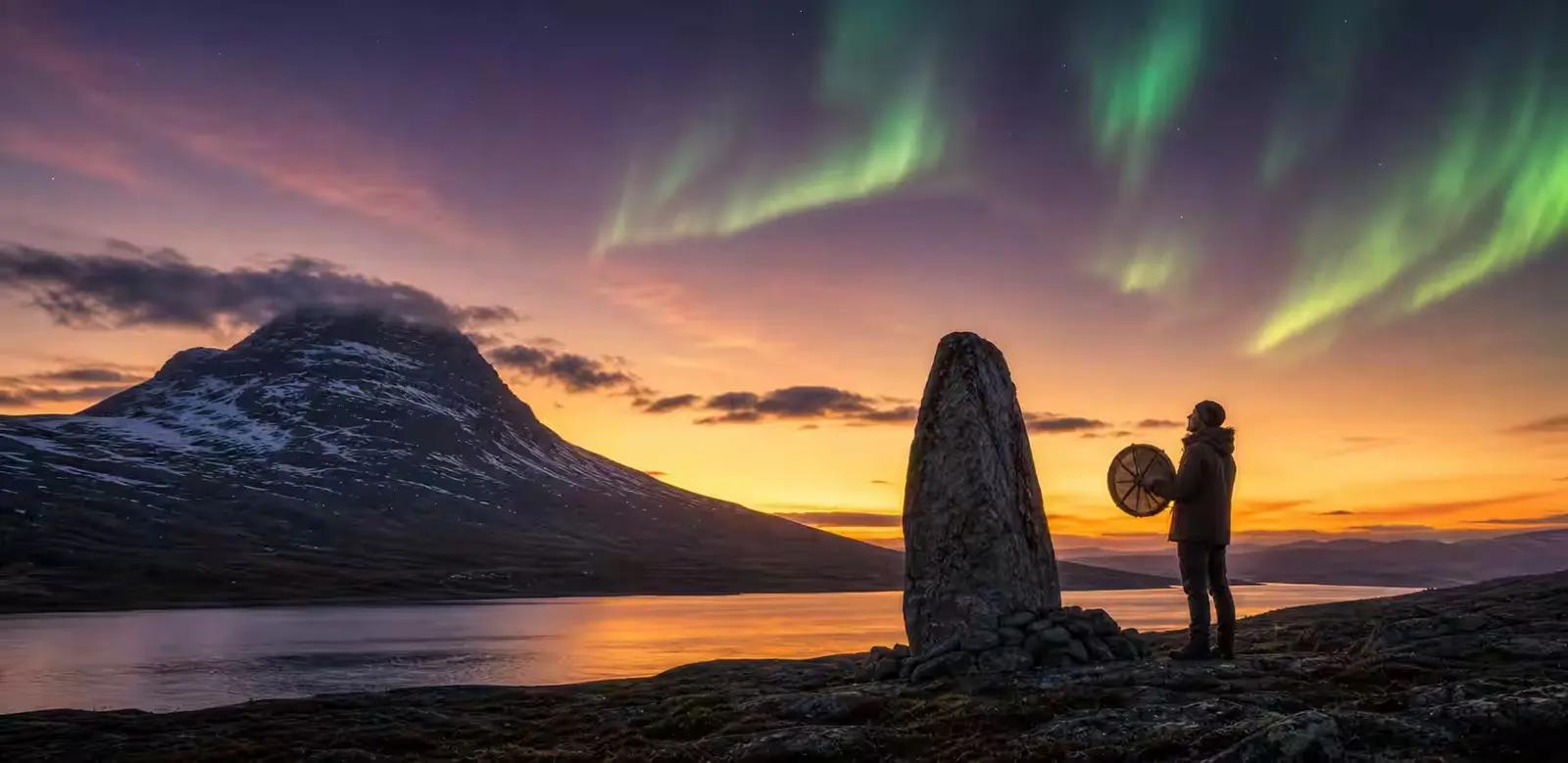
There are landscapes that cannot be fully understood with maps and coordinates. They must be met with attention, listened to with patience, and experienced with a kind of silence that is more than the absence of sound. In Sápmi, the Sami settlement area that stretches across parts of Norway, Sweden, Finland and Russia, such landscapes have for centuries been understood as alive. Mountains, water, stone, animals, wind and people are part not only of a shared environment, but of a shared life. The world is not a dead backdrop for human activity; it is a network of relationships, spirits, memories and forces that continually act upon one another.
For the one who grew up with this worldview, the soul was never one single thing. It was something that could move, be divided, be called by name, be lost, return, be carried on and influence the kin long after a person had died. The Sami concept of the soul is therefore not merely a religious idea. It is a way of understanding the human being, a way of understanding illness, a way of understanding nature, and a way of understanding kinship and responsibility.
Today this is not merely the past. It is a living tradition, carried by Sami languages, stories, rituals, joik, art, knowledge bearers and modern revitalisation. Although many expressions were suppressed through Christian mission, colonisation and the policy of Norwegianisation, the knowledge has survived, changed and returned in new forms.
The worldview that never went out
If one is to understand the Sami understanding of the soul, one must begin with the world itself. In the Sami tradition the world is composed of several levels or realities that overlap one another. There is the ordinary everyday world, where people work, eat, travel, raise children and grieve over their dead. But alongside this there is a spiritual reality, a landscape of presence that is not always visible, but that is nonetheless at work.
This means that a stone is not merely a stone, a lake not merely water, and a mountain not merely mass and form. Certain places can be portals, meeting points or sacred sites where humans and spirit forces are in contact. Some places can be especially charged with the memories of offerings, prayer, hunting fortune or kinship bonds. They can be sieidi, sacred places where the invisible and the visible meet.
This way of seeing the world is old, but it is not dead. It still exists in stories, in respect for particular places, in lived knowledge of nature and in contemporary expressions where Sami artists, teachers and spiritual practitioners carry on the tradition. For many this is not a symbolic idea, but a reality that still shapes how one relates to landscape and life.
What is most striking about this worldview is perhaps that it does not draw as sharp a distinction between the spiritual and the material as modern Western ways of thinking often do. Nature is not something neutral. It is co-creative. It responds. It remembers. It carries forces that can support, warn, disturb or heal.
The soul as several layers of life
In many modern languages one thinks of the soul as one inner core. In the Sami tradition the picture is more complex. The human being is understood as a being with several soul-aspects, where different parts have different functions and different fates. The free soul can wander. The body soul keeps the body alive. The name soul ties the human being to the kin and carries on memories and identity through the generations.
The free soul is the most mobile part. It can leave the body during sleep, in dreams, during illness or in trance. It is this soul that can travel between worlds. It can seek knowledge, meet spirits, visit the dead or fetch information that is not available in the ordinary world. After death it is often this part that passes on to another state or reality.
The body soul, by contrast, is more bound to physical life. It keeps the body going, carries the life-giving force and is closely connected to health and vitality. When a person dies, this soul part does not necessarily disappear. It can remain tied to the grave, to the kin or to the place where the person lived. It can give protection, but can also disturb if it is not treated with respect.
The name soul shows how person and kin hang together. When a child is given the name of a deceased relative, it is not merely a courteous tradition. The name carries a spiritual and social continuity. Something of the deceased's presence lives on in the child. This creates a connection between generations that is at once emotional, social and cosmological.
In this perspective human life becomes something more than biological existence. A human being is a moving relationship between body, name, kin, land and spirit. No one lives entirely alone. Everyone is woven into a larger order that both gives support and demands responsibility.
The tradition lives in the present
It is important to emphasise that this does not merely describe a vanished world. Sami soul concepts live today, albeit in different ways and in different forms. In some places they are tied to family traditions that were never quite broken. In other places they live through revitalisation work, teaching, cultural projects and spiritual practice among Sami who wish to reclaim knowledge that was long suppressed.
Modern Sami society is diverse. Some are Christian, some are secular, some combine different worldviews, and some are actively concerned with reviving pre-Christian traditions. This diversity does not mean that the old understanding is gone. On the contrary, it shows that the tradition is still in motion. It lives in conversations, in music, in ceremonies, in families and in cultural practices that continually find new ways to express old insights.
This is precisely what makes the Sami understanding of the soul so interesting today: it is not a closed chapter in history, but a living language for speaking about identity, health, belonging, grief and contact with the world. Even when the forms change, the core remains: life is relational, and the soul is not isolated from its surroundings.
When the child receives a name
One of the most moving places to see this thinking in practice is in the naming custom. When a child is named after a deceased relative, more happens than a social marking. In Sami tradition this can be understood as a real transfer of presence and identity. The child receives not merely a name; it receives a connection to the kin's memory and power.
This can still be strongly felt today. Many families experience the choice of name as a way to keep the dead near. Not because the dead replace the living, but because the kin continues to be at work in the life of those who come after. In this way the child becomes not a new beginning without roots, but a continuation of an ongoing story.
This also gives a deeper understanding of responsibility. To bear a name is to carry a memory with you. It is to stand in a relationship with those who came before. And it is to understand that identity is not merely private self-creation, but participation in a larger story.
Born of divine care
Sami stories about the soul's coming into being are full of divine figures, especially female powers who play decisive roles in the emergence of life. Creation is not a single moment, but a chain of acts in which the soul is formed, carried on and embodied.
Ráđienáhčči, the highest creator god, sets the process in motion. But it is the female deities who carry the soul-life forward towards birth. Mátteráhkká, Sáráhkká, Juksáhkká and Uksáhkká are among the most important in this chain. They receive, form, protect and place the soul in the body.
In these stories birth is a sacred work. It is not merely biological reproduction, but an encounter between divine power, female care and human vulnerability. To be born is to have the soul given and surrounded by protection. The woman giving birth is not alone; she stands in a landscape of cosmic help.
This emphasis on female power is significant today as well, especially in a time when many indigenous communities are working to strengthen female knowledge, reproductive dignity and continuity between the generations. The old stories work not merely as myths, but as cultural resources that can inspire new understandings of life and care.
The noaidi's task
In the midst of this complex landscape stands the noaidi. In older sources the noaidi was often referred to as a shaman, but that term captures the role only partly. The noaidi was a male or female intermediary between worlds, one who could travel in a spiritual sense, one who healed, foretold, negotiated and protected the community.
The noaidi's role was never accidental. Not just anyone could choose to become a noaidi. The calling could come through illness, visions or strong encounters with spiritual helpers. It was as if the coming noaidi was drawn into the task by forces outside themselves. This created both vulnerability and authority. The one who had experienced the calling had also undergone a kind of ordeal.
Today the role of the noaidi lives on in various ways. Some use the term for spiritual practice and healing. Others examine old sources, reconstruct rituals or develop artistic expressions that carry something of the same function. There are also Sami voices working to restore respect for older knowledge in the encounter with contemporary life, health work and cultural management.
It is important to understand the noaidi's place as part of a living community. The noaidi worked not only for individuals, but for the siida, the traditional Sami community that shared landscape, responsibility and survival. When someone fell ill, it was therefore the whole relationship that had to be examined. What was broken? Which connection had to be restored? What had happened in the relationship between the human, the animals, the kin and the spirits?
The drum as a map
One of the most iconic symbols of Sami spiritual practice is the drum. The traditional noaidi drum was not merely an instrument for sound, but a map of the cosmos. On the drum skin different worlds, powers and symbols were depicted. When the noaidi struck the drum, it was not merely to create rhythm; it was to set the worldview in motion.
The drum helped the noaidi orient themselves on the spiritual journey. It was a surface for navigation in movement between worlds, a visual and auditory support for the soul's journey. Through the drum the noaidi could penetrate into another reality and fetch information, negotiate with powers or follow a soul that had lost its way.
Many of the historical drums were confiscated during Christian mission and state oppression. Some ended up in museums, others were lost. But their symbolic value is not gone. Today they still arouse attention, debate and reconstruction work. The drum has become a sign of both loss and survival, of pain and continuity.
For modern Sami the drum is not merely an old object. It represents a connection to a knowledge that was long sought to be broken, but that can still resound. It reminds us that spiritual practice is not merely something that once happened; it can still be part of living experience.
The joik as presence
Beside the drum stands the joik, one of the most distinctive forms of expression in Sami culture. A joik is not merely a song about something; it is a way of bringing something into presence. A joik can express a person, an animal, a place or a mood so directly that it is experienced as the thing itself in the form of sound.
In a spiritual context this is of great significance. To joik someone is to call upon their being. It can strengthen, protect, remember or bind together. The joik is therefore more than aesthetics. It is a form of relational practice, a sonic way of staying in contact with the world.
Today too the joik lives strongly. It exists in traditional settings, in family histories, in ceremonies and in modern music. It has become a symbol of Sami identity, but also an active carrier of old knowledge. Many experience that joik does not merely express culture, but opens a space where people, places and memories become present anew.
This is one of the reasons joik is often experienced so strongly by those who encounter it for the first time. It does not merely describe. It calls forth. It is a form of living memory.
Illness as soul loss
In Sami tradition illness was often understood as more than bodily imbalance. A person could fall ill because the soul had gone astray, been frightened away or caught in another realm. In this way illness could be seen as an expression of the soul's break with the body or the community. This is similar to many other shamanic cultures.
This may seem strange, but it also holds a deep psychological and social insight. People who are subjected to grief, trauma, fear or prolonged strain may experience themselves as disconnected, empty or split. The Sami understanding of the soul gives language to such states through a spiritual universe in which healing involves the return of what has been lost.
The noaidi's task was therefore not merely to "cure" in the modern sense, but to find out where the lost element was. Had the soul been frightened away? Had it been stolen? Was it caught among the powers of death or in a sacred place? These questions required journeying, negotiation and insight.
In our time many in the Sami tradition find new ways of speaking about such experiences. Some use modern health concepts side by side with old notions. Others see how a traditional understanding of soul loss can give language to psychological processes that may otherwise be difficult to describe. The tradition is not an alternative to the present; it is a way of meeting the present.
Bringing the soul home
The most important healing act in this tradition is the soul journey. When something is lost, it must be brought home. The noaidi's journey into the invisible is therefore not a flight from reality, but an attempt to repair it.
In the ritual the patient often lies still while the noaidi, helped by drumming and joik, enters a trance. The free soul travels to find the lost part. Along the way helper figures can step forth, often in animal form: reindeer, fish, bird or other beings with the ability to move between worlds.
If the soul has gone into the realm of the dead, the journey becomes dangerous. Then the noaidi must negotiate with the powers of death. This is one of the most dramatic motifs in Sami tradition, because it shows how highly life is valued. Healing is worth the risk. The community is worth the risk. To bring someone back is an act of great spiritual power.
In modern times such stories can be interpreted in several ways. Some read them symbolically, others as direct spiritual practice. Whatever the level of interpretation, they point towards the same basic idea: the human being can be split, but it can also be restored. There is a way home.
Grave, memory and continuity
The relationship to the dead was and is decisive in Sami culture. The dead do not disappear into complete absence. They can remain near the family, the landscape or the grave site. This is why burial customs and respect for the dead have been so important.
Graves were to be treated carefully. To disturb them was not only disrespectful, but to break a spiritual order. The dead needed proper care, and the living needed to keep their relationship to them in balance. In this way the dead could contribute protection or presence, but could also bring discomfort if they were neglected.
This thought still exists in modern Sami contexts, where memory, kin and landscape hang closely together. Many experience that places of the ancestors carry a particular calm or weight. Others use stories of the dead to strengthen kin-consciousness and cultural identity. What was once described as pre-Christian belief is still at work in lived practice.
Animals, reciprocity and responsibility
Especially important in Sami tradition is the relationship to animals. The reindeer is of course central in many Sami communities, but the bear, fish and other animals are also part of a system of reciprocity. The animals are not merely resources. They are co-actors in the order of life.
When an animal was killed, the body was to be treated with respect. Bones had to be gathered, laid out correctly and returned in the right way. In this way one showed that the animal was not a thing, but a being with a soul and dignity. This was especially clear in bear and fish rituals, where the body's remains had spiritual significance.
Today too there are strong Sami ideas about sustainability, respect for nature and responsibility for the landscape. Many of these attitudes are not "new environmental ideas", but continuations of an older understanding that the human being can only live well if it maintains good relationships with what surrounds it.
This insight has become increasingly relevant. In a time of climate crisis and loss of nature, Sami traditions appear not as romantic relics, but as valuable knowledge systems with deep relevance for how one can think coexistence and responsibility today.
Oppression and survival
This tradition was not only carried on in peace. It was met with control, condemnation and forced change. Under Christian mission and the exercise of state power, drums were confiscated, rituals forbidden and Sami spiritual practice portrayed as wrong or dangerous.
It is impossible to understand today's Sami revitalisation without knowing this history. Many families lost language, practice and public space for their knowledge. Yet much survived. What could not be said openly could be lived quietly. What could not be taught formally could be passed on through stories, ways of working, songs and memories.
This survival is perhaps one of the most remarkable aspects of the whole history. The tradition was harmed, but not wiped out. It was pushed back, but not abolished. And precisely for this reason it carries today a strong emotional and cultural force for many Sami.
Reconstruction in our time
Today a clear reconstruction of Sami culture, language and spiritual knowledge is under way. Drums are studied and in some cases recreated. Joik is brought forth both as art and as tradition. Young people and adults learn language, history and kinship connections anew. Researchers and cultural workers collaborate with Sami communities to document, protect and carry on knowledge.
This is not merely a question of "going back" to the past. It is about finding forms that work in today's life. Many live in modern cities, many are shaped by globalisation, education and digital culture. Yet the tradition need not disappear in this. On the contrary, it can find new expressions in precisely such contexts.
It is therefore better to speak of continuity than of revival alone. The tradition is not dead and then awakened. It has been there all along, in some places clearly, in others quietly, and now it is coming into view more strongly again.
The meeting between tradition and the present
A living tradition must always relate to its own time. The Sami understanding of the soul is therefore not a fixed system that is merely repeated unchanged. It is interpreted, discussed and carried on anew in the encounter with modern experiences.
For some this happens through art and music. For others through ritual practices, conversations or teaching. For others again through research work, language revitalisation or work with indigenous rights. What they share is that the tradition is not treated as something dusty and concluded, but as something that can still affect how people live, feel and understand themselves.
This dynamic makes the tradition especially strong. It is not fragile because it is old. It is robust because it has shown an ability to survive change. What is alive must be able to move.
What the soul teaches us
Sami soul concepts also offer something more universally human. They remind us that a life consists not only of individual choices and biological processes. People are also tied to places, kin, memories, rituals and invisible bonds that shape who they are.
They remind us that illness cannot always be understood in isolation from the life around it. That grief is not only private. That loss can demand restoration. That the human being must sometimes seek back to what has been lost, whether it is name, belonging, language or inner balance.
This makes the Sami understanding of the soul relevant far beyond Sápmi. It speaks to people who experience rootlessness, distance from nature, ruptures in kinship or a lack of coherence in life. It shows that wholeness is not something one merely thinks one's way to. It must be tended, repaired and kept alive.
A living heritage
The most remarkable thing about the Sami understanding of the soul is perhaps precisely this: it is not merely a chapter in history books, but a heritage that is still at work. It lives in stories, in language, in song, in ceremonies, in family histories and in modern cultural reconstruction.
It also lives in the quiet respect many still feel for particular places, for names, for the dead and for the landscape. It lives in the way one speaks of belonging. It lives in what cannot always be measured, but that is nonetheless felt deeply.
In this way the Sami understanding of the soul becomes more than a historical teaching about spirits and souls. It becomes a living way of being human. A way that says that life is relationship, that death is not a complete break, that nature is co-creative, and that what is lost can still be called home.
In a world that often reduces the human being to individual, production and performance, this is a strong reminder. The Sami tradition says something else: you are part of a larger weave. You carry names and memories. You stand in relationship to the dead. You live in a landscape that also lives with you. And the soul, it still wanders between the worlds, just as real today as before.
References
Kaikkonen, Konsta. Contextualising Descriptions of Noaidevuohta (doctoral dissertation, University of Bergen, 2020).
Fonneland, Trude and Torjer Andreas Olsen. "Samisk religion i dag: kyrkjeliv, urfolksidentitet og nyreligiøsitet" (2015)
Fonneland, Trude and Torjer Andreas Olsen. "Samisk religion i dag: kyrkjeliv, urfolksidentitet og nyreligiøsitet" (2015)
Olsen, Torjer. "Samisk kristendom i ny drakt. En analyse av en samisk katekisme" (2011).
Kaikkonen, Konsta. University of Bergen: "Beskrivelser av samiske noaidier: fra trollfolk til sjamaner"