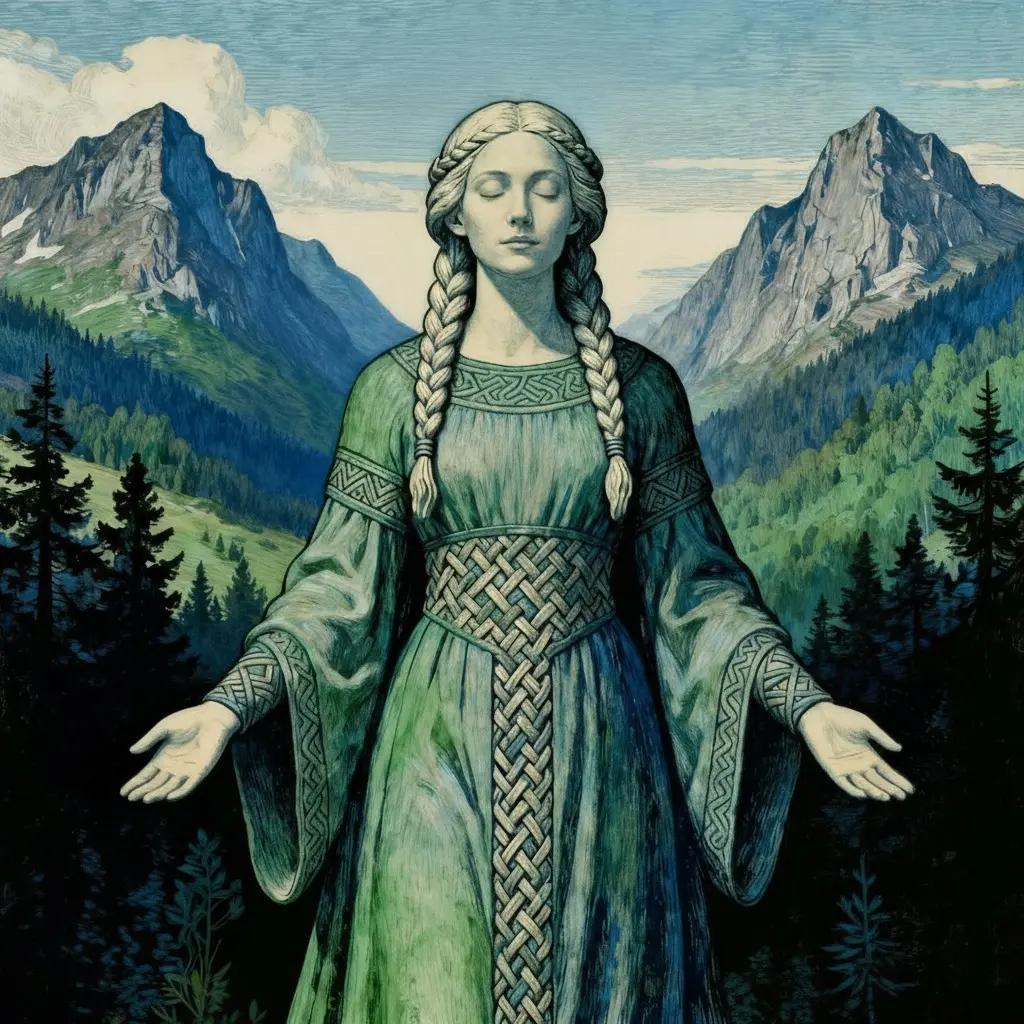
Imagine a world where nature pulses with hidden forces – the mountains have their own spirits, the forests whisper ancient wisdom, and people can leave their bodies to meet mysterious beings in another world. This was the reality for our ancestors in the old Nordic region, where shamanism formed a central part of the spiritual fabric. But what was actually the origin of Norse shamanism? Was it influenced by the Sami, or can it be traced back to traditions from distant Siberia or the Carpathian basin? How did this spiritual practice develop in step with societal change?
Shamanism – a universal way of understanding the world
Shamanism is a practice in which chosen people, called shamans, attain trance states that enable them to journey to other worlds. There they retrieve knowledge, heal, or influence the forces of nature to help human beings. This practice is not tied to one place, but is found in many cultures all over the world. In the old Scandinavian societies – including in the Viking Age – we find traces of this magic, which adapted to local traditions and realities.
It is nonetheless important to emphasise that shamanism has never been a uniform practice, but shaped by environment, climate, culture and the needs of society. That is why it is fascinating to explore where Norse shamanism has its roots.
A cultural blend across time and space
Research has shown that elements of shamanism occur in various forms in Norse religion, in sagas, myths and archaeological finds. These elements are often the result of a long chain of development that binds together several cultures and traditions over a thousand years.
The origin of Norse shamanism cannot be unambiguously tied to a single source. Although classical Siberian shamanism shares many similarities, Nordic shamanism is not a direct copy. There is a common heritage from hunter-gatherer societies that spread across large parts of Eurasia, and fundamental shamanic features appear to be universal.
At the same time, the Sami of northern Scandinavia carried on shamanic practices long after the Viking Age, and it is assumed that there was a form of cultural exchange and influence between Nordic peoples and the Sami. It is important, however, to recognise that Sami shamanism also developed independently, in close interplay with the northern ecosystem.
In addition, there are theories that some ritual elements may have arrived with migrations and trade connections from the east and the south, where various indigenous traditions merged with local customs in the Nordic region.
Taken together, Norse shamanism can be understood as a synthesis of indigenous traditions from hunter-gatherer cultures that adapted to the Nordic environment, while also developing through contact and exchange with neighbouring cultures.
Societal development and change in the shaman's role
To understand the shaman's role in the old Nordic region, we must look at societal development. The earliest hunter-gatherer societies were small, egalitarian, and closely tied to nature. Here the shaman had a central role as healer, seer and intermediary between people and spirits.
With the rise of agriculture, the population grew, and society became more complex. Religion developed in parallel, with several types of religious specialists holding different roles and status. Priests, or goðar, gained more official and political power. Shaman-like roles such as völvur – female seers and magicians – and seiðr practitioners were in many ways marginalised, and magical functions were pushed out towards the periphery of society.
This development reflects a shift from local, practical magical work to more institutionalised religion, where earlier shaman roles became fragmented.
Völvur, seiðr and gender roles
In the sagas and Norse mythology we encounter the völvur – female shamans who could see into the future and journey to other worlds. They played important roles in religious rituals and as advisers to leaders. At the same time, some men practised seiðr, a magical form strongly tied to divination and fate. Because of the gender roles of the time, it was often regarded as "unmanliness" (ergi) for men to practise seiðr, something that led to social exclusion.
This illustrates how shamanic practices were tied to gender and power. Women held certain magical roles, often a position of power, while men who performed magic outside official frameworks often stood on the margins of society. The sources we have are largely written by Christian monks, which influenced how gender roles were portrayed.
Faith, power and shamanism in the Norse age
Religion and society in the Norse age were governed by stratified power structures in which magic and faith had to be organised. Religious leaders such as the goðar and gyðjur combined both political and religious authority, while shaman-like roles were often looked down upon or suppressed by the elite.
Even so, the myths about, among others, the god Odin contain clear shamanic features. Odin journeys in trance, seeks knowledge in other worlds and has contact with mythical creatures. This shows that shamanic elements remained central in Norse cosmology, even if they did not always have social acceptance.
Why do shamanic features live on?
Shamanism is tied to the human being's deep need to understand and influence the world, especially when it seems unpredictable and frightening. Even as society changed, people retained the need to communicate with forces beyond the visible.
That is why shamanic traditions such as seiðr and the völvur survived – often hidden or marginalised, yet still important for ordinary people in difficult times.
A legacy of mystery and community
Norse shamanism is not an imported phenomenon, but a complex blend of local traditions and a common heritage from hunter-gatherer cultures that has developed through contact and adaptation. It reflects societal development, where magic, faith, gender and power lived closely together.
Today, studies of this shamanism give insight into how people in the past lived with the invisible and sought meaning and security in a dangerous and mysterious world.
For us, in an age dominated by science and technology, it reminds us that magic and faith are about the human being's eternal search for meaning and connection with something greater than the visible. We still carry something of this heritage with us – in dreams, in stories, and in the longing to understand the hidden.
Sources
Andrén, Anders, Jennbert, Kristina, Raudvere, Catharina (2006). The Concept of Shamanism in Old Norse Religion from a Scandinavian Perspective. Nordic Academic Press.
Hultkrantz, Åke (1983). The Religions of the Circumpolar North. Mouton Publishers.
Eliade, Mircea (1964). Shamanism: Archaic Techniques of Ecstasy. Princeton University Press.
Pentikäinen, Juha (1998). Oral Reproduction and Shamanism. Journal of American Folklore.
DuBois, Thomas A. (1999). Nordic Religions in the Viking Age. University of Pennsylvania Press.
Abram, Chris (2016). Shamans of the North: Sami Spirituality and Northern European Shamanism. Journal of Northern Studies.
-1.avif)
-1.avif)