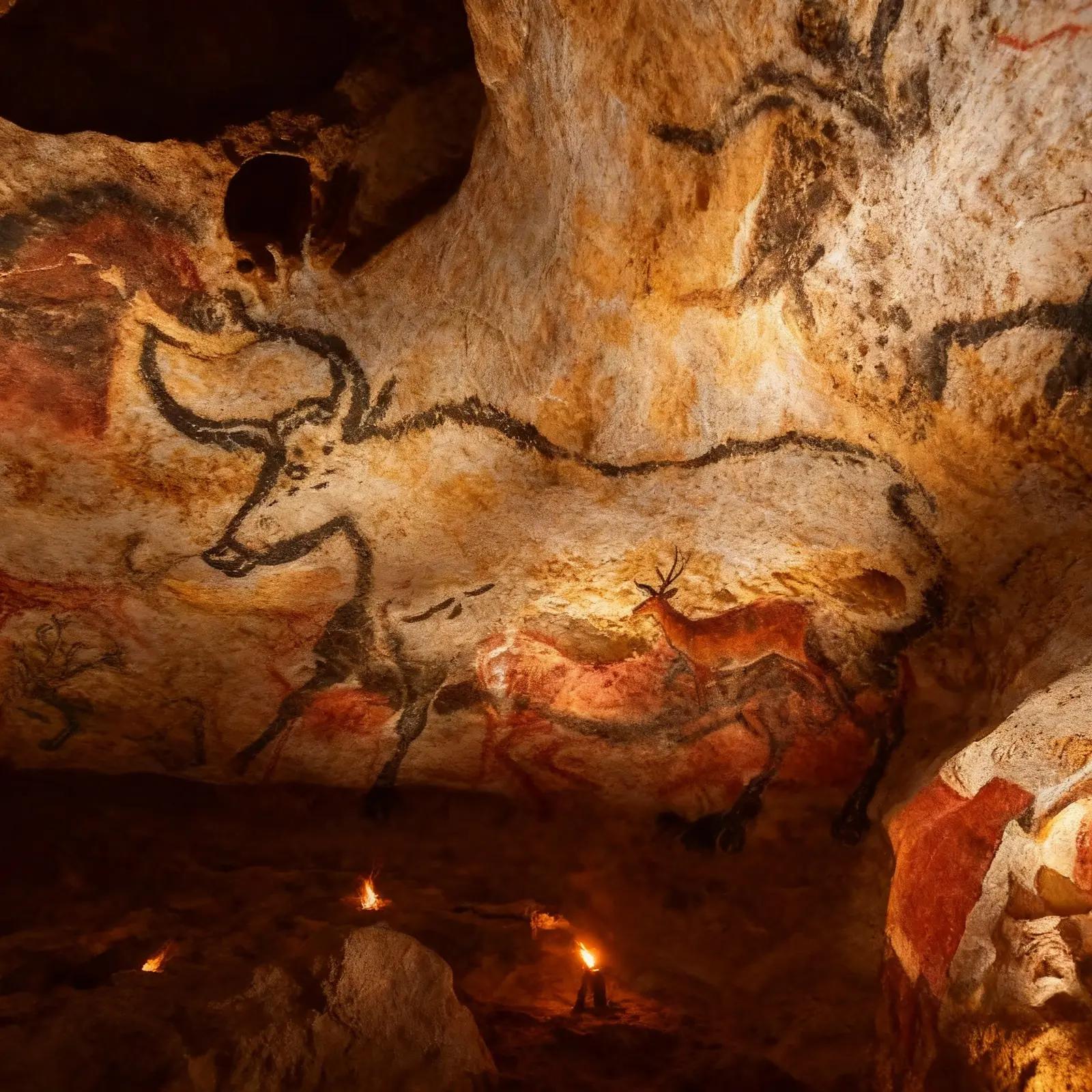
Before there were cities, before people had written a single word, and long before churches and temples rose toward the sky, humans lived in a world where nature itself was home, deity, and mystery all at once. We can almost picture them: small groups of hunters and gatherers following the tracks of animals, lighting fires in dark caves, and gazing up at the starry sky with unease and awe. For them, everything was alive: the river, the stone, the wind, the herd of reindeer, and not least the shadows that danced between the flames.
In this world the shaman emerged – the human who dared to cross the boundaries between the visible and the invisible. And it is into this mist-filled spiritual landscape that we shall wander.
Life Before Writing – When Nature Was Sacred
Imagine that you are living 20,000 years ago. You do not know what books are, there are no laws written down on paper, no technology. All you know about the world is what you can observe yourself, and what the elders of the tribe tell you. The course of the sun, the moon waxing and waning, the animals migrating through the landscape – all of this becomes the clock and calendar of life.
When someone dies, it is not seen merely as a loss, but also as a transition. When a child is born, it seems as though the very mysteries of the earth are unfolding. For the people of this time, religion was not a separate part of life. It was woven into everything. Every stone could carry power, every forest could conceal spirits. And some people – the shamans – had the ability to move within this invisible web. They could dream their way into the powers of animals, fetch counsel from ancestors and spiritual beings, and return to the tribe bearing wisdom.
The Shaman – The Human Between Worlds
The shaman was not a priest as we know one today, not a king, and not always a man. She or he could be young or old, woman or man – but always someone who was different. Perhaps they were born with special gifts, perhaps they had endured an illness or a near-death experience that gave them insight.
A shaman was a healer when illness struck. They were soothsayers who interpreted the signs the wind or the stars gave. They could dance themselves into trance to the deep rhythm of the drum, sing special words that carried power, or use herbs that opened the senses.
This was not merely a matter of belief, but a vital function. For imagine: when someone in the tribe fell ill, when the herd of reindeer vanished, or when a child was born too early – it was the shaman who bore the responsibility of bending over the flames, singing with nature, and praying for help from the powers that ordinary people could not see.
The Dark Cathedrals of the Caves
Let us step into the caves of southern France – the great cathedrals of the Ice Age. Deep inside Lascaux we find paintings that still make the heart pound. Bison, deer, and horses run along the walls, painted with charcoal and mineral pigments more than 15,000 years ago. Among the animals we see something even stranger: human figures that are half animal, half human. One figure with reindeer antlers, another with a bird's beak, a third with a wolf's body.
This is not merely art. It is a trace of the shaman's journey. When the shaman danced in trance before a glowing fire, she could become an animal, speak on its behalf, or draw its power into the tribe. The animal paintings were stories, magical maps, and at the same time doorways to an invisible world.
The First Drum
Try to imagine the sounds that filled these ceremonies. People sing in chorus, some play flutes made of bone, and the drum thunders with rhythms that recall the beating of the heart. The whole cave vibrates. In the half-darkness they see dancing shadows on the walls. A simple drum can be a rocket toward the secrets of the universe.
The music was not entertainment, but the very engine of the shaman's journey. It could carry the whole group into another room – the room of the sacred – where animals and humans, the living and the dead, could meet.
The Graves That Told Stories
When we look at archaeological finds, we discover many traces of the shaman's significance. Certain graves, such as the one from Brno in present-day the Czech Republic, are full of mysterious objects: figures of mammoth ivory, small discs, ritual implements. The bodies were often painted with red ochre – a color that symbolized life and blood.
In many graves one finds hybrid figures – half animal, half human. It is as if the dead were already in the process of moving over into another existence, ready to meet the spirit world. When a shaman was buried, she or he was given implements for eternity itself.
The Women Who Carried the Power
There is much to suggest that women played a central role in these early spiritual lives. Gravettian figures, such as the famous "Venus statuettes," depict voluptuous female bodies with large hips and breasts. In the past, archaeologists have often said they were symbols of fertility – but perhaps they were more than that. They may have been amulets, protectors, or symbols of the earth mother herself.
Later, in the Neolithic period, female figures were made in clay with clothing, jewelry, and masks. Perhaps they were specific people – priestesses or shamans. And many of them were smashed after use, as if they were offerings in themselves. This tells us that women, visionaries, and healers had a role just as important as men in many prehistoric societies.
The Magic of the Mask
One of the most powerful symbols we find is the mask. When a person put on the mask of an animal or a spirit, he or she was no longer themselves. The mask made it possible to become another being, to speak on behalf of something greater than oneself.
Masks were used in rituals where the boundary between humans and spirits was wiped away. In archaeology we find both small statuettes with masks and traces of headdresses themselves. Imagine the trance dance, the lights from the fire, the shadow of a wolf-masked shaman moving slowly in toward the tribe. It was not a performance – it was real.
The Home as a Temple
Even in everyday life, existence was filled with magic. Excavations of early houses reveal small models of dwellings that served as altars. There stood miniature figures, vessels, and offerings. When the ritual was over, the objects could be smashed – as a reminder that the act was concluded, but also as an offering to the powers.
A house was not merely a place to live. It mirrored the cosmos. The roof could bear figures of animals or women as guardians. The floor could be marked with hearths that became sacred centers. The whole home became a small universe in which humans, nature, and the spirits lived together.
Objects Filled with Power
Clay, stone, metal – all of this held a special value. A bowl could be shaped like a woman, a drinking horn could be covered with spirals. Many such objects were used only once. They were then destroyed or hidden, as if they had served their purpose and had to be returned to the world below.
We find hoards of gifts – copper, gold, or pottery – buried in the earth. These were most likely offerings, meant as a barter with the hidden powers. For prehistoric humans, matter was not merely matter. Everything could be infused with spirit and power.
From Shaman to Priest
As society changed, a transformation also took place in spiritual life. When people began to cultivate the land and build large communities, the roles became more structured. The shaman, with his free role as healer and visionary, was gradually replaced or supplemented by priests – people tied to temples, power, and institutions.
The fertility goddesses were eventually exchanged for male deities who had names, stories, and statues. But the shaman's tasks – to protect against illness, interpret dreams, and negotiate with the invisible – never disappeared entirely. They were reworked and reborn in new forms.
The Bridge to Us Today
What does all this mean for us? It tells us that humans have always had a need to understand the world. Before we had science, we had shamanism. Before we had a priesthood or organized religions, we had stories painted on cave walls, rhythms that pulsed in the night, and masks that made us more than mere humans.
When we today look at a shaman from Siberia, a healer from the Amazon, or an indigenous tradition in the Nordic countries, we see threads that reach back thousands of years. The shaman's core task – to build a bridge between the visible and the invisible, to give hope and meaning in the face of life's riddles – has always been there.
A Living Story
So the next time you look at a starry sky or feel the wind blow across the landscape, you might try to imagine what it was like to be one of these people. For them, the universe was not cold and distant. It was full of voices and powers that could speak.
To understand the prehistoric shamans is not merely to look back in time. It is to recognize ourselves in humanity's eternal search to find meaning, to heal, and to live in connection with something greater.
For the shaman's dance, the rhythm of the drum, and the strange paintings of the caves tell us one thing: humans have always longed to be more than just themselves.
Sources:
Kovárník, Jaromír. "A probe into the spiritual life of prehistoric people, a reflection of shamanism in archaeology." In: Shamanism and Nature Worship Past and Present, 2023.
-1.avif)
-1.avif)