%2520(1)-1.avif)
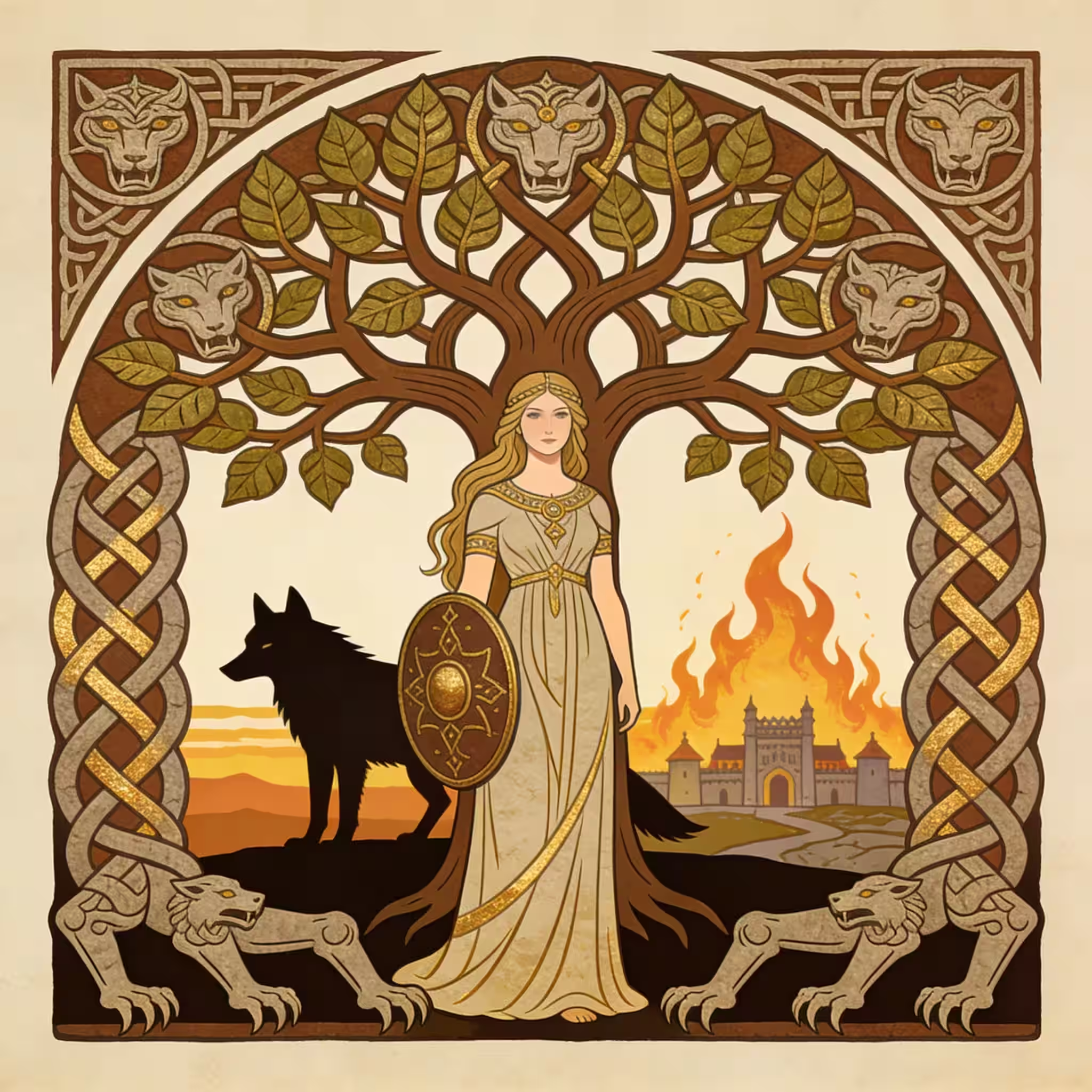
The goddesses' silence, Loki's knowledge and the fragile weave of fate in Norse mythology
In Ægir's hall there is a feast. Gold gleams along the walls, the mead flows, and the gods sit gathered – mighty, self-assured, secure in their own story of order and control. But there is one among them who does not share this security. One who knows more than he should. One who cannot – or will not – keep silent.
Loki.
When he steps into the hall in Lokasenna, it is as if time itself holds its breath. For this is not merely a quarrel between gods. It is a reckoning with memories, secrets and fates. And at the centre of it all stand the goddesses – Frigg, Gefjon, Freyja – bearers of a knowledge that reaches far beyond the present, yet remains unspoken. For in Norse mythology it is not always the one who knows the most who says the most. Often it is quite the opposite.
The feminine time
One of the most striking things about Norse mythology is how the relationship to time is divided between the sexes. The men act. They fight, travel, gather information, ask, press and threaten. The women know. They know of what was before the world was shaped, and of what comes after it perishes.
The völva in Völuspá speaks of creation and of the world's end with the same calm. The Norns – Urðr, Verðandi and Skuld – spin the lives of gods and humans into a single continuous weave of past, present and future. The valkyries decide not only who dies, but when. And goddesses such as Frigg and Gefjon are said outright to know the fate of all.
And yet: they keep silent.
This silence is not weakness. It is power. To know fate is one thing; to speak it is another. For in the Norse imagination, words are not neutral. To say something is to draw it nearer. To name Ragnarök is to touch it.
This is why Frigg is silent.
Frigg – the one who knows, but does not tell
Frigg is not merely Odin's wife. She is his counterpart. Where Odin sacrifices his eye for knowledge, Frigg pays the price through restraint. She knows – both Odin and Freyja say so explicitly in Lokasenna – but she chooses to keep silent.
"Ørlǫg Frigg hug ek at ǫll viti, þótt hon sjálfgi segi," says Freyja. Frigg knows all fates, but she does not speak them herself.
This is crucial. For Frigg represents a form of knowledge that seeks not control, but balance. She knows that fate cannot be avoided – but perhaps it can be delayed. Perhaps it can be softened. Perhaps silence can give the world a little more time.
But then there is Loki.
Loki – the one who says what must not be said
Loki is obsessed with revealing. With speaking. With dragging secrets into the light. Again and again in Lokasenna he says the same thing: "Now I shall tell." "I know." "I will hide it no longer."
It is as if the words burn within him.
He accuses the goddesses of infidelity, of lust, of betrayal. Iðunn. Gefjon. Frigg. Freyja. Skaði. Sif. None go free. And often it is Loki himself who claims to have been their lover – sometimes openly, at other times in disguise.
And here lies something deeply unsettling.
For Loki is not merely a gossip. He is a shape-shifter. One who can be anyone at all. One who can enter the goddesses' lives without being recognised. The question that quivers between the lines in Lokasenna is not only what Loki reveals – but whether the goddesses themselves know with whom they have shared their bed.
Was it Loki who gave Gefjon the necklace?
Was it Loki whom Iðunn embraced?
Was it Loki who sowed children in Asgard?
And if it was – what does that mean?
The fear of the unseen child
In Norse mythology, kinship is never merely biology. It is loyalty. Fate. Alliance.
Loki himself is proof of this. Born of a jötunn father and a mother who belongs among the Æsir, he carries the division within himself. He is inside – and outside. Brother and enemy. Helper and destroyer.
When Loki in Lokasenna claims to have fathered a child with Týr's wife, it is not merely an insult. It is a threat. A possible new Loki. A child with jötunn blood growing up among the gods, undetected.
And this is precisely what the goddesses perhaps sense – but will not say aloud.
Goddesses as guardians of life and time
Looking more broadly at the mythology, it is striking how often female figures control the transitions of life. They determine birth. Death. Rebirth. Old age.
Iðunn guards the apples that keep the gods young. Freyja rules over the dead as much as over love. Hel governs the realm of the dead. The valkyries choose who falls. The Norns decide how long each life shall last.
These are not arbitrary roles. They point toward a conception in which time – real time – is not linear action, but circular insight. And this insight belongs to the feminine.
Odin must learn seiðr from Freyja. And even then it is said that this knowledge is "ergi" – too shameful for men. Prophecy is not only dangerous; it is gendered.
Loki's blind spot – and the goddesses'
But even the goddesses have a limit. Their ability to see – does not see everything.
They know the fate of gods and humans. But not that of the jötnar. And not that of Loki.
Loki falls between the categories. His jötunn blood makes him invisible to the knowledge that otherwise encompasses all. And this is his greatest weapon.
He knows this.
This is why he can operate in the shadows. This is why he can deceive Frigg – twice – in the tale of Balder's death. This is why he can sit in Ægir's hall and speak of the future as if it were already decided.
For Loki is not afraid of fate. He uses it.
When words become deeds
The most disturbing thing about Lokasenna is not the insults, but the prophecies. Loki says not only what has been. He says what is to come.
To Frigg he says that Balder will never ride home again.
To Freyr he says that he will stand without a sword when the sons of Muspell come.
To Thor he says that he will fail when Odin is swallowed by the wolf.
These are not random barbs. They are precise images of Ragnarök.
And remarkably: Loki does not use the form "it will happen." He uses "I bring it about." "I know." "I am responsible."
It is as if, by speaking fate aloud, he also takes ownership of it.
Silence as the last defence
When Thor finally steps forward and threatens Loki into silence, it is not merely a demonstration of power. It is an attempt to halt the words before they do more harm.
For the gods understand something Loki understood long ago: that there are words that cannot be spoken without consequences.
The goddesses knew this all along.
That is why Frigg kept silent.
That is why Gefjon said nothing.
That is why Freyja carried her knowledge in rage, not speech.
And perhaps this is the deepest tragedy in Norse mythology: that the world's destruction comes not from a lack of knowledge – but from the fact that the one who speaks the most is the one who ought to have kept silent.
A note on sources and interpretation
The sources underlying this text were for the most part written down in the Middle Ages by authors already influenced by Christian faith and thought. The myths of the pre-Christian, Norse imagination are therefore transmitted through a Christian lens, and may be coloured by Christian morality, theology and historiography. They cannot be read as direct or neutral renderings of older heathen belief.
At the same time, Norse mythology was originally an oral and dynamic tradition, varying across time and place. When we interpret this material today, we move inevitably between historical sources and interpretation. In this process we may at times move away from what can be counted as historical fact, in favour of symbolic, mythological or contemporary readings. Such interpretations are not meant to replace historical research, but to complement it, and should be read with a critical and open eye.
Sources:
Primary sources
Snorri Sturluson: Edda – Gylfaginning and Skáldskaparmál.
Ed. and trans. Anthony Faulkes. Oxford: Clarendon Press / Viking Society for Northern Research.
The Poetic Edda (Codex Regius).
Ed. Gustav Neckel, rev. Hans Kuhn. Heidelberg: Winter.
The Poetic Edda. Trans. Carolyne Larrington. Oxford University Press.
Secondary literature
Quinn, Judy. "What Frigg Knew: The Goddess as Prophetess in Old Norse Mythology." Cambridge University.
Clunies Ross, Margaret. Prolonged Echoes: Old Norse Myths in Medieval Northern Society, Vol. 1. Odense University Press.
Clunies Ross, Margaret. "The Creation of Old Norse Mythology." In The Viking World, ed. Stefan Brink & Neil Price. Routledge.
Lindow, John. Murder and Vengeance among the Gods: Baldr in Scandinavian Mythology. Folklore Fellows' Communications.
Lindow, John. Norse Mythology: A Guide to the Gods, Heroes, Rituals and Beliefs. Oxford University Press.
McKinnell, John. "Motivation in Lokasenna." Saga Book 22.
McKinnell, John. Both One and Many: Essays on Change and Variety in Late North Heathenism. Il Calamo.
Näsström, Britt-Mari. Freyja: The Great Goddess of the North. Clock & Rose.
Schjødt, Jens Peter. Initiation Between Two Worlds. University Press of Southern Denmark.
Bek-Pedersen, Karen. The Norns in Old Norse Mythology. Dunedin Academic Press.
Dronke, Ursula. The Poetic Edda, Vol. II: Mythological Poems. Clarendon Press.
von See, Klaus et al. Kommentar zu den Liedern der Edda, Bd. 2: Götterlieder. Winter, Heidelberg.
Quinn, Judy. "Dialogue with a völva." In The Poetic Edda: Essays on Old Norse Mythology. Routledge.
-1.avif)
-1.avif)