There are times of year when nature feels almost as if it is speaking. Not because it uses words, but because it shows us something through its movements, its shifts and its living creatures. A track in the snow, a plant breaking through the ground, a bird returning, or a stillness settling over the landscape – all of this can be experienced as small messages within a greater whole. In the ceremony wheel such signs are not random. They become part of an annual story in which animals, plants and seasons are woven together into a living understanding of life.
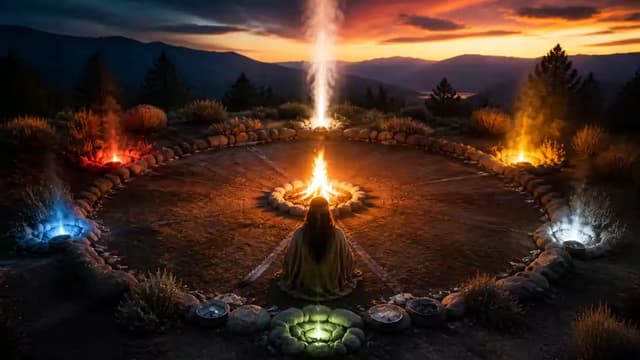
The ceremony wheel is more than a calendar. It is a wheel of life, a way of seeing the world that builds on the idea that everything is connected, and that nature's rhythms also mirror human life. In shamanism it is described as a model for understanding cyclical time, the balance between forces, the connection between microcosm and macrocosm, and a path toward living more in step with nature. The animals and plants linked to the various months are chosen because they both carry symbolic meaning and because they relate to actual conditions in nature, traditional use and the character of the seasons.
When we follow the wheel through the year, we therefore follow not just a series of symbols. We follow a landscape of experiences: winter's endurance, spring's awakening, summer's abundance and autumn's preparation. Each month has its own tone. Each animal and each plant carries its own lesson. And together they show us how life can be understood as a circle, not as a straight line.
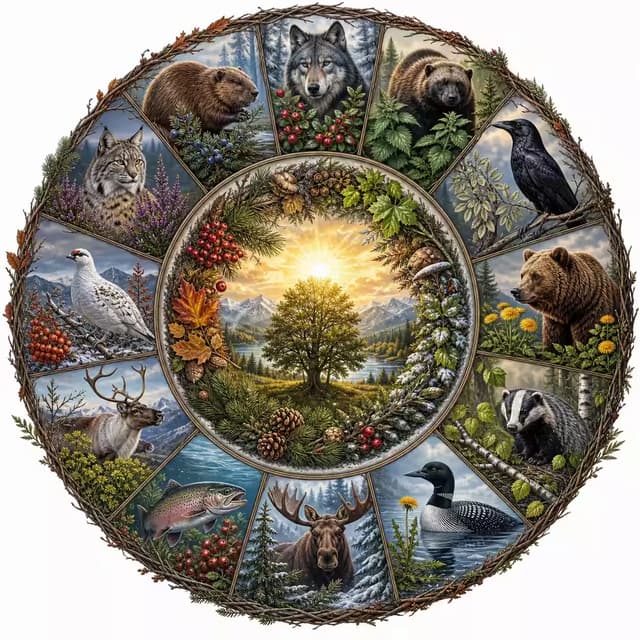
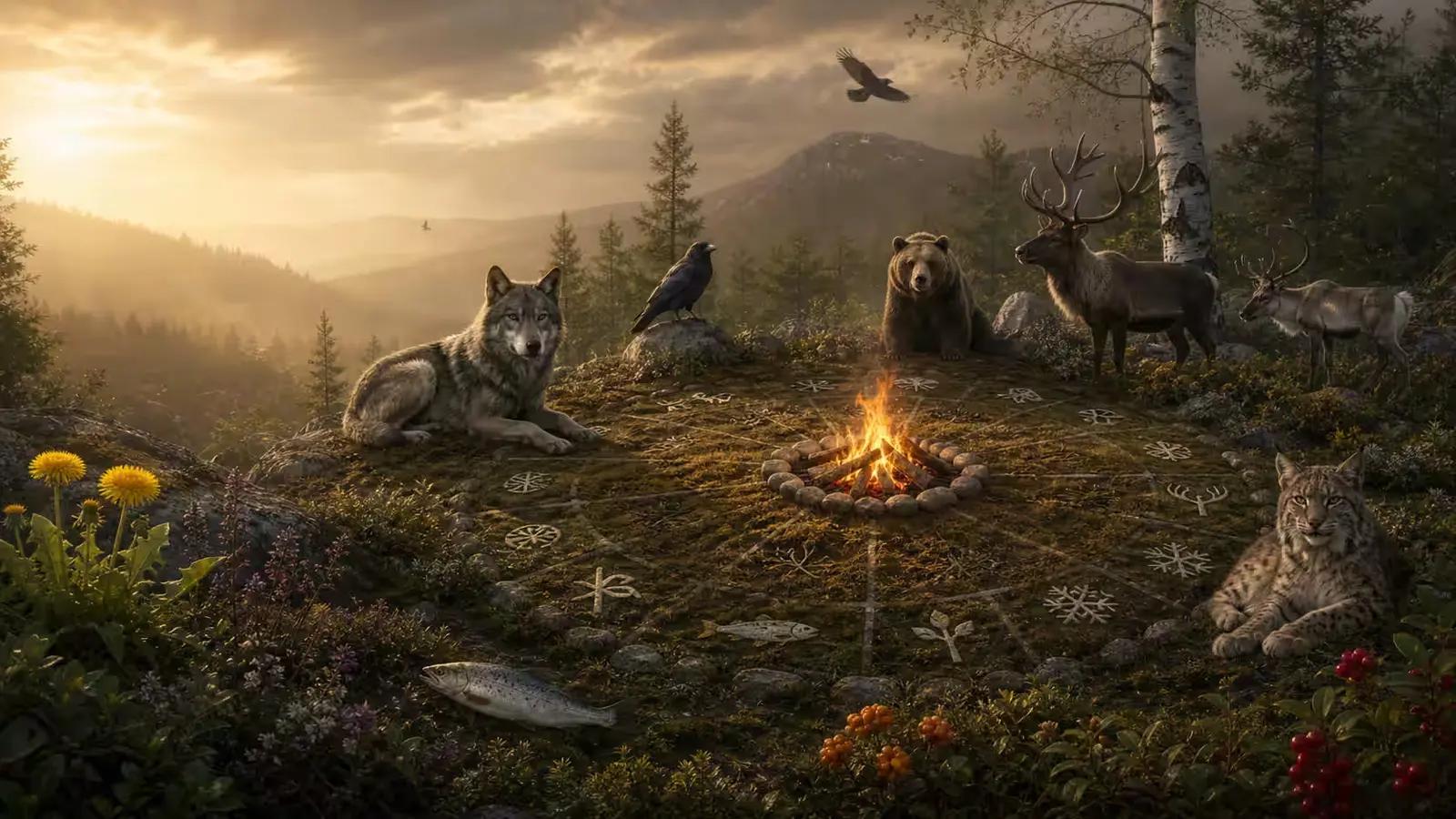
The various animals in the ceremony wheel are chosen because they express qualities, patterns of life and forces that fit the rhythm of the year and the experiences a person meets through the year. In Sjamanistisk Forbund's ceremony wheel, each animal is linked to a particular month or period because it carries symbolism that mirrors nature's movements, the Nordic seasons and the spiritual lessons belonging to that time. The wolf stands for endurance and survival in the winter darkness, the raven for wisdom and new beginnings, the bear for awakening and protection, the moose for strength and growth, the fish for flow and abundance, and the lynx for quiet power and adaptation. The choices thus build on observation of nature, traditional symbolism and the shamanic understanding that everything is ensouled and speaks to us if we learn to listen.
January: the wolf and the lingonberry
The year begins at the heart of winter. In January the landscape is often covered in snow, and in many places it is difficult to find food and to move without resistance. It is therefore no coincidence that the wolf and the lingonberry stand at the center of this month.
The wolf represents adaptation, survival and sharp watchfulness. In the tradition, January is explained as a time when the wolf could more easily approach human settlements because the snow made it harder to hunt in the wilderness. Symbolically this becomes an image of how strength is not always about force alone, but about reading the situation correctly and finding the way through difficult conditions. The wolf teaches us to be alert, strategic and true to our instincts.
The lingonberry carries a different kind of strength. It is small, but important. It grows in nature as a reminder that nourishment is often found in the simple and modest. In the compendium, the lingonberry month is linked to the need for vitamin C and strength in the dark winter time. It is a clear image of winter's wisdom: even in a time of scarcity, there is something that keeps the life force alive.
Together, the wolf and the lingonberry express January as a month of endurance, cleverness and quiet strength. It is a time for getting through the darkness, not by fighting against it, but by understanding how to live within it.
February: the wolverine and the nettle
February is still winter, but winter begins to lose a little of its grip. It is felt in the light, in the day slowly growing longer, and in nature's hidden preparations. In the ceremony wheel, February is the month of the wolverine and the nettle, and in the teaching material St. John's wort is also mentioned as part of this period, linked to winter's heaviest phase and the need for relief.
The wolverine is an animal that symbolizes strength and endurance. In the compendium it is described as especially well adapted to this time because it can run on top of the snow crust while larger animals struggle. This makes the wolverine an image of how the ability to move through difficult conditions often comes from agility and the power of adaptation, not from size.
The nettle is one of nature's most versatile plants. It has been used for food, medicine and animal fodder, and in the compendium it is highlighted as an important resource when the food stores began to empty. The nettle teaches us that what at first may be experienced as sharp or difficult may later prove to be useful, nourishing and healing. It also carries a clear message that nature gives us what we need, often in forms we do not at first understand.
February thus becomes a month of hidden endurance. It is a time when winter is not yet over, but where there are already signs of life force in what seems hard or troublesome.
March: the raven and the alder
March is the month of transition. Winter loosens its grip, but spring has not yet fully taken root. This makes March a time of expectation, movement and openness. In the ceremony wheel, the raven and the alder are the strong symbols of this month.
The raven stands for wisdom, new beginnings and observation. The compendium points out that the raven lays its eggs and has its mating activity in this period, which makes it a natural sign of new life. It becomes a symbol of the ability to see connections, to perceive what is on its way, and to understand the world with sharp attention. The raven is not only a herald of change; it is a teacher in how to read change.
The alder is another strong sign of spring. It appears when the earth begins to awaken, and it represents what lies beneath the surface before it breaks forth. In the compendium the alder is described as one of the first trees to bloom, and as a symbol of hope and the coming spring. The alder tree points toward a movement upward and outward, from hidden life to visible growth.
March thus becomes a month when nature begins to whisper loudly. The raven and the alder remind us that renewal first happens in the hidden, and that being alert to the signs is a form of wisdom in itself.
April: the bear and the coltsfoot
April arrives with clearer light and a growing sense of movement. The snow may loosen its grip, streams find their way, and the ground opens. In the ceremony wheel, the bear and the coltsfoot are linked to this month.
The bear symbolizes awakening, renewal and protection. The bear comes out of its den with its cubs, and this becomes an image of life returning with responsibility and care. The bear is strong, but also down-to-earth. It teaches us that power and protection belong together.
The coltsfoot is one of the first flowers to appear in spring. It is early, robust and important; it is like a source of the first nourishment for both animals and people. The coltsfoot thus becomes a symbol that nature not only awakens, but also gives. It reminds us that the first light of a new season often comes in small forms.
April therefore carries the message that new growth always needs both strength and nourishment. The bear and the coltsfoot stand side by side as an expression of a safe awakening.
May: the badger and the birch
In May, spring is clearly present. The landscape turns green, birdsong fills the air, and the earth seems more alive. In the ceremony wheel, the badger and the birch are linked to this time.
The badger stands for family bonds, protection and down-to-earth strength. It is connected to the den, the earth and to taking care of one's own. The badger comes out of its den with its young, and therefore symbolizes care and kinship. It teaches us that safety and belonging are important parts of life's growth.
The birch is one of the most important spring trees in Nordic landscapes. It bursts into leaf as a sign of renewal and growth, and in the wheel of the year it is highlighted as a symbol of exactly this. The birch carries both light and movement within it. It is not heavy or dark, but open and full of spring force.
May therefore becomes a month in which we can feel both grounding and momentum. The badger reminds us to stand firm, while the birch reminds us to let in the new.
June: the loon and the dandelion
June is a bright and outward-turning month. Summer has arrived, and nature is in full growth. In the ceremony wheel, the loon and the dandelion are expressions of this period.
The loon is a bird associated with the summer sun, water and the soundscape of the night's darkness. It is like a symbol of summer's mood, especially through its characteristic call in the summer night. The loon carries with it something raw and beautiful at the same time. It reminds us that nature's beauty often also has a wilder side.
The dandelion is robust, bright and powerful. It represents strength and healing, and in the compendium it is highlighted as a plant with a traditional place in midsummer celebrations. The dandelion grows where it wants, and shows that resistance does not hinder life – sometimes quite the opposite. It is an image of endurance and life force in the midst of summer's abundance.
June teaches us to receive the light, but also to respect nature's wild character. The loon and the dandelion stand as signs that summer's power is both nourishing and free.
July: the moose and the spruce
July is one of the most powerful summer months. The warmth is stronger, growth is at its peak, and nature seems mature. In the ceremony wheel, the moose and the spruce are central to this month.
The moose symbolizes strength and growth. The moose grows its first antlers in this period, and calves are also born now. This makes the moose an image of both development and life force. It is large and prominent, yet at the same time peaceful in its movement.
The spruce represents healing and protection. Symbolically, its soft cones and medicinal potential are highlighted, and it is described as a stable and protective presence in the landscape. The spruce stands firm when much else changes. It is an anchor in the green.
July therefore becomes a month of mature strength. The moose shows the power of growth, and the spruce shows the protective side of power. Together they remind us that strength can also be calm and supportive.
August: the fish and the berries
August marks the great abundance. Now is the time to harvest, gather and receive. In the ceremony wheel, the fish and the berries are linked to this time.
The fish symbolizes abundance, migration and flow. Salmon and sea trout go up the rivers in this period, which makes the fish a natural image of harvest and wealth. The fish teaches us that life's goods often come as movements in currents, not as fixed stores.
The berries represent nature's generosity. The forest is ripe, and berries and mushrooms are ready for gathering. This is a time when nature shows its generosity fully. The berries are small, but carry within them the taste of a whole year of growth.
August teaches us to receive with respect. The fish and the berries remind us that abundance also requires gratitude and consideration.
September: the reindeer and the roseroot
September is a transition from summer to autumn. The air becomes sharper, the days shorter, and a new preparation begins. In the ceremony wheel, the reindeer and the roseroot stand for this time.
The reindeer is a symbol of harvest, migration and preparation for winter. The compendium links it to slaughter time and an important turning point in the year. The reindeer teaches us to read the season and be prepared before the cold arrives.
The roseroot is a plant that represents strength and resilience. In the compendium it is described as used medicinally and magically, and as a plant with clear significance in the autumn time. It is an image of being able to bear pressure and still preserve life force.
September therefore becomes a month for gathering one's strength. The reindeer and the roseroot teach us that preparation is a form of wisdom.
October: the ptarmigan and the rowanberry
October marks that autumn is now clearly present. Nature withdraws, and it is time to sharpen the senses. In the ceremony wheel, the ptarmigan and the rowanberry are linked to this month.
The ptarmigan stands for adaptation. It changes its plumage and prepares for winter. It reminds us that the ability to change with the situation is often the very key to managing.
The rowanberry also marks harvest and preparation for winter. It is an important winter resource. The rowanberry is autumn's last gift, and within it lies a quiet reminder that everything has its time.
October teaches us to let go of what is ripe, and to prepare for what is coming.
November: the lynx and the heather
November is a month of stillness, darkness and inner strength. The light is faint, and nature seems more gathered and at rest. In the ceremony wheel, the lynx and the heather are central to this period.
The lynx is an animal that represents strength, sharpness and survival. The compendium describes how the lynx travels much in deep snow and how it builds up reserves in this time. The lynx teaches us to be quiet but watchful; to use our strength where it is needed, and to let the rest be at rest.
The heather represents endurance and survival. Historically it is an important food plant for animals and people in the winter time, and a source of food, medicine and warmth. It carries color into the darkness and shows that life is still present, even when the season seems harsh.
November thus becomes a month of quiet strength. The lynx and the heather show that there is still life in what looks most subdued.
December: the beaver and the juniper
December is the deepest winter month of the year. It is dark, cold and still, but also a time for protection, gathering and cleansing. In the ceremony wheel, the beaver and the juniper stand central here.
The beaver symbolizes work, protection and the creation of a safe space. The beaver lives much of its life inside its own house, and it stands for protection and winter adaptation. It teaches us that care can also be structure, responsibility and practical building.
The juniper has a particularly strong place in winter's symbolism. It was traditionally used for switches, washing and protection, and was connected to cleansing around midwinter. The juniper carries a clear and penetrating power. It clears space and marks transition.
December therefore becomes a month for protecting what is meant to last, and for entering the darkness with clarity and purity.
The ceremony wheel as a whole
When we look at the animals and plants in the ceremony wheel together, it becomes clear that they do not merely describe months. They show an entire view of life. The wheel mirrors nature's rhythm and our own journey through life's various phases. It is about understanding that strength is not only struggle, that growth is not only forward motion, and that rest is not the same as the absence of life.
The ceremony wheel becomes a model that connects nature's cycles, the four directions, the elements and the living experience in the ceremonies. The wheel is not static. It is alive, and it can be used as a basis for reflection, preparation and spiritual understanding. Animals and plants thus become not random illustrations, but carriers of concrete and symbolic knowledge.
It is also important to note that the ceremony wheel in the compendium is closely tied to a practice in which the ceremonies are built up through observation, tradition, channeled input and nature's own rhythms. This means that the animals and plants are not just "symbols" in a loose sense, but parts of a living ritual tradition in which one seeks to synchronize oneself with the land, the seasons and the forces one works with.
Living in step with nature
To follow the ceremony wheel is therefore also to practice living more in step with nature. It means acknowledging that life moves in cycles, and that each phase has its value. Winter teaches us patience. Spring teaches us to awaken. Summer teaches us to receive. Autumn teaches us to gather and prepare.
This is a way of understanding life that places the human being within a larger context. We do not stand outside nature and observe it. We are part of its pulse. We go through our own winters and springs, our own periods of abundance and decline. The animals and plants in the ceremony wheel can therefore also be read as mirrors for human phases of life.
One can connect this further to the idea of the four directions, the seven directions and a holistic cosmology in which the heart, Mother Earth and the Creative Force are also included. This shows that the ceremony wheel is not only a description of nature, but a way of understanding the relationship between the earthly, the human and the spiritual. The animals and plants are therefore both concrete and symbolic. They stand in the landscape, but also within us.