There are words that try to capture something greater than themselves. Shamanism is such a word. It points towards a world where people live not only with the earth, the animals, the weather and the kin around them, but also with the invisible, the dreaming and what lies beyond the ordinary gaze. In many cultures such experiences have been part of life for generations: some heal, some interpret signs, some enter trance, some sing forth what cannot be said in ordinary words.
Shamanism is therefore not merely a question of belief. It is also about experience, community, body, sound, memory and the relationship between people and the world around them. When an illness is understood not only as a physical problem, but as a sign of imbalance in life, relationships or spiritual contact, shamanism takes on a place all its own. It becomes a language for what may otherwise be hard to grasp.
When the world becomes greater than the visible
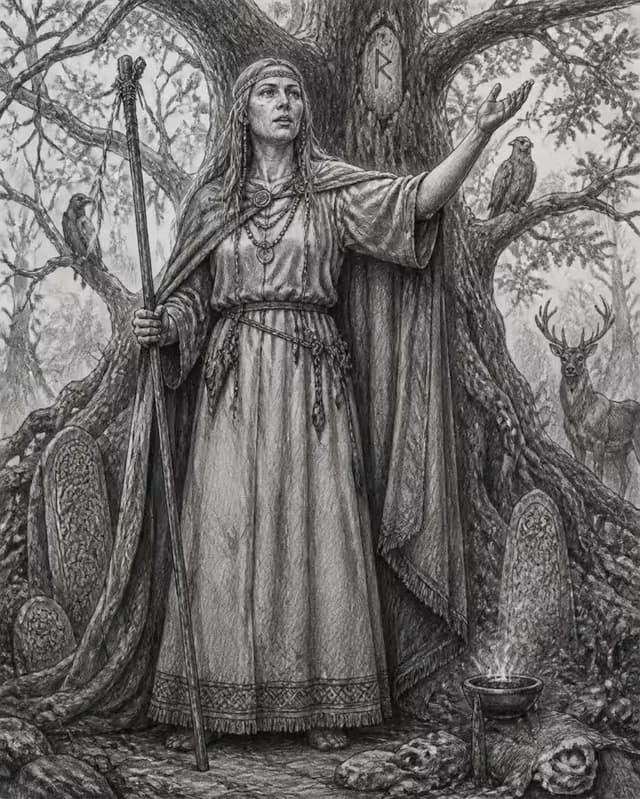
Imagine a small village far from the noise of the city. Evening has fallen. Some are ill, some are afraid, and some have lost their direction in life. Instead of seeking answers in a book or at a hospital, the community may turn to a person who knows the rituals, the songs and the signs. This person is not necessarily a priest in the usual sense, but an intermediary figure. One who can listen, negotiate and carry messages between the human and the spiritual.
In this way the shaman becomes a figure standing with one foot in everyday life and one foot in the invisible. It is precisely this duality that makes the figure so fascinating. The shaman is not only a mystic, but also a practical helper. Not only a dreamer, but also one who acts. Not only one who sees, but one who translates what is seen into something others can understand.
In many stories it is precisely in the encounter with illness, grief or chaos that the shaman steps forward. When ordinary explanations fall short, the ritual becomes a space where people can breathe a little more freely. There it can be said aloud that something has gone wrong, that something must be restored, that a person must be helped back to themselves.
A word with many layers
The word shamanism has a long and complicated history. It was used by scholars to gather various forms of religious ecstasy, healing and spiritual contact under one concept. But the word is not neutral. It bears traces of how European scholars, especially in their encounters with non-Christian traditions, tried to explain other cultures' ways of life through their own ideas of religion and order.
For this reason shamanism is a word that both opens and closes. It opens because it makes it possible to speak of rituals, trance, healing and mediation across cultures. But it also closes, because it can make very different traditions seem more alike than they really are. When everything from Siberian rituals to Indian village practices and modern neo-spiritual movements is called shamanism, much of what is distinctive can be lost.
Even so, the term has gained wide currency. This is perhaps because it points towards something many people recognise across languages and traditions: the sense that life cannot always be understood linearly. That a person can be more than one thing. That there are experiences that find expression only through song, ritual, symbols and body.
The shaman as healer
One of the strongest images in shamanism is the shaman as healer. Not only as someone who eases symptoms, but as someone who helps people back to balance. The shaman is often described as a person who helps reunite the sick with their spiritual cosmos, so that the suffering can take its place within a larger picture.
This is a different way of thinking from the purely medical. It does not necessarily say that illness is only psychological or spiritual, but that the human being can be understood holistically. The body, the emotions, the kin, the landscape and the spirit world hang together. When something breaks down, the healing too must take place on several levels at once.
This is why the ritual takes on such significance. A ritual is not merely an act performed for show. It can be a way of gathering energy, creating meaning and giving a person the experience of being seen and met in their pain. In many traditions it is precisely this that makes the ritual effective: it gives form to what is otherwise chaos.
Trance, song and voice
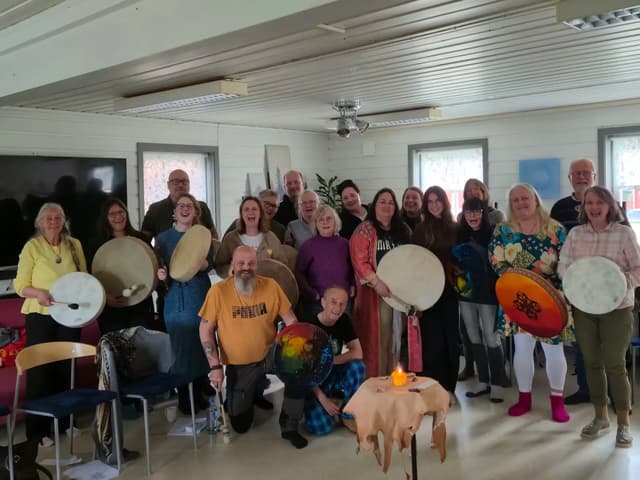
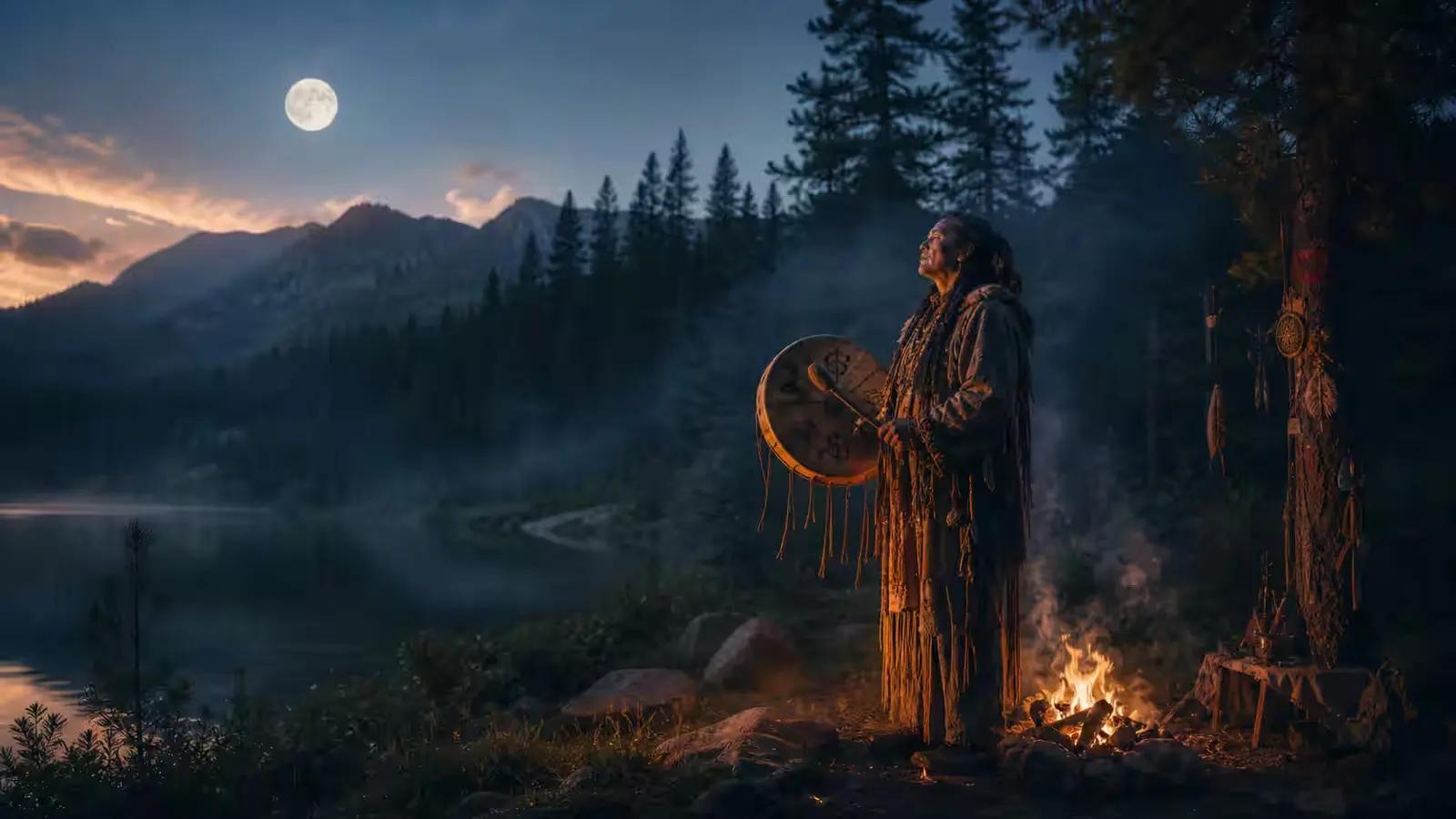
Many associate shamanism with trance. This is no coincidence. Trance is often about a state in which ordinary boundaries loosen: between waking and dreaming, between control and surrender, between body and spirit. In such moments, song, rhythm, drums and repetition can lead the practitioner into another form of presence.
But trance is not only a dramatic expression. It can also be understood as a tool. A language. A way of opening up attention. Scholars have described shamanism as a form of "altered states of consciousness", that is, states of consciousness different from everyday awareness. What is central to this understanding is not loss of control, but control over the transition into and out of the state.
This makes the shaman's work more complex than many outsiders believe. It is not necessarily chaotic. On the contrary, it can be strongly structured, deeply learned and shaped by generations of practice. Behind the apparent spontaneity there often lies strict discipline, social trust and a detailed understanding of how the ritual is to hold.
The stories of origin
Scholars have tried to explain where shamanism comes from, and why it is found in so many different cultures. Some have linked it to Central Asian traditions, others to Siberian milieus, others again to more far-reaching mythological patterns that stretch far back in time. Such theories can be inspiring, but they also show how difficult it is to gather everything under one historical explanation.
In the Indian context, shamanism was linked, among other things, to non-Brahmanic, Buddhist and wandering ascetic traditions, which are associated with the Shramana. Here lies an interesting bridge between spirituality, asceticism and healing. It suggests that what was later understood as shamanic was not only about ecstasy, but also about disciplined ways of living, movement and a different way of being in the world.
Such stories of origin are important because they tell us how people try to give meaning to what seems old, enigmatic and deeply rooted. But they can also become too simple. For shamanism is not one thing with one source. It is rather a whole landscape of practices, ideas and experiences that have lived different lives in different cultures.
India, the villages and the everyday sacred
In India, shamanism has taken on a particularly complicated place. Here the word is often used for village-based practices, Adivasi traditions, mediumship, exorcism and healing connected to gods, spirits and local rituals. At the same time, the text emphasises that the distinction between healer, medium, exorcist, herbalist and ritual leader is often blurred.
This is an important point. In real life the categories are rarely as tidy as in academic books. The same person can be a herbalist, an adviser, a ritual practitioner and a source of social support. The same practice can be medicine, prayer, magic and social care all at once.
In such milieus it is also not necessary to draw a sharp line between the religious and the practical. A prayer can be a treatment. A song can be a protection. A ritual can be a way of restoring relationships. The everyday and the sacred flow into one another.
When scholars create frameworks
An important point concerns how scholars have used shamanism as a framework of explanation, but also how this framework can become too narrow. Some scholars see shamanism as a useful concept for understanding ritual, liminality and healing. Others criticise it for being a product of colonial and Christian perspectives, in which non-Christian forms of religiosity are portrayed as more primitive, more bodily or more exotic.
This criticism is essential. It reminds us that when we describe a tradition, we often also describe ourselves. What we call religion, what we call healing, what we call culture and what we call superstition says a great deal about our own values.
This does not mean we should stop speaking of shamanism. It means we must do so carefully. We must ask: who uses the word? In what context? Which differences are erased?
Shamanism and modernity
In the modern world, shamanism has been given new life in many contexts. Some seek it as a path to personal development. Others see it as a method for coming into contact with nature, the body or a deeper dimension of themselves. Some find inspiration in traditional cultures, while others use the word more loosely and symbolically.
It is easy to understand why. In a time when many experience stress, fragmentation and distance between human and nature, shamanism can appear as something whole and down to earth. It does not necessarily promise an easy solution, but a way back to connection. To rhythm. To presence. To a world where the human being does not stand alone.
At the same time, one must be aware of the danger of romanticising. Not all forms of shamanism are peaceful or harmonious. Many are also bound up with conflict, social control, gender power, hierarchy and struggle over interpretation. It is therefore important to write about shamanism with both warmth and clarity: with respect for the experiences, but also with an understanding of the complexity.
A language for what cannot be measured
One of the reasons shamanism still arouses interest is that it points towards experiences that cannot always be measured with ordinary instruments. Fear, grief, healing, dreams, presence, visions and the relationship to the dead or the invisible can be decisive in a person's life, even though such experiences are difficult to place within a purely scientific framework.
Sudhir Kakar tried to write about this with psychological sensitivity, and showed how healing in Indian traditions can be linked to self-understanding and plurality in the self. This is a useful thought outside India too. Perhaps this is precisely how rituals work: not by abolishing reality, but by making it more habitable.
When people gain the experience of being seen by something greater than themselves, it can create calm, direction and new room in life. It may be through a song, a symbol, a ceremony or a dimension of encounter that opens up hope. Shamanism holds many such moments.
Between tradition and interpretation
The most interesting thing about shamanism is perhaps precisely that it always stands between one thing and another. Between old practice and modern interpretation. Between local experience and academic theory. Between body and spirit. Between healing and language.
This is why the term is so difficult to use, but also so fascinating. It cannot be reduced to a single definition. At the same time it refuses to disappear. Each time people seek meaning in crisis, seek community in unrest or try to understand the connection between the visible and the invisible, shamanism returns as a possible answer.
Not as a fixed answer. But as a living trace.
References
Stone, A. (2003). Explore Shamanism. Loughborough: Explore Books.
Berman, M. (2009). Shamanic Journeys Through Dagestan. Ropley Hants: O Books.
Eliade, M. (1972). Shamanism: Archaic Techniques of Ecstasy. Princeton, NJ: Princeton University Press.
Witzel, E. J. M. (2012). The Origins of the World's Mythologies. New York: Oxford University Press.
Hutton, R. (2007). Shamans: Siberian Spirituality and the Western Imagination. London: Hambledon Continuum.
Hultkrantz, Å. (1996). Shamanic Healing and Ritual Drama: Health and Medicine in Native North American Religious Traditions. New York: Crossroad.
Narby, J., & Huxley, F. (Eds.). (2001). Shamans: 500 Years on the Path to Knowledge. New York: Penguin.