There are texts that not only tell a story, but open a door into a whole world. Völuspá is such a text. It stands first in the Poetic Edda, and for centuries it has fascinated readers because it seems both ancient and alive, obscure and clear, simple and incomprehensibly rich in meaning. In the poem a seeress steps forth and speaks with a voice that is both personal and cosmic. She tells not only of the world's beginning, but also of the gods' greatness, of the world's destruction and of a new world that springs forth after all the old has perished. Catharina Raudvere points out that the poem is both visionary and didactic, literary and mythological all at once.
This makes Völuspá something more than a poem. It becomes a kind of journey through the Norse imaginative world, where everything hangs together: creation, fate, power, ritual, violence, order and chaos. At the same time the text is not a neutral window into "genuine" pagan religion. It was written down in the thirteenth century by Christian Icelanders, and it bears clear traces of a world that had already been interpreted, shaped and retold by people with their own time and their own interests. It is precisely for this reason that it is so fascinating. It is not merely an old echo; it is also an edited memory, a poetic construction and a cultural heritage that has survived because it was told anew.
A voice that demands silence
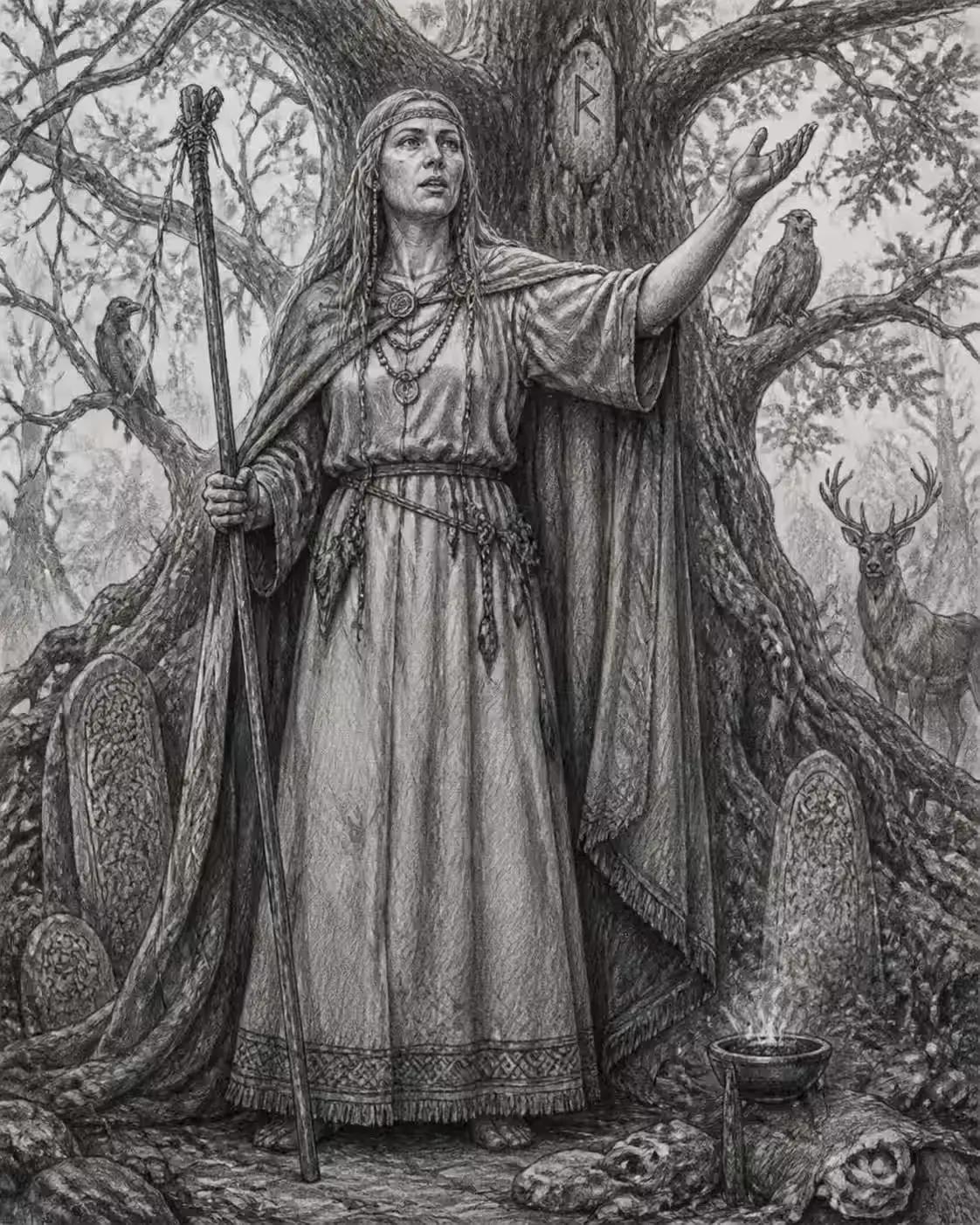
The poem opens with a voice that does not ask for attention timidly. It demands it. The seeress addresses both gods and humans and bids them be silent and listen. It is a striking beginning. In Norse literature it is not common for a woman to speak with such authority to high and low at the same time. She stands in no one's shadow. On the contrary, she comes as a figure who knows more than the others, and what she knows is no small matter. She knows the world's deepest past and its most dramatic future.
Raudvere emphasises that the seeress's voice is closely connected to Odin, the most ambiguous and powerful of the Norse gods. Odin is god of war, god of wisdom, god of death and god of poetry all at once. He is both the one who rules and the one who seeks knowledge beyond the ordered world. In the poem it is precisely the seeress who makes his project of knowledge possible. She is the instrument that lets him, and us, come to know what is otherwise hidden. According to Raudvere, the text suggests that Odin has bidden her speak, and that he later gave her jewellery as payment for performing seiðr and revealing still more. Here lies something important: knowledge is not free, and it does not come from a pure and calm order. It comes from the edge, from the strange and the unsettled.
This is precisely why the poem's first lines feel so strong. The seeress is not a random narrator figure. She is an authoritative bearer of cosmic insight. She speaks as if the whole order of the world rests on what she is now about to say. And in a certain sense it does.
The seeress as a ritual figure
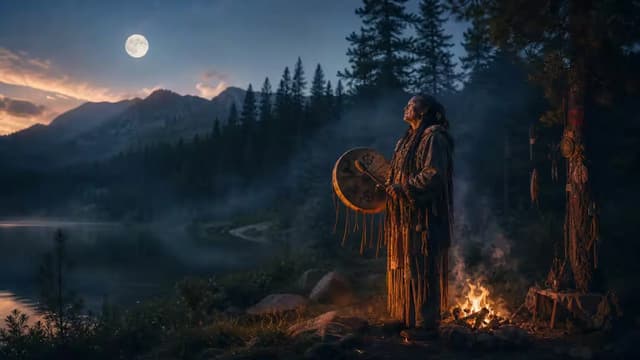
In the text the seeress is both mythic and concrete. She is a figure in the story, but also an echo of a real ritual practice. Raudvere reminds us that women who could see into the future are, in the sagas and other texts, referred to as seiðkona, völva or spákona, and that such figures were connected to rituals that had to do with fate, harvest and the future. This belongs under the broad concept of seiðr. In this way the poem becomes more than mere fantasy; it ties together notions of magic, knowledge and social power.
Nevertheless, Raudvere warns against reading Völuspá as a direct report from an actual ceremony in pre-Christian times. The poem is not a "thousand-year-old ethnographic record". It is a literary construction, made by a male skald who creates a scene in which a seeress speaks. This does not mean that the rituals are invented from scratch, but that they have been transformed into poetry. It is important to hold on to that duality. The text is rooted in a cultural practice, but it is at the same time a work of art.
This blend of ritual and poem makes Völuspá especially interesting. The seeress stands in a position that recalls the skald's, the professional poet's, role in the chieftain's hall. She speaks as one who knows, and those who listen must be silent and attend. It is a form of authority that rests on the word, not on weapons. And precisely for this reason she is so well suited to tell of gods, fate and the course of the world. Words can carry the cosmos.
The cosmos in motion
The most striking thing about Völuspá is perhaps that it does not merely give us individual stories about gods. It gives us a whole cosmic structure. In the poem we meet Odin, Freyja, valkyries, dwarves and elves; we meet creative power, salvation, conflict and destruction. It is as if the whole universe is opened in one long vision. But this vision is not systematic in the modern sense. It is fragmentary, saturated with symbols and full of leaps and allusions. The poem assumes that the listener already knows many of the stories.
Raudvere points out that the poem follows a chronological movement from creation to destruction. First comes nothingness, then the emergence of the world, then the coming into being of humans, and finally Ragnarök. But at the same time it is not a purely historical narrative. It is a poetic organisation of time, in which the cosmos comes into being and dissolves according to a fated rhythm. This is not a world governed by morality as we often imagine it in Christian stories. It moves towards the end because it lies in its nature and in its fate.
The poem's strength lies precisely in this sense of inevitability. Everything seems at once to be born of order and at the same time already marked by destruction.
In the beginning there was nothing
Like many other creation myths, this one too begins with emptiness. In Völuspá the first state is Ginnungagap, a gap, a void, a primordial state without form. This is not a world where things simply exist. Here the order of the world must be built up piece by piece. But while Snorri's prose account explains how ice and fire meet, and how the primeval giant Ymir is formed and then killed so that the world can be built from his body, Völuspá is far more concentrated. It mentions Ymir, but without long explanations. It is as if the seeress merely points to a great truth and expects the listener to fill in the rest.
It is here that the oral character becomes clear. Raudvere emphasises that the poem bears traces of an oral tradition, in which repetitions, fixed expressions and terse allusions are part of the form. What in a written modern text might have seemed unclear was, in an oral performance, an invitation to recognise and recall. The audience were not passive readers, but active co-creators of meaning.
This is also why Völuspá can seem so strange and so near at the same time. It speaks in short and charged images, but these images open doors to larger stories that the audience must already have known. The text is like a key ring with many small keys, but without all the locks being explained alongside.
The gods build the world
After the emptiness comes the creation. The sons of Bur are active in the world's coming into being, and Snorri helps us understand that these are Odin, Vili and Vé. In the poem they are not set out in detail, but they act. They lift land from the sea, create Midgard and bring order to the world. It is a powerful image: the world does not merely come into being, it is established as a place with boundaries and form.
What is given the most space in this part of the poem, however, is the celestial phenomena. The sun, the moon and the rays of light create growth and time. The divine powers sit in council and assign names to the heavenly bodies. Here Raudvere sees a connection between cosmic order and social form: the gods act as at a thing, that is, as in a political and legal assembly. It is a fine point of observation. The order of the world mirrors the order of society. When the gods consult and name, it is not only light and time that are created; structure, authority and collective decision are also created.
This gives the poem a political resonance. It is not only about myths in an abstract sense, but about how an order is established and maintained. The gods build not only temples and holy places, they also build a model for how power can be organised. In this lies much of the poem's force. It tells of the cosmos, but it also says something about the society that thinks the cosmos.
Dwarves, humans and fate
In the midst of all this the dwarves are given a long and conspicuous place. A whole eight stanzas are devoted to lists of dwarf names. To modern readers this may seem strange. Why so much space for names? But the names are not merely names. They carry associations to directions, celestial phenomena, craft and creative power. They form a layer of their own in the cosmos, and they point towards a world of design and craft. It is no coincidence that the dwarves in Norse tradition are often connected with art, smithing and creation.
When the humans then enter, it is again Odin who stands central, now together with Hænir and Lóður. Ask and Embla lie there as dead pieces of wood, without fate and without life. The gods give them breath, spirit, blood and a likeness to the gods. It is a short and powerful creation story. The human is not magnificent in itself; it comes into being through a gift. It receives life and form through divine action.
Raudvere points out that fate is a fundamental condition throughout the poem. To have a fate is something all beings share. At the same time the ability to know fate is a coveted quality. In Völuspá this is very important. The cosmos is not random. It is permeated by predestination. Yet the humans are not given a long and detailed place. They are there, but they are not the centre. The poem is first and foremost concerned with the great forces that shape the world.
Beside the creation of humans stands also Yggdrasil, the world tree, as a load-bearing structure. At the foot of the tree sit the Norns, who give laws, life and fates to humans. This is one of the most beautiful and concise images in the whole poem. It gathers the cosmic, the biological, the existential and the social in one movement: first life, then form, then fate.
Order is never safe
Even in the creation, dissolution lies smouldering. Raudvere stresses that Norse cosmology in Völuspá must always be understood in the tension between order and chaos. After the gods have established the world, signs nevertheless appear that the world is not entirely safe. Three mighty giantesses come from Jotunheim to the gods' Midgard. No explanation is given. But the visit itself reminds us that the world is not closed. Outside there are still forces that cannot be tamed.
This is an important point. Norse cosmology is not a smooth and harmonious model. It is full of boundaries that can be broken, and of powers that can always return. The giants are not merely "villains". They also represent what came before and what can never quite be abolished. Where the gods try to build, there is always something threatening to break in.
The poem therefore creates a constant unease. Even as the world is built, it is already on its way towards its ruin. And precisely this makes Völuspá so deeply human. We recognise the feeling of building something we know is more fragile than we wish to believe.
Ragnarök comes
It is clear that what truly interests the poem is not only the creation, but the destruction. Raudvere says outright that most of the attention is directed towards the world's destruction. This does not mean that the creation is unimportant, but that it serves as the foundation for understanding what is lost. Ragnarök is not a random collapse. It is the opposite of the world order, the reversal of the ordered structure. What was built is torn down.
Ragnarök is foreshadowed early. Odin is called Valfather, the one who takes the fallen to himself. In the poem the destruction lies already in the god's name. And when the seeress later begins to ask her repeated question – "Do you understand yet, or what more?" – the reader knows we are heading into a series of catastrophes. The question is repeated six times and functions as a kind of rhythmic hammer. Each time a new vision of destruction comes. It is as if the seeress drives us forward towards the end, piece by piece.
It is not human sin that triggers Ragnarök. It is fate. This makes the story darker, but also more tragic. For if the destruction is not due to moral decay, but to the world's own structure, then there is no simple solution either. The poem does not say that everything goes wrong because humans are bad. It says that everything goes wrong because the world's course is as it is destined to be.
At the same time the poem lets us feel that social unrest and the breaking of relationships are nevertheless connected to the destruction. In one of the stanzas a time is described where brothers fight against brothers, where swords and knives reign, and no one spares anyone. This can be read as an apocalyptic experience of the present: an image that at any time can seem near to one's own day. Even though this is not the cause of Ragnarök, it is a sign that the world is on its way down.
The forces of chaos
When the destruction first begins, the dark forces come in a throng. Balder's death functions as a portent and as a moral rupture within the world of the gods. Loki is punished and portrayed as evil itself. Then forces break loose from the north and east, the wolf attacks, the Midgard serpent is set free, Fenrir runs loose, and Garm howls. Behind several of these figures Raudvere senses variations on Loki. It is a good reminder of how Norse mythology works with mirrorings and doublings. Evil has many faces, but it often comes from the same root.
It all culminates in the great battle where Odin, Freyr and Thor go against the strongest powers of chaos. Odin kills the wolf, but dies himself. Freyr fights against the fire giant Surt. Thor kills the Midgard serpent, but falls after nine steps. After this the sun turns black, the earth sinks into the sea, and the stars cease to shine. Everything returns to the original nothing. Here it is not merely a catastrophe, but a complete dissolution of the cosmic order.
It is hard to read these lines without feeling their force. The images are brutal and simple. They are not psychological, but cosmic. They do not tell how anyone feels. They tell what happens to the world itself.
A new world
But Völuspá does not stop at the darkness. After the ruins the seeress sees something new. The earth rises again from the sea, green and alive. The Æsir gather on Iðavöll, but now it is a new generation of gods that leads. Balder returns, and Odin-runes and old wisdom are still found in the grass. There is, then, a return, but it is not simple and complete. Raudvere emphasises that this is no paradise. The new landscape is not a finished heaven, for Niðhögg too, the dragon that carries corpses in its feathers, is still there.
This is an important nuance. The world does not become perfect. It merely becomes new. Even in the return there are remnants of chaos. This makes the ending less triumphant and more open. The new is not the same as the perfect. It is rather a continuing world, where the balance between order and unrest persists.
This makes the poem's ending both beautiful and unsettling. The seeress speaks her final enigmatic words that she must sink down. Is it she herself who disappears? Is it the earth? Or is it the ritual and the vision that cease? The text leaves the question open. And in this openness lies something of the poem's endurance. It does not close everything. It keeps the door ajar.
Why the poem still works
It is easy to understand why Völuspá has fascinated so many. Raudvere describes the reading as overwhelming, because the poem is at once direct and inaccessible. It is precise, but full of riddles. It requires the reader to know the mythology, yet at the same time awakens precisely an interest in this world. In this way the text functions almost like the seeress's own role: it points, alludes and opens.
There is also something deeply modern about the poem's way of thinking about time. The world is created, perishes and is reborn in a cycle. It is not a linear story of salvation where everything leads towards a final goal and a completed harmony. It is a rhythmic world, where building up and breaking down follow one another. This gives the text a character of both grief and endurance.
For a reader today this may be precisely what makes the poem so strong. It does not merely say that the world can collapse. It says that collapse too is part of the world's order. And at the same time it shows that after the ruin something new can come, even if not entirely free of old unrest.
The seeress as bearer of the message
Raudvere concludes by stressing that the seeress's role is utterly decisive for the poem's form and message. She is not merely a narrating figure, but a bearer of the whole mythic architecture. Through her we receive a story of the world from beginning to end. She is thus at once figure, ritual, artistic device and bearer of authority.
It is easy to think that Völuspá is about gods. But in a deeper sense it is about how knowledge is given and received. Who can speak about the world? Who can see fate? Who can lay forth what lies hidden behind the ordinary? In this poem the answer is the seeress. She is the voice that connects the human with the cosmic, and it is through her that Odin gains the insight that makes him who he is.
At the same time she is not merely an instrument. She is also an independent power. She stands at the poem's centre with her knowledge, her dark authority and her ability to see both backward and forward. She is a figure who points both towards ritual and towards poetry, towards reality and towards art.
References
Catharina Raudvere, "Vision, ritual and message. The universe of Old Norse mythology as reflected in the poem Völuspá" (2012).
Ursula Dronke (ed./trans.), The Poetic Edda (1997)
Neil Price, The Viking Way (2002)
Catharina Raudvere (2003, 2005, 2007, 2012)
Stephen Mitchell (2011)
François-Xavier Dillmann (2006)
Clive Tolley (2009)