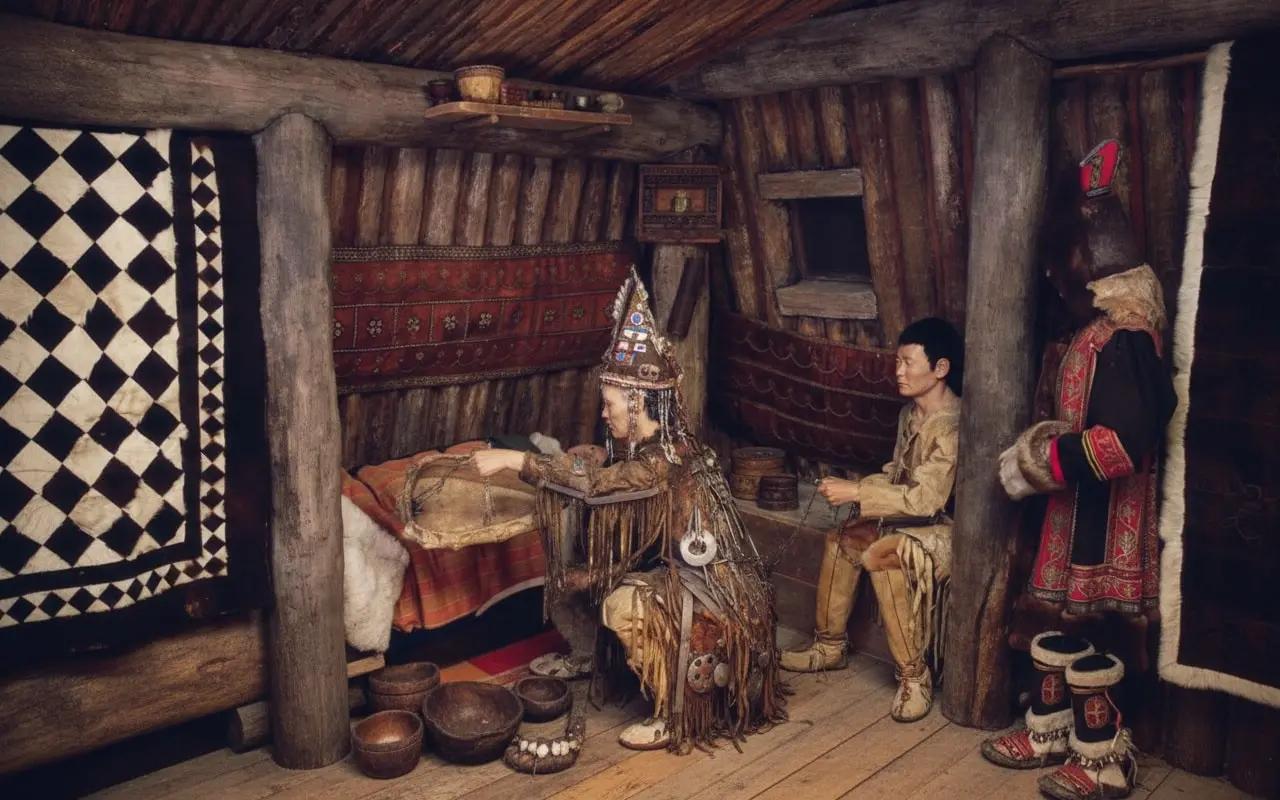
Far within the world's largest forests in northeastern Siberia, where the rivers wind like silver bands and the sky dances with northern lights, an ancient power streams out of the earth. In the Sakha Republic – Yakutia – there once lived some of the world's most powerful shamans, guides between humans and spirits. Now, on the threshold of a new age, the magic awakens again. And it is young Sakha people who stand at the very center of events – those who build bridges between past and future.
Childhood in the shadow of old drums
Most Sakha grew up to the sound of old myths – stories of the aiyy oiuun, the white shamans, who called upon good spirits, and of the abaahy oiuun, the black shamans, who drove away illness and evil powers. Grandparents told of summer nights when drums rolled across the plains and where every single stone and river had its guardian spirit. The children listened with wide eyes, but the passage of time carried the traditions into the mist of forgetting. Christian mission and the Soviet regime pressured people to forget. Songs and rituals were forbidden; the shaman's drum fell silent, and many parents sent their children to schools where their mother tongue was forgotten.
Among the young a new grief arose – not only over the loss of language and rituals, but over the absence of the deep roots that could give strength and meaning. Many felt like strangers in their own land, and the dreams of going to the places of power in the forest were exchanged for foreign dreams.
Historical adversity and the shaman's ability to stand upright
The shaman's role in society was no small matter. From ancient times the shaman has stood as a guardian of balance – between humans, animals, plants and the unseen spirits. The initiation was anything but easy: often the shaman-to-be was struck in their youth by illness or other trials, and in deep visions they were “dismantled” by spirits before being reassembled – stronger, more clear-sighted, and able to help others by conveying knowledge from nature's mysterious cycles.
The ability to heal was not only magic, but also language, poetry and the wisdom of life. The best shamans became known for “cleansing” the soul, restoring balance and offering people renewed strength through dance, music, trance and storytelling. All of this was almost lost when those in power introduced strict rules against the rituals, and forced the Sakha to distance themselves from their own healers.
Freedom and courage – The awakening of the new spirit
Not until the 1990s, after the fall of the Soviet Union, did new possibilities open up for the Sakha. For the first time in generations, people could celebrate yhyakh – summer's great festival for the spirits – and sing, dance and pray in the Yakut language. No one needed to hide their identity any longer. Society slowly rose with new confidence, and the children were once again allowed to learn about their own roots in school. Organizations for revitalization grew forth, and people began to research and teach dance, song, food and old rituals in order to understand who they really were.
Kyta Baaly and the journey to the primal power – Young voices find the soul
A shining example comes from the village of Megino Kangalask ulus, where Kyta Baaly has led his own movement. He started from a modest background, but with a deep love for the landscape and the spirits. Together with other young people he gathered folk for private festivals where the aim was to build community and convey power, joy and healing.
Imagine a summer evening when you stand in a dancing ring around a fire, hearing the prayers rise toward the sky. A rainbow breaks the darkness after the rain, and people feel that the whole community awakens to life. Kyta Baaly throws kumys (fermented mare's milk) toward the earth to nourish the spirits, and ancient poems are improvised rhythmically. Yin-yang paintings symbolize the balance between man and woman, light and darkness, and draw references from ancient Sakha motifs. Young and old share joyful cries, but also tears over rediscovered fellowship. The atmosphere is filled with tension, respect and hope.
The feelings of the young and the new confidence
For young Sakha who have grown up in the digital age, the discovery of shamanism has often been like winning a treasure they did not know existed. One young person says: “Before, I felt empty, but now – in the middle of the dance around the fire – I feel that we are one people. We are not just from Sakha, we are nature itself.” Grandparents look on with tears in their eyes – their grandchildren now sing the songs they themselves once feared were lost.
Some of the young experience strong spiritual experiences during the prayers, with light glittering over the water and ancestors said to appear. Others find a new calm, a community where everyone, regardless of background, is included and important. That feeling of belonging gives courage to face life's challenges together, and creates lasting friendships.
The rituals – the power behind the festival
At the center of the revitalization stand the rituals and the symbols. Praying and singing together, casting offerings to the spirits and retelling old myths builds community. Kyta Baaly says: “I want everyone to feel that I protect them – just as the earth protects us all.” He sees himself not as a superhuman, but as the head of the family for the whole region. He teaches his followers that true strength is being able to give care, to heal and to make the gifts of nature available to all.
The initiatives are also about removing shame and fear. Through healing poetry, dance and words, the community releases everything that was bound – and creates room for play, laughter and comfort. For some, the rituals have become the rescue from loneliness, racing thoughts and unrest.
Language, poetry and music – the magical place
Language stands strong in the new movement. Not only as communication, but as a carrier of magical power. The prayers – algys – are performed in Yakut, and even the youngest learn to improvise poems and songs inspired by the spirits. A young boy says: “When I speak the old words, I feel my body grow warm, as if the earth is answering.” Nature and language are woven together, and give the landscape meaning and power – the names of rivers become spells, the names of mountains become protectors.
Through poetry, many experience rediscovering their place in the world. Words and rhythms give strength to face modern life, and old wounds can heal. Songs about heroes and spirits are composed anew, with modern tones and traditional motifs – and shared on social media, so that the community grows.
Nature's hierarchy – healing and balance
A large part of the revitalization lies in the view of nature – that everything is connected, and that every child, every river, every stone has its place in the great family. The spirits hold sway, but only those who understand their role as protectors receive the full power. Kyta Baaly warns: “Nature is calling to us. If we do not learn to protect our land, the animals and the plants, imbalance and misfortune will grow.” This gives the young a responsibility – they must safeguard the landscape, take care of one another, and make old rituals a part of their everyday life.
The festival yhyakh and other rituals form not only a symbolic landscape, but also a physical space where health, balance and community are created in practice. Together they shape a hierarchy in which nature, spirits and human care stand highest – and give strength to all.
From division to healing – the journey back
The revitalization is not only about learning old rituals, but about mastering today's adversity together. The Soviet regime's division of families led to the loss of cohesion. With the new shamanism, the young receive tools to breathe together, speak together, and understand that no one stands alone. Through the circle dance and the fire they experience old wounds healing, and new friendships forming with strength from both spirits and nature.
The inner power, conveyed by Kyta Baaly and the spirits, gives courage to face the future. The festivals are not only celebrations, but real experiences of overcoming fear and building community.
The many layers of shamanism – historical depths and modern dreams
Shamanism among the Sakha is not static. It has historical layers stretching thousands of years back, with roots in Paleolithic times, and traces of ancient healer burials. And yet, each generation colors the tradition with its own longings and dreams. The movement for revitalization is not only a recapitulation of the old, but also an innovation. The festivals at first counted only a few, then hundreds, and eventually thousands who made use of both traditional and digital platforms – with poetry readings on TikTok and prayers filmed for YouTube.
The organizations that grew forth after 1990 have invested heavily in making room for the young – not only as spectators, but as active practitioners. Schools, museums, networks and local communities arrange their own courses, festivals and experiences, where children and young people refine old techniques, improvise new prayers and songs, and build further on the primal power.
A modern shaman – technology and community
Modern shamans such as Kyta Baaly have made use of everything from traditional drum dance to platforms like Messenger, so that young people from all over Sakha can take part. Some festivals are livestreamed, where poems and circle dances are shared in real time. This builds a bridge between villages and cities, between generations and worlds. Grandparents can follow along from a distance, and grandchildren forge new bonds over the internet.
With the help of technology, the community expands to include both urban and rural Sakha, and the revitalization is more strongly tied to the global movement for Indigenous rights, environmental protection and healing.
The inner secrets of the rituals – an analysis of the healing
In Sakha shamanism, the healing takes place on several levels. The rituals often contain a triad:
Preparation, where the community gathers and gains insight into the intention (pre-disposition)
Empowerment, where people actually feel the power of the spirits and the strength of the community
Transformation, where beliefs, attitudes and bodily experiences are changed in order to restore balance and courage.
Through the circle dance, poetry, food and song, there is built not only healing of illness, but of community. People are helped to place their sorrows and joys in a landscape of meaning, and the formation of social trust strengthens both individuals and the whole society.
Magic, love and family – the heart of shamanism
Perhaps the most important thing, even so, is the feeling of love and family. Young people experience that everyone, regardless of background, is part of one great community. In summer the festivals create room for laughter, tears and care. Wounds heal, and each person's story becomes a part of the great story.
The shaman's power, whether as healer, counselor or protector, is about giving courage and security. Kyta Baaly says: “We are one family, and we protect each other.” This makes the rituals a source of both personal and collective strength – a foundation for building the future of the Sakha.
The primal power of the young and the living spirit
The revitalization of shamanism among the Sakha is no simple journey – but it is full of hope, love and courage. Young people find both challenges and strength, and the festivals become places where past and future meet in dancing sparks. The magic lives not only in old songs, but in the community that is built every time the fire is lit, the drum beats and the voice is raised in prayer.
The next time you stand in the ring around the fire, you may feel that you are part of an ancient story – a tale of courage, fellowship, nature and spirits. Shamanism has been given new life, and it will continue to grow as long as there are children and young people who want to dance, sing and heal together.
Sources
Goncalves, John. "Revitalization of Shamanism In the Sakha Republic." Field study of the shaman's role, the restoration of tradition, Kyta Baaly and festivals, with emphasis on healing, symbolic language and rituals. Academia.edu, 2017.
Yamada, Takako. "The revival of rituals among the Sakha‐Yakut and the Ainu in Hokkaido." Compares ritual revitalization between Indigenous peoples in Siberia and Japan. Scandinavian Journal of History, 2000.
Peers, E. "The Post-Colonial Ecology of Siberian Shamanic Revivalism." On the ecological and cultural context of new shamanic movements among the Sakha. Journal of Postcolonial Studies, 2015.
Goncalves, J. "Shamanic Revitalization: Kyta Baaly, Shamanic Rituals, Practices and Healing." A more complete analysis of the transformative power of shamanism, festivals and tourism after the fall of the Soviet Union. Brown University, 2012.
Balzer, Marjorie Mandelstam. "Healing Failed Faith? Contemporary Siberian Shamanism." A cultural-scholarly review of new shamanism and personal healing rituals in Sakha. Anthropology and Humanism, 2002.
Yamada, T. "Yakut (Sakha) Shamans' Concepts about the Universe and Spiritual Beings." An analysis of the worldview, spirituality and cosmology of contemporary shamans. University of Tokyo Press, 2015.
Mykhailova, Yulia. "An Ethnological Model for Assessing Social Evolution of Magico-Religious Practitioners." The connection between social conditions and new shamanic roles in Siberia. Social Evolution & History, 2025.
-1.avif)
-1.avif)