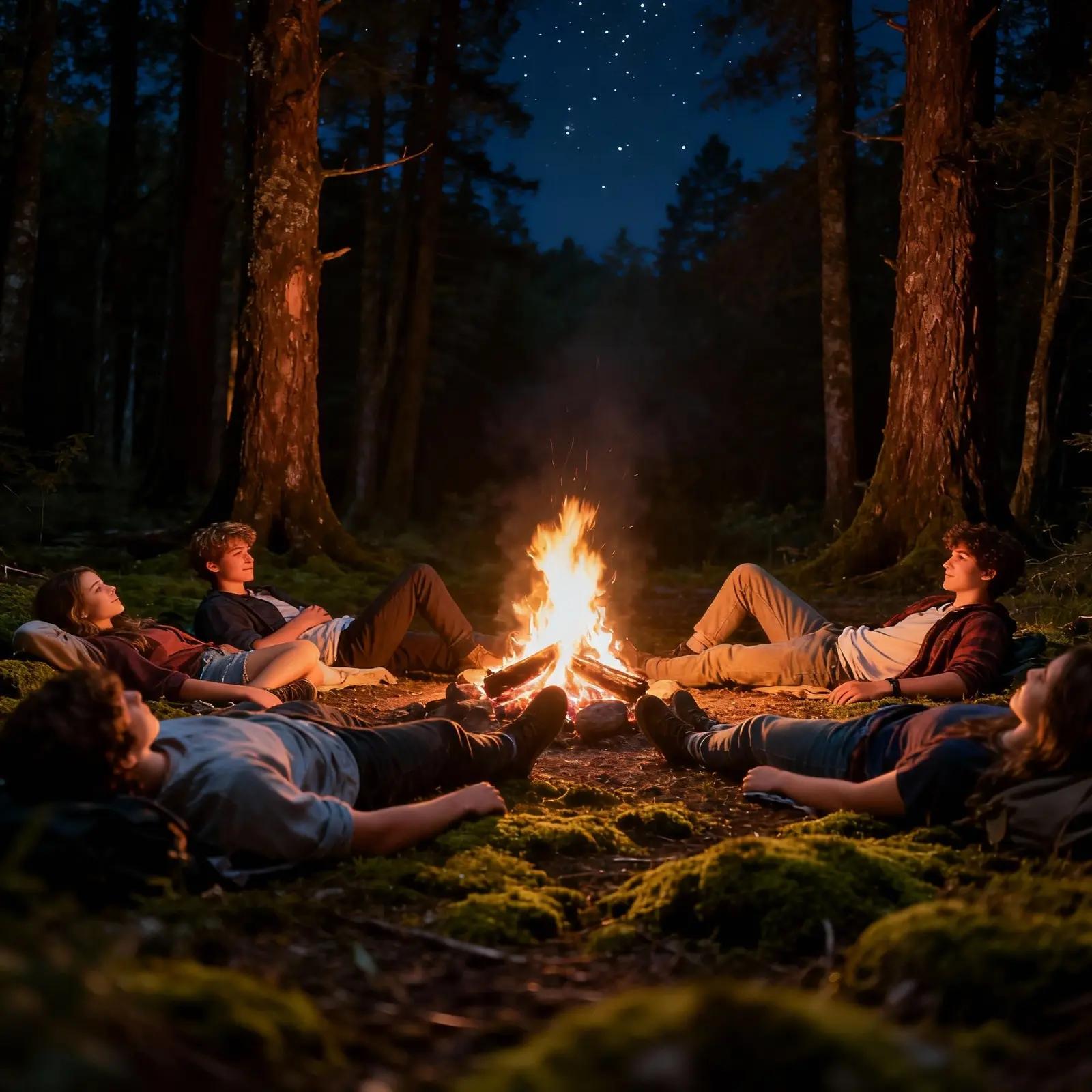
Just a stone's throw from the city lights, beneath mighty trees and a sky full of stars, a group of young people gather around a fire. They dance, drum and sing. Some throw themselves into ecstatic movements, while others sit silent and let the wind play in their hair. It may look like an ordinary camp, but this evening is something quite special. It is the young people's encounter with shamanism – an ancient practice that, for many young people today, gives new meaning, community and not least: a chance to explore themselves at a deep level.
Let us follow “Mari,” 17 years old. Mari does not exist in real life. Even so, her experiences are set down here to illustrate something real: they are based on the actual experiences of young people who have explored shamanic ceremonies, both in nature and in modern urban communities.
Mari – in search of something more
Mari grew up in the center of Oslo. She has always felt that there is “something more” behind the hectic, digital everyday – something that cannot be captured on screens or liked on social media. When she hears about a “shaman night” event for young people, she decides to join. A little nervous, but above all curious, she packs her bag and heads out into the forest with her friends. She does not quite know what awaits – only that she wants to find something real and alive, something that feels deeper than what everyday life can give.
What is shamanism, really?
Shamanism is one of humanity's oldest spiritual practices. The word comes from Asia, but shamanism has developed in parallel in cultures all over the world, including in Indigenous traditions north and south, east and west. The shaman is the link between the human world and what shamanic traditions call the spirit world, or the unseen forces behind all living things.
What does the shaman do? In the traditional understanding, the shaman is a guide who, with the help of drum, song and dance, enters an altered state of consciousness. There they retrieve insight, power and sometimes help for healing. But most importantly, the shaman functions as a bridge-builder between humans and nature, between individual and community, between the visible and invisible dimensions of life.
Why does this captivate young people today?
For many young people, shamanic gatherings are not about imitating old rituals point by point. They are about finding experiences that feel real, meaningful and engaging far beyond the light of the mobile screen. “Taking part in a shamanic ceremony was the wildest thing I have ever done,” says one of Mari's friends. “I felt that I really belonged, both in the group and in the nature around us.”
In a time when many experience stress, pressure and demands, shamanic techniques make room to explore feelings, release creativity – and not least: to be oneself, exactly as one is.
Altered consciousness – a door to the inner self
The core of shamanism is the ability to change “gears of consciousness.” This usually happens through the use of rhythms, dance, short periods of fasting, staying awake through the night, and what community provides. The body and the brain respond to such experiences, and measurable changes take place. When you dance or drum long enough, the brainwaves change – from quick logic to slower rhythms that make room for images, feelings and dreams.
For Mari it is the drumming that makes all the difference. At first she is shy – hardly dares to join in. But as the drums and clapping draw her into the flow, the body lets go. She closes her eyes, and in a flash she “sees” herself from above – surrounded by friends, a blazing fire and the night sky. It is not a hallucination or a fantasy, but an experience of being present in a new and different way.
“I felt both greater than myself and much softer. It was as if my whole body became one with the rhythm, one with everything around me,” Mari recounts.
Soul journeying and inner images
Many traditions describe the shaman's journey as a “soul journey” – a kind of inner expedition, in which a part of you leaves ordinary consciousness and ventures out into unknown terrain. For young people today, such journeys can be just as dramatic, if not more. To meet one's inner landscape, find counsel in symbols or animals in the mind, confront fear and doubt – all of this is real experience within a safe, ritualized community.
During the ceremony, Mari encounters a fox. It slips forward in the inner landscape she sees. The fox does not “speak” in words, but Mari understands that she does not always need to be so tough. She can be curious and careful, exploring new ways of being herself.
This is a classic feature of the shaman's world. To use symbols, animals and stories to work through one's own feelings, challenges and dreams.
Community and strength
Shamanic rituals are rarely a solo performance. They almost always take place in groups. Drumming, dancing and singing together creates community. The rhythms synchronize not only the movements, but also the feelings among the participants. For many young people it gives courage. “Here I suddenly didn't need to put on an act; there was room to be exactly as serious or childish as I actually feel at times,” explains another participant.
Research points to the fact that such experiences strengthen both mental health and social cohesion. When feelings are processed within safe boundaries, together with others, creativity, empathy and self-esteem are all awakened.
Dramatic adventures – but always safe
In shamanic practice the journey is often portrayed as an adventure: one may encounter storms, deep waters or dark forests in one's own inner images. But in reality it is all about meeting one's own feelings, thoughts and dreams in a safe way. The rituals have clear boundaries, and are led by someone with experience.
As Mari says after her first journey: “I met my own fear, but there was room for laughter, song and shared joy too. Everything happened within the safety of the group.”
Urban shamanism and ancient roots
Although shamanism has its origin in Indigenous traditions, it lives on in modern cities. Young people put together their own rituals – often with elements of both old and new: drums, contemporary music, poetry or even elements from gaming and popular culture.
Common to all of it is the wish to find something more – a community, a meaning, a connection to nature and to something that feels real in an otherwise superficial everyday life. Many say that shamanic practice today gives a pause from pressure, performance and constant distractions, and lets them explore who they are, on their own terms.
Practical techniques – how is the door opened?
Young people who explore shamanic journeys use, for example
Drum journeys: Simple, deep rhythms that shift attention and make room for new experiences.
Dance: Dancing freely and at length lets the body shed its inhibitions and gives the feeling of merging with others and with nature.
Song and chanting: Shared sounds and melodies strengthen cohesion and open the mind to inner images.
Night vigils: Staying awake together until late at night makes room for reflection and inner journeys.
Sincere conversation: Participants share their experiences – no one is pressured, and everything happens in trust and respect.
Science and shamanism – not a contradiction
Some believe shamanism is just fantasy. But modern psychology and neuroscience show that altered consciousness gives people the opportunity to handle feelings, traumas and life transitions in healthy ways. It is not dangerous or “abnormal” to experience deep feelings, irresistible imagination or strong physical reactions in such safe rituals. On the contrary, it can give better coping and understanding – especially for young people.
What do young people take away from it?
For Mari and the other young people, shamanism is seen as a journey into oneself, but also out into community with others and with nature. There is little focus on spirits – it is more about challenging oneself, daring to feel, daring to be vulnerable and at the same time discovering new sides of oneself.
The practice of the future?
Is shamanism the youth ritual of the future? Perhaps. For many, returning to the oldest techniques – to the sound of the drum, the fire and community under the stars – is exactly what is needed to find balance in a busy world full of distractions. In such moments, with the rhythm in the body and the presence of friends around the fire, many dare to get to know both themselves and the great, mysterious world we are all a part of.
Sources
Wikipedia: Shamanism – definition and traditional background
Sjamanistisk Forbund: What is a shaman? – overview of shamanic roles and practice
NAFKAM: Shamanism – scientific and religious understanding
Sjamanistisk Forbund: Is shamanism new religiosity or a living tradition?
Sjamanisme.no: Shamanism in today's culture and health perspective
Sjamanisme.no: What is shamanism and what is a shaman?
Medium.no: “Shamanism is experiences” – reflections on modern practice
Michael Winkelman: "Shamanism and the Alteration of Consciousness"
-1.avif)
-1.avif)