Sami spirit beings and nature's hidden world
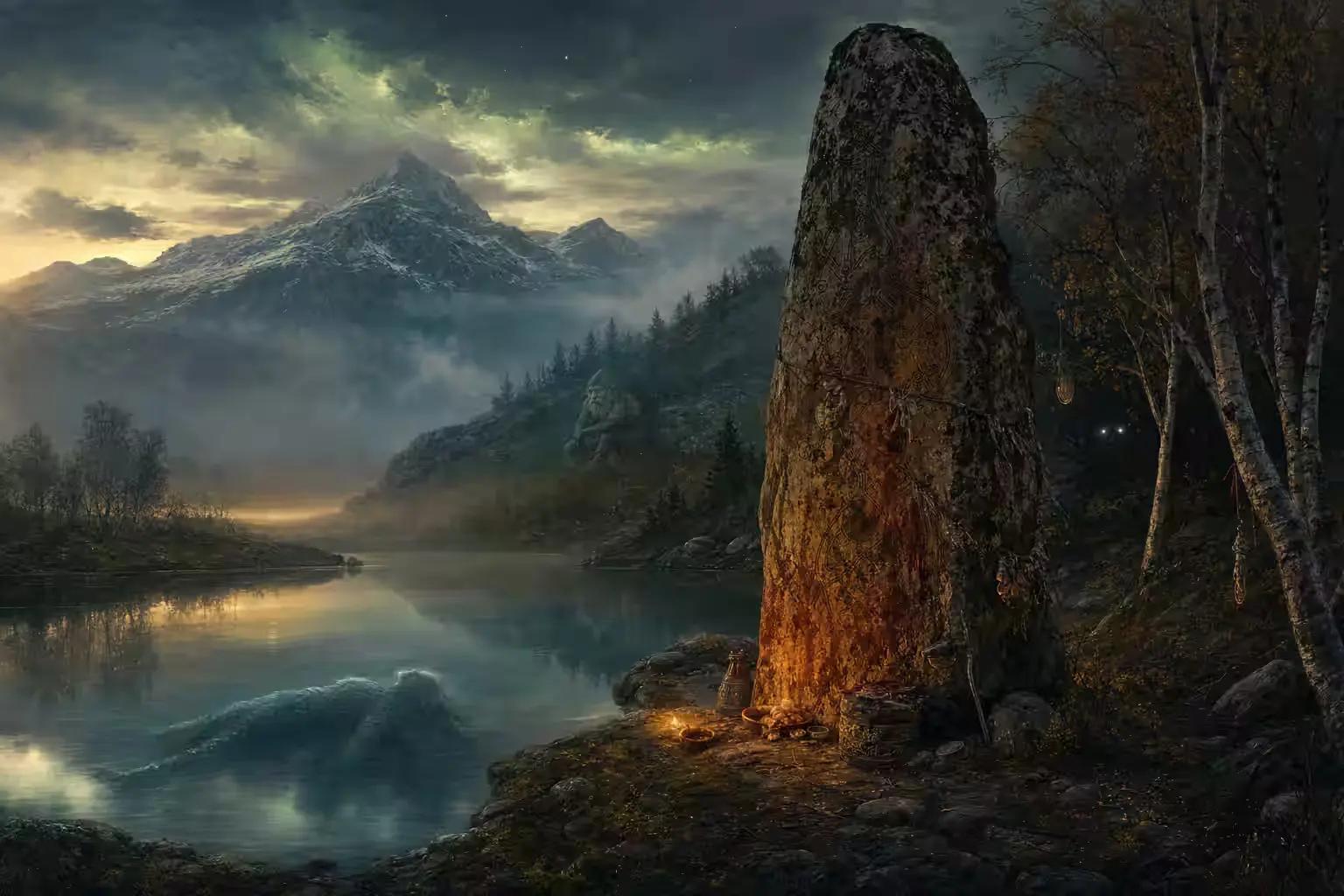
It is early morning in Finnmark. The light is pale and low, as it always is in the short northern summer. A man steps out of the lavvu, stretches, and looks out across the water. He says nothing, but he gives a barely visible nod towards a large, grey stone that juts up from the water's edge. His family has given gifts to that stone for three generations. No one has ever told him there is anything strange about it. That is simply how it is.
This small scene — a man nodding to a stone — holds the whole essence of what we today call Sami animism: a way of living that recognises the world is not empty. Nature is not a backdrop for human activity. It is inhabited, alive, and in active dialogue with those who live in it. From the fundamental perspective of understanding Sami spirituality, this is not superstition. It is knowledge — a diversity-economy of relationships between people and the many beings who share the world with them.
This article is an entrance into that world. Not an exhaustive list, but a walk through the terrain. Along the way we meet guardians who protect places and species, underground peoples who live in parallel with us, water spirits who pull the curious down into the deep, and the deceased ancestors who never quite stop being family. It is a world that is denser than ours, more binding, and in many ways more just — because it requires us to take responsibility for everything we surround ourselves with.
The stone by the water: Sieidi and the haldis
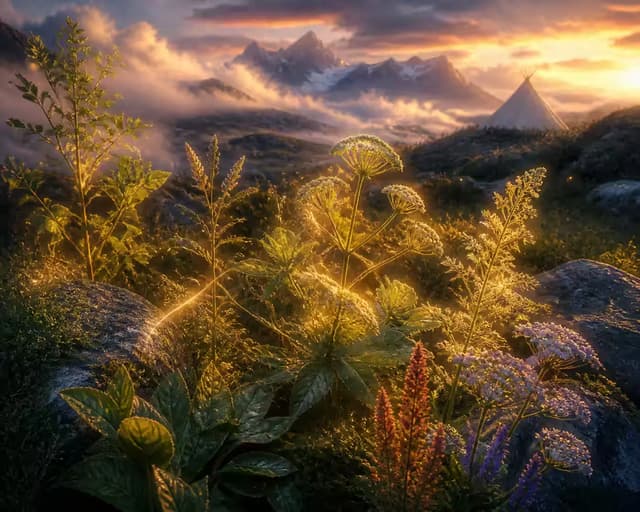
To understand Sami spirit beings, we must begin with the landscape itself. In Sami cosmology, it is not the case that spirits dwell in another world and occasionally visit ours. They are already here. Mountains, lakes, great stones, particular trees — all can be the dwelling place of a spirit, a haldi (North Sami: háldi). The haldis are guardians, tied to specific places in nature. They watch over the animals and plants in their territory, and they expect to be treated with respect.
The physical manifestation of such a place-spirit is called a sieidi — a gathering point for communication between people and the spirit world. A sieidi is not always made by human hands. It may be a stone with an unusual shape, an island in a lake lying in the wrong place, a single old pine on a bare mountain ridge. It is what stands out that deserves attention. The extraordinary is a sign.
For centuries, perhaps millennia, Sami hunters, fishers and reindeer herders brought offerings of butter, fish fat and reindeer blood to such places. Archaeological finds of metal objects from the tenth to the fifteenth century at known sieidi sites confirm that this was a living and widespread practice. To neglect a sieidi, or worse — to move or damage it — was not merely religiously wrong. It was dangerous. The spirit that lived there would take note.
Closely connected to the place is another figure: Storjunkaren, in Norwegian and Swedish, a territorial spirit who ruled over all wild animals, birds and fish in a particular area. He was the true owner of the game. The hunter who returned home with much was not simply skilful — he had a good relationship with the Storjunkare on his land.
The mothers of the species: Máddut
Among the most fascinating categories in Sami spirituality are the máddut — the mothers of the species. These are not gods in any all-powerful sense. They are something more intimate and more concrete: the living spiritual substance of a whole species, the being through whom a species' life force is channelled and protected.
The ethnographer Erika De Vivo, who researched the márka Sami in the Stuornjárga area, documented one of these máddut in living tradition: Čuoppomáddu, the frog mother. She dwells in deep pools, streams and marshes. Physically she is the size of a human child, with strong arms and smooth skin. As long as she is left in peace, she is invisible and causes no problems. But if her young are harmed, she comes up and attacks.
"A máddu may be known in some areas and unknown in others. The presence of a species-mother in local folklore says a great deal about what a community recognises and depends upon." — Erika De Vivo, "A Landscape Full of Voices", 2022
Note what this really means: to kill frogs without reason was not merely impolite. It was to attack Čuoppomáddu directly, with real consequences. The Sami tradition codified a deep ecological insight in narrative form: take care of the species, for they have mothers who are stronger than you.
These stories are not dead. When the author Sigbjørn Skåden, of Sami background, moved to Tromsø, he told his own child the story of the frog mother — but placed her in the city's sewer system. No marsh available, but the principle was the same: respect the boundary, do not go alone to dangerous places.
The hidden people: Gufihtar and uldda
Underground there live people. This is not an image or a metaphor in Sami tradition — it is a statement about the world. The underground beings are real, they live in parallel with humans, and contact with them can be dangerous or blessing-giving, depending on how it is handled.
Gufihtar (North Sami) are gnome-like beings who live in specific mounds in the terrain. They are essentially benevolent — spoken of as good wights — but they exert an irresistible power of attraction, especially on children. Whoever eats or drinks anything inside a gufihtar mound can never come out again. The resemblance to the Nordic nisse tradition is not coincidental: the gufihtar corresponds to the Finnish maahinen and the Norse vette, and bears witness to ancient shared notions that have lived side by side through the millennia.
The uldda are somewhat different. They are beautiful, human-like, and live inside the mountains in a mirror image of human existence — complete with reindeer herds, families and ceremonies. In South Sami tradition they are called gadniha or saajve. Encounters with the uldda can be romantic and alluring, but they rarely end well for humans: you can follow an ulda into the mountain and never find your way out again. The motif of exchange is widespread throughout Sápmi — the uldda swap their own old or sick for Sami infants. The answer was to baptise the child quickly and lay a silver object or a hymnbook in the cradle.
In Inari Sami oral tradition, tales of gufihtarat and uldda are recognised as genres in their own right. They are not loose anecdotes, but structured narrative forms that generation after generation has learned and passed on.
The dangers of water: Rávga and Čáhcerávga
Water is a boundary space in Sami cosmology. It is not merely wet and dangerous. It is a place where the world opens towards something else. Rushing water is in many northern cultures understood as a portal — an opening between the living and the dead world — and this is reflected in the beings who dwell there.
Rávga (North Sami) is the shadow of a drowned person who remains trapped in the water they died in, hostile to the living and out to drag them down into the deep. The name is probably borrowed from Proto-East Norse, related to the Old Norse draugr, and shows that this concept has been shared between Sami and Norwegians for over a thousand years. In North Sami the form is čáhcerávga — literally "water-rávga" — the most commonly used expression. In South Sami it is raavke, on the Kola Peninsula roāvvk. One of the truly pan-Sami figures, known across all of Sápmi.
The rávga can change shape and appear as a large pike or seal. The stories about it are used to this day: do not go alone to dangerous water. In the coastal tradition along Ruija (the outermost Finnmark/Troms) there is another figure — áfruvvá, a mermaid-like figure known only from the Sea Sami tradition, a testimony to the great differences between the spirit world of the interior and that of the coast.
In the still, deep lakes called sáivojavri — those with a false bottom that hides a deeper world beneath — there lives another figure: Saivo Niejta, the "sáivo girl". She is the guardian of the underworld, the being who mediates between the living and the dead in the deepest layer of the water world.
The noaidi's helpers: Spirits that choose
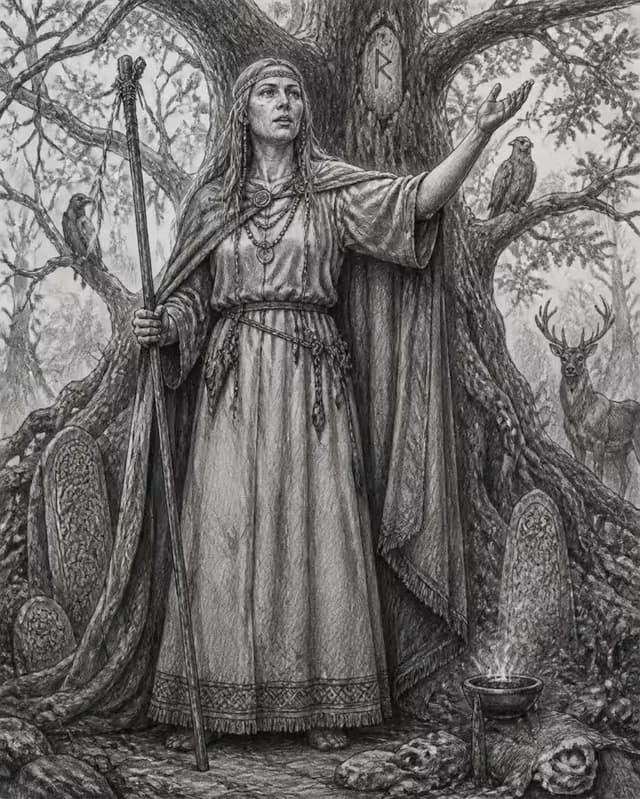
A noaidi — the Sami shaman, healer and spirit traveller — did not work alone. He or she had helpers, called gázzi (North Sami), who were personal spirit companions. What sets this apart from many other traditions' conception of spirit help is this: the helpers chose their noaidi, not the other way around. They sought out the one they wanted, and the bond lasted a lifetime.
The gázzi could appear as a small person in colourful Sami clothing, or as an ancestor's spirit in recognisable form. They accompanied the noaidi through all soul journeys to the other worlds — to Jábmiidáibmu, the realm of the dead, and to the upper cosmos where the birds travelled. The three classic helper-animal forms mirror the worldview directly: the bird (noaideloddi) for journeys upward and through the sky, the fish (noaideguolli) for journeys downward into water and the underworld, and the reindeer bull (noaidesarvvis) for all three worlds — the strongest and rarest of them all.
A gázzi could be inherited, given as a dowry from parents to children, or in rare cases sold. The relationship was deeply personal and reciprocal: the spirit gave power and guidance; the noaidi gave attention, offering and service. To lose a gázzi was a serious loss.
Stállu: The legend of the cunning giant
No Sami tale is more widespread than the stories of Stállu. Johan Turi, the great Sami author and reindeer herder (1854–1936), described him as "half human and half troll or devil". He is enormous and strong, but clumsy and stupid — and therefore always outwitted by clever Sami protagonists. The stories are spread across all of Sápmi, from Härjedalen in the south to the Kola Peninsula in the east.
Stállu exists in two basic forms. The first is the classic monster: a man-eating giant who roams the wilderness, kidnaps children and steals from people. He comes especially around Christmas and midsummer. His sledge is drawn not by reindeer, but by bears, wolves, foxes and wolverines. He always carries with him a magical dog that can bring him back to life — so the dog must be killed first.
The second form is darker: Stállu as a zombie. A powerful noaidi could shape such a figure out of earth and give it a fragment of his own soul, then send it against an enemy. This made the noaidi more dangerous, but also more vulnerable — if the creature was destroyed, the soul fragment was lost with it.
The etymology is interesting. Stállu means "steel man" or "iron man" in Sami, which has led researchers to suggest that the figure originally encoded the Sami's experiences with iron-armoured Norse or Scandinavian warrior peoples. Strange, enormous, clumsy compared to the Sami people's more agile way of life — but always, nonetheless, possible to outwit.
The voices of the deceased: Máddut and jábmid
In Sami cosmology the dead do not cease to exist. They continue in Jábmiidáibmu, the realm of the dead, and they are active participants in the life of the family and the community. This was what the Christian missionaries found most irreconcilable with Sami belief: that the living and the deceased were understood as two halves of the same kin.
The deceased ancestors — jábmiid, máddut — could send fortune, wisdom and protection down to their descendants. Or, if they were neglected or offended, send illness and misfortune. A noaidi could travel to Jábmiidáibmu to consult with them, to bring back a sick person's stolen soul, or to negotiate a healing. Graves were tended, offerings were given at grave sites, and children were named after specific ancestors to carry on the spiritual bond.
Among the best-documented categories of the spirits of the dead are bijagat and mánnelaččat — usually invisible, but at times audible or visible to people with a noaidi-near sensitivity (noaideslágáš). In early twentieth-century ethnographic recordings, a woman is described driving away such spirits by using her own clothing and bodily scent to herd them across a watershed — a scene that says much about the down-to-earth, practical character of Sami engagement with the dead. Not mystical fear, but knowledge of how to handle it.
A living system
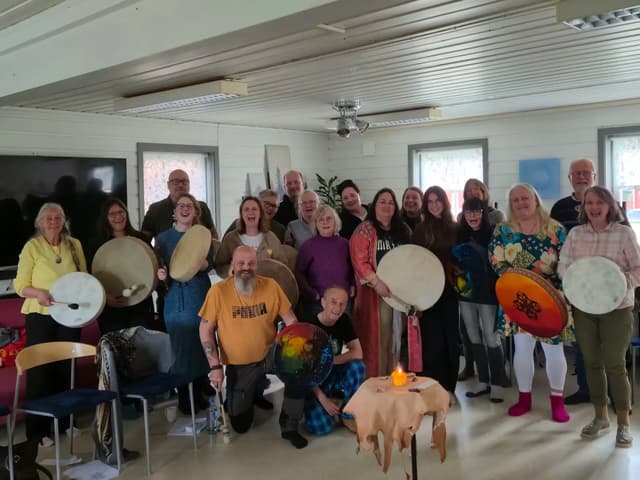
It would be wrong to read all this as a collection of picturesque tales from the past. Much of what is described here is alive and well — adapted, but recognisable. Sieidi sites across Sápmi are still visited by people who lay down a coin or sit still for a moment. Stories of the rávga are still used to keep children away from dangerous water. Noaidevuohta is undergoing active revitalisation as part of a broader Sami cultural renaissance.
What is perhaps most striking about this system, seen from the outside, is its built-in accountability. It is not possible simply to take from nature without maintaining a relationship with those who live there. You cannot kill frogs without Čuoppomáddu. You cannot fish without Guolleipmil. You cannot hunt without Leaibealmmái. Every extraction of resources was anchored in a web of mutual obligations.
This is not naive romanticising of an old world. It is a recognition of something genuinely sophisticated: that a people who have lived in the Arctic for thousands of years developed a system for regulating their relationship to nature that was not written in law books, but lived in stories, in place names, in daily rituals and in the names they gave to their own landscape.
Every place name in Sápmi is an archive. Čuoppomáddojorbmi means "the frog mother's pool". Čuopponjunnji means "the headland where the frogs gather". The map is a creed. And in that map, between mountain and sea and rivers and marshes, they live still — hálddi, uldda, rávga, máddut, gufihtar — all the beings who have watched over this land far longer than any state, any church or any law book.
References
De Vivo, Erika (2022). "A Landscape Full of Voices — Sami knowledge of nature and spirit beings in Márka". Sjamanistisk Forbund. https://www.sjamanforbundet.no/artikler/et-landskap-fullt-av-stemmer
Pollan, Brita (1993). Samiske sjamaner: religion og helbredelse. Oslo: Gyldendal. ISBN 82-05-21660-0. A foundational Norwegian-language introduction to noaidivuohta and Sami cosmology based on historical and ethnographic sources.
Mebius, Ernst (2003). Bissie: studier i samisk religionshistoria. Östersund: Jengel. ISBN 91-631-3863-4. One of the most detailed scholarly surveys of Sami religious tradition, with a particular focus on the South Sami area and the bridges to other Fennoscandian cultures.
Rydving, Håkan (1993). The End of Drum-Time: Religious Change Among the Lule Saami, 1670s–1740s. Uppsala: Almqvist & Wiksell International. A thorough academic study of the older Lule Sami religion as it appears in missionary records, including descriptions of spirit beings and the noaidi's practices.
Turi, Johan (1910). Muitalus sámiid birra (An Account of the Sami). Published in Sami and Danish (translated by Emilie Demant Hatt). New Norwegian edition: Davvi Girji, 2010. The first book written by a Sami about Sami life and belief — Johan Turi's own descriptions of Stállu, the spirit world and Sami cosmology are primary sources of the first rank.