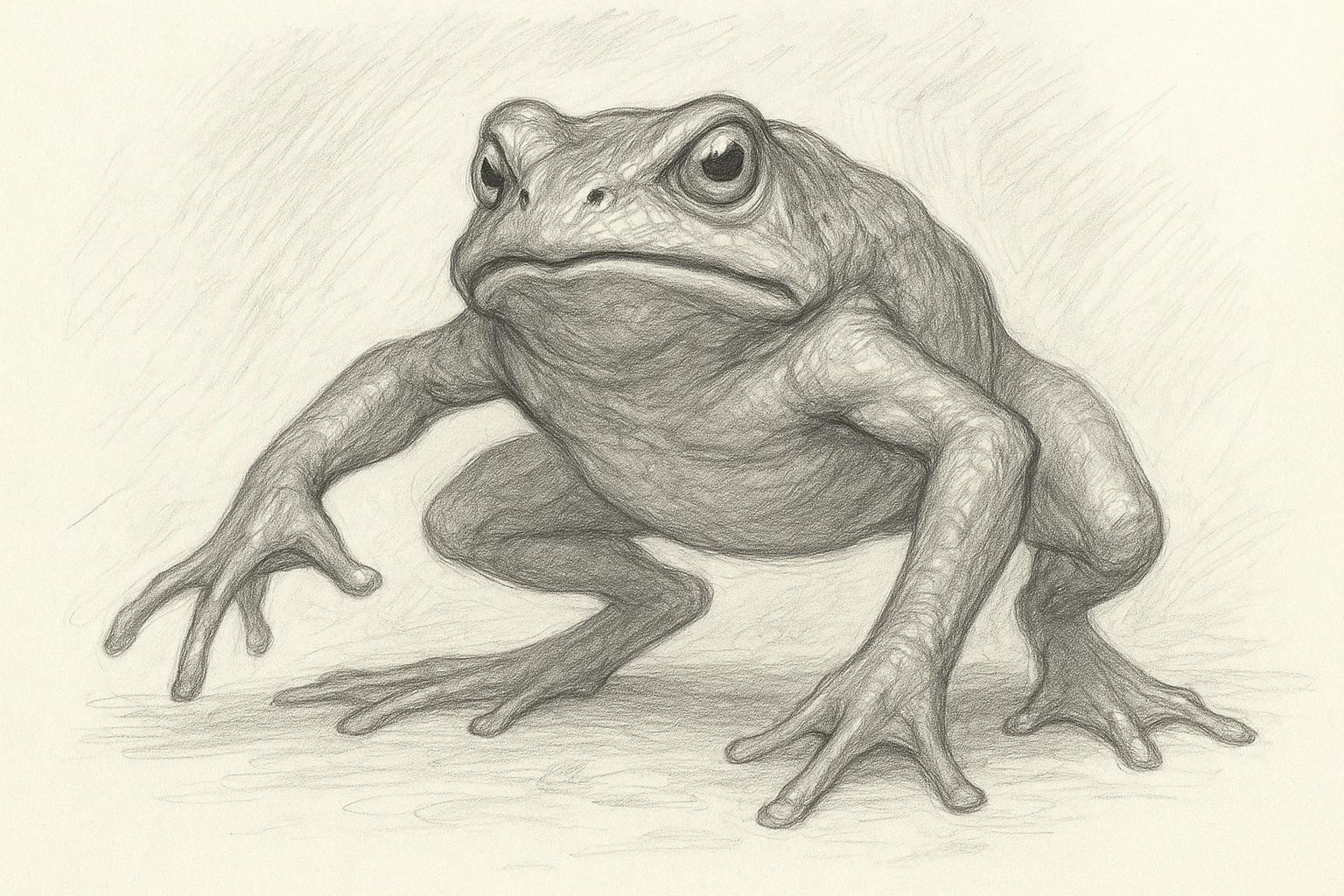
For the Márka Sámi the landscape was never silent. Mountains, water, forest and bog were living parts of a larger family. The place names were not arbitrary; they were stories, memories and warnings, woven into the language.
Erika De Vivo describes it like this:
“Indigenous Sámi toponyms enshrine local understandings of relations between the environment and its inhabitants – humans and other-than-humans – offering an emic perspective of Indigenous conceptions of shared spaces regulated by relationships, reciprocity, and respect.”
In Márka this understanding still lives in the words. A name like Čuoppomáddojorbmi means “the Frog Mother's hole” – a body of water or a bog where the Frog Mother dwells. Other names point to her presence: Čuoppoláddu (the Frog Pond), Čuoppojávri (the Frog Lake), Čuopponjunnji (the headland where the frogs gather).
Each name is an echo of a relationship between humans and other beings, and reminds us of a time when the boundaries between the spirit world and that of humans were closer.
The Mothers – Máddut
The Frog Mother is one among many Máddut – spirit beings that act as guardians and mothers for various species. Each Máddu is the guardian of its part of nature: one for the fish, one for the birds, one for the small creatures in the ground.
De Vivo explains:
“Among the many beings dwelling in the Márka, Čuoppomáddu holds a special place in local memory; she is one of the numerous Máddut or ‘Mothers’, guardian spirits presiding over their species, protecting their offspring and environments. Offending a Máddu or harming her descendants brings consequences.” (p. 15)
To show respect for a Máddu is to show respect for the very web of life. In this understanding, the human is never a ruler, but a participant – one who must live in balance with everything else.
The Frog Mother watches in the bog
According to the stories, as Asbjørg Skåden collected them in the book Čuoppomáddu (1994) and later translated into Norwegian as Froskemora – Čuoppomáddu (2008), the Frog Mother lives in deep pools, brooks, rivers and bogs. She is as large as a human child, with powerful arms and glistening skin. She shows herself rarely – only when humans disturb her or harm her little ones.
Then she leaps up, seizes the guilty one and drags them down into the water.
But if she is left in peace, she lives quiet and unseen.
De Vivo writes:
“She resembles a large frog, appearing to humans only when disturbed or her offspring are threatened: then she jumps on the persecutor, killing, maiming or frightening her/him off. If she and her offspring are left in peace, she minds her own business.” (p. 15)
For the Márka Sámi she was both frightening and sacred – a protector of the boundaries between the worlds of humans and of nature.
A child's respect for the water
Asbjørg Skåden recounted that as a child she knew exactly where she could bathe, and where she must not go. No adults needed to warn her – for she knew where Čuoppomáddu lived.
“She does recall avoiding those places out of respect rather than fear, observing the spatial division between humans and other-than-humans because she understood where Čuoppomáddu dwelt.” (De Vivo, p. 16)
She waded and played in the river, but never in the still pool below – for that was the Frog Mother's home.
This was not merely fear, but a learned respect: an intuitive interplay between child and nature.
“As a child, she had waded and splashed in the creek but never in the pool below – Čuoppomáddu territory – with whom she respectfully shared the river.” (p. 16)
In this way the children of Márka learned the boundaries of their own world. It was not the human who owned nature – but nature that shared its space with the human.
A story to safeguard life
Asbjørg's son, the author Sigbjørn Skåden, told De Vivo how the Frog Mother stories were passed on in his childhood:
“You start telling Čuoppomáddu stories because you do not want your child to go down to the river or the lake on its own, of course, or down to the water where they can drown. Čuoppomáddu is like a big frog, between half a meter and a meter. She is huge. She chases people. If she gets to take you it can just strangle you because she's got strong arms.” (p. 16)
The parents thus used the Frog Mother as a guardian figure – an image of both nature's power and the necessity of being careful. The stories kept the children safe, but they also taught a deeper principle: respect for all that lives.
The ecology of the myth
In Márka the stories were never detached from reality. They were anchored in an experience-based relationship with nature. The frogs, De Vivo explains with reference to the researcher Boekraad (2016), had an important role in the ecosystem – they kept the water clean and balanced.
Therefore they were also seen as beings with a spirit. To harm a frog without reason was to violate the natural order.
“Both Boekraad's and Magga et al. consider Sámi indigenous values and practices as factors fostering intra/inter-species equilibrium.” (De Vivo, p. 15)
The Frog Mother, Čuoppomáddu, thus became an image of nature's self-sustaining power. She was the guardian of life's smallest link – a reminder that even what seems insignificant carries a sacredness.
The names return
In colonial-era Norway, Sámi place names were long removed from maps and road signs. De Vivo describes this process as “toponymic silencing” – an attempt to erase language and thereby culture.
“Naming a place anew is a widely documented act of political possession… Equally, the taking away of a name is an act of dispossession.” (Helander, cited in De Vivo, p. 9)
But the Márka Sámi did not let the names disappear. They were kept alive in the stories, in everyday speech, in the memories. In the year 2001, when activists put up hand-painted Sámi name signs in the area, Čuoppomáddu also returned – as a symbol of the restoration of culture and dignity.
“The reclaiming of formerly silenced toponyms and the conscious use of Indigenous placenames is an act of decolonisation considered a form of toponymic resistance.” (De Vivo, p. 5)
When the name once again became visible in the landscape, the spirit too regained its place.
From bog to sewer
De Vivo recounts that Sigbjørn Skåden in adulthood moved to Tromsø, but still told Čuoppomáddu stories to his little son. In the city there were no bogs or pools, so he adapted the story:
“Since there are no swamps or marshes in Tromsø, he said he could adopt the sewer system as his reference… By collocating Čuoppomáddu stories in the sewers rather than in the swamps, Sigbjørn hopes to prevent his child from playing near dangerous waters.” (p. 17)
The Frog Mother had thus moved – from the bog to the city's pipes and manholes – but the meaning was the same. The story lived on, shaped by the times, but faithful to its core: respect for life and for the boundaries that nature sets.
This is, as De Vivo writes, an expression of cultural adaptation without loss – a living tradition that changes form without losing its spirit.
“Through this form of adaptation, by absorbing change… these stories transform and yet maintain their core features while reinforcing the bond between younger generations and the cultural landscape of their ancestors.” (p. 17)
Márka – a landscape of memory
In Márka there are still place names like Ulddaráigi (Uldda's cave), Stáloráigi (Stállu's cave) and Eahpádusjalga (the meadow of the unwanted children). Each name carries memories of other beings, other times. Together they form a spiritual map of the human's place in a living world.
“In Stuornjárga, toponyms function as repositories of meaning, encapsulating elements of local Sámi cosmologies, testifying to non-Christian Sámi worldviews while documenting the relationship between the Márka-Sámi and their landscape.” (De Vivo, p. 18)
The names make the landscape many-voiced – a chorus of stories, animals, humans and spirits that all dwell in the same space.
More Mothers – Máddut
The Frog Mother is only one of many Mothers who guard nature's species and places. Throughout Sápmi there are stories of Guollemáddu (the Fish Mother), Čuoppomáddu (the Frog Mother), and other lesser-known guardians.
De Vivo underlines this diversity:
“A máddu may be known in some areas and unknown in others, and the presence of a Mother of a species in local folklore reveals a lot about the community acknowledging her.” (p. 15)
Each Máddu mirrors a particular relationship between humans and their surroundings. They are at once nature's guardians and symbols of human responsibility. That is why they live on – in stories, in names, and in the way people still speak about nature in Márka.
The return of the Mothers
When the stories of Čuoppomáddu are told today, they are more than fairy tales. They are cultural memory, a living connection between generations.
They remind us that respect for nature is not only about laws, but about relationships – about reciprocity, gratitude and moderation.
As De Vivo writes in the conclusion:
“By evoking and transmitting Čuoppomáddu stories, orally or in writing, Sámi values reach younger generations, preserving knowledge about local culturally-specific practices.” (p. 17)
And perhaps it is precisely this that makes the stories so relevant in our time. For when the world again searches for balance with nature, the Márka Sámi's stories of the Mothers – Máddut – have much to teach us.
An echo from the water
If you walk quietly in Márka on a spring day and listen, you may perhaps still hear the low gurgling from a pond, a breath beneath the water, a movement in the reeds. Perhaps it is only the wind.
Or perhaps it is Čuoppomáddu, the Frog Mother, reminding us to watch where we tread, and to remember whom we share the earth with. She does not belong to the past. She is still here – in the names, in the water, in the memories.
Sources:
De Vivo, Erika. 2022. “Everybody Knew Čuoppomáddu Stories: On Human/Other-Than-Human Relations in Stuornjárga as Revealed Through the Márka-Sámi Toponyms.” Lagoonscapes, Vol. 2, No. 1, 1–22.
Skåden, Asbjørg. 1994. Čuoppomáddu. Skánik: Skániid Girjie.
Skåden, Asbjørg. 2008. Froskemora – Čuoppomáddu. Skánik: Skániid Girjie.
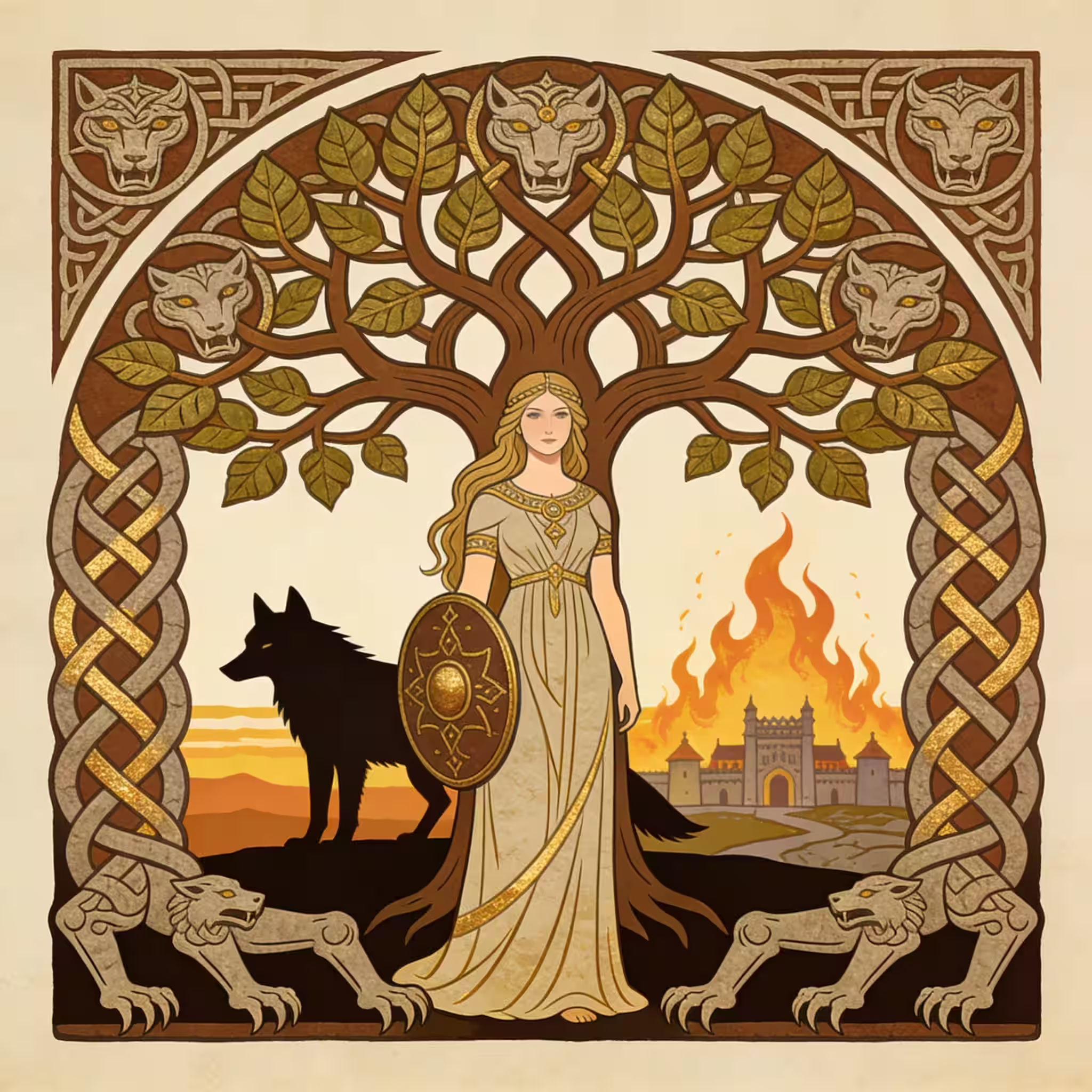
-1.avif)
-1.avif)