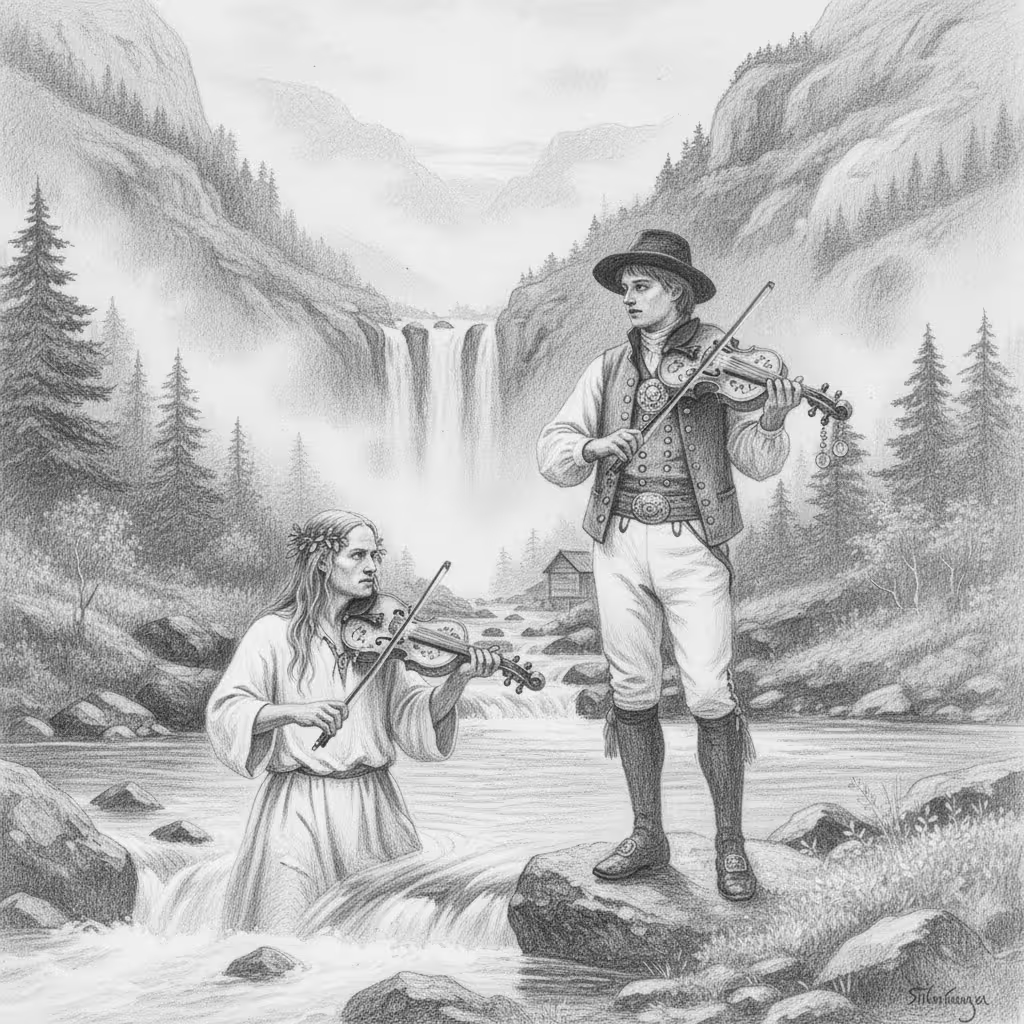
At dusk, by the roaring fall of the waterfall, a young boy stood with his fiddle in hand, his heart pounding with longing for the ultimate tone. The river sang its eternal song, and from the depths a shadow rose – Fossegrimen, with golden hair that wove itself into the foam, and eyes that glowed like moonlight on wet leaves. He was not a figure from Norse mythology, but a living part of later Norwegian folk belief, a teacher of the wilderness of music who could give or take life with a stroke across the strings.
The waterfall's keeper
Imagine a time when rivers and waterfalls were not just water in motion, but living beings filled with power and wrath. Fossegrimen, or simply Grimen, dwelt mainly by rivers, waterfalls and mills, where he watched over the peace and harmony of his realm. If anyone disturbed him – like the man in Hallingdal who worked in the mill house after nightfall – he appeared as a fearsome troll. The door flew open, a hideous face filled the opening, and the whole building shook beneath his rage: "That was a skull, man!" He let his victim go unharmed this time, but warned: "Unharmed you escape now, but if you come more often this way, then perhaps you will get a broken leg to remind you that you were a bother to me."
This tale from Hallingdal is typical of the oral folk belief of the 1700s and 1800s, in which Fossegrimen represented nature's demand for respect. He was a personification of the waterfall's power, a spirit who could shift according to his mood – from a frightening troll to a little man with small white hands and long golden hair when his mood was good. In Swedish folk belief there are corresponding figures such as strömkarlen or kvarngubben, who also taught music, but Norwegian tradition gives Grimen a distinctive place as the master of the waterfall. He was not a god or jötunn from Norse times, but a later development in folk superstition, possibly connected to older water spirits such as Nøkken.
Myllargutten and the magic of the strings
The best-known story about Fossegrimen is the one about Myllargutten, a poor fiddler from Grungedal who longed to master the fiddle. One Thursday evening – the day that is often sacred in folk belief – he carried a fat goat's leg to the waterfall as an offering. Fossegrimen rose up, gripped the bone, and guided the boy's hand across the strings until blood ran from his fingertips. The result was a tune so powerful that the trees danced and the waterfall halted in its fall: "Fossegrimen's strings were stirred, the foam sprang and whirled withal. None but Myllargutten heard how the river ran with the play of strings."
But if the offering was meager, the teaching was hard. "I shall teach you the quiet, but not the strike, for you gave me a leg that was not whole," Grimen is said to have said. Myllargutten, also known as Ole Øvredal or Håvard Gibøen in various versions, became a legend who wandered from village to village, while people whispered that it was the waterfall's power that gave him his unsurpassed playing technique. Rikard Berge recounted that he himself had heard the story as a boy, and although Myllargutten became skeptical when townspeople mentioned Grimen in 1847, the myth lived on in oral tradition. Olav Faremo of Setesdal, a real fiddler born in 1786, himself told of such an experience in which Fossegrimen twisted his fingers so they fit the playing better – "the evil one has twisted my little finger onto the back of my hand!" – and equated him with the devil. Such tales show how Fossegrimen tested the will and the willingness to sacrifice of humans, in a folk belief that flourished in the 1700s and 1800s.
Similar legends circle around legendary Norwegian fiddlers such as Torgeir Augundssøn from Telemark, one of the greatest violinists of the 1700s. According to folk belief, he visited a waterfall near Vågå, where Fossegrimen himself gripped the bow and showed him the secrets behind the most gripping tunes, so that the cows danced in the stall and the moose stormed down the mountainsides when he played. The same was true of Ole Bull, the world-famous virtuoso from Bergen, who in the tales of National Romanticism is linked to Fossegrimen through myths of nightly meetings at the waterfall. Although Bull himself denied it, the stories spread about how Grimen taught him to draw the bow with a force that imitated the roar of the waterfall, and this culminated in the monument to him in Bergen, where Fossegrimen himself is depicted in the waterfall behind.
Nøkken, the dangerous relative
Fossegrimen must be distinguished from Nøkken, a closely related but more malevolent figure in Norwegian folk belief. Nøkken, from the Old Norse nykr, is a water spirit who lures people to drowning, often as a beautiful horse or fiddler. He dwells in tarns and rivers, while Grimen is connected to waterfalls and mills. An early trace of a violent jötunn beneath the waterfall is found in Grettis saga from the 1300s–1400s, which some scholars see as a forerunner to Fossegrimen's more gentle form, but it is not the same being. Nøkken sings and plays to enchant, but Grimen teaches only the worthy. Both are connected to music, but while Nøkken lures to death, Grimen gives life through tones, in a folk belief that developed after Norse times.
The development of folk belief
Fossegrimen has no clear place in Norse mythology like the Æsir or the jötnar, but belongs to a layer of folk belief that flourished from the 1700s and was recorded in the 1800s. Norse texts such as the Edda or Snorri's Gylfaginning mention no Fossegrim, and the earliest written traces come from collectors such as Peter Christen Asbjørnsen and Jørgen Moe, inspired by the Brothers Grimm. They used a simple style of language to preserve the dialect tradition, and contributed to national identity under Danish dominance. Research such as Magne Velure's genre-analytical study of Fossegrimen and Nøkken emphasizes how these are nature-myth legends from post-Norse folk belief. These tales of fiddlers such as Torgeir Augundssøn and Ole Bull show how the myth wove itself into real lives from the 1700s, where masterpieces on the fiddle were attributed to the direct intervention of the waterfall's spirit.
The revival of Romanticism
In National Romanticism, Fossegrimen became a national hero. Johan Sebastian Welhaven wrote a poem about Myllargutten, and Sigurd Eldegard wrote the play Fossegrimen (1905), the National Theatre's first production in Nynorsk, with 140 performances. Stephan Sinding's monument to Ole Bull in Bergen shows Bull playing while Grimen harps in the waterfall – a symbol of nature and folk music. Geirr Tveitt composed symphonic works inspired by these myths, and in Sweden there is Näckens polska. Modern research, such as in the FolkOrg essay by Magne Velure, shows how Grimen became an identity marker for folk music. He represents the wild, nature-bound music tradition that was romanticized.
The symbolism behind the tone
Fossegrimen symbolizes the balance between humans and nature in late Norwegian folk belief. He demands an offering for knowledge, such as the blood on the fingers or the fat bones, and reminds us that genius requires sacrifice. In a time of industrial development, such as power plants that threaten the waterfalls, the myth becomes relevant again – Grimen loses his home when the water is led into pipes. He binds together the stories of Myllargutten, Torgeir Augundssøn and Ole Bull, where each master's playing bears the mark of the waterfall's wildness from the traditions of the 1700s.
A living heritage today
Today Fossegrimen lives on in culture and media. Orchestras, choirs and dance tunes bear his name, and he inspires the protection of nature. On an evening by the waterfall, when dusk falls, you can still hear the strings. Try to listen – but bring a good offering.
This article about Fossegrimen is meant to convey the rich Norwegian folk belief. Although it draws on academic sources such as Asbjørnsen and Moe, Wikipedia and folk-belief research, it blends historical accounts with literary interpretations and symbolic reflections. The tales of Myllargutten, Torgeir Augundssøn and Ole Bull reflect oral legends and romantic myths, not always strictly fact-based history. Opinions about Fossegrim as a symbol of nature's balance and shamanic spirituality are the author's subjective perspective and not objective facts. The reader is encouraged to consult primary sources for historical accuracy.
Sources
Asbjørnsen, P. C. & Moe, J. (1842–1871). Norske Folkeeventyr. A collection of folk legends including Myllargutten.
Wikipedia: Fossegrim. An overview of folk belief and variants.
Wikipedia: Nøkk. Links to water spirits and Grettis saga.
Velure, M. (n.d.). Tradisjonen om fossegrimen og nøkken: Ein genre-analytisk studie. A genre analysis of legends.
FolkOrg: Det overnaturlege som identitetsmarkør for folkemusikk. An essay on Grimen in the music tradition.
-1.avif)
-1.avif)