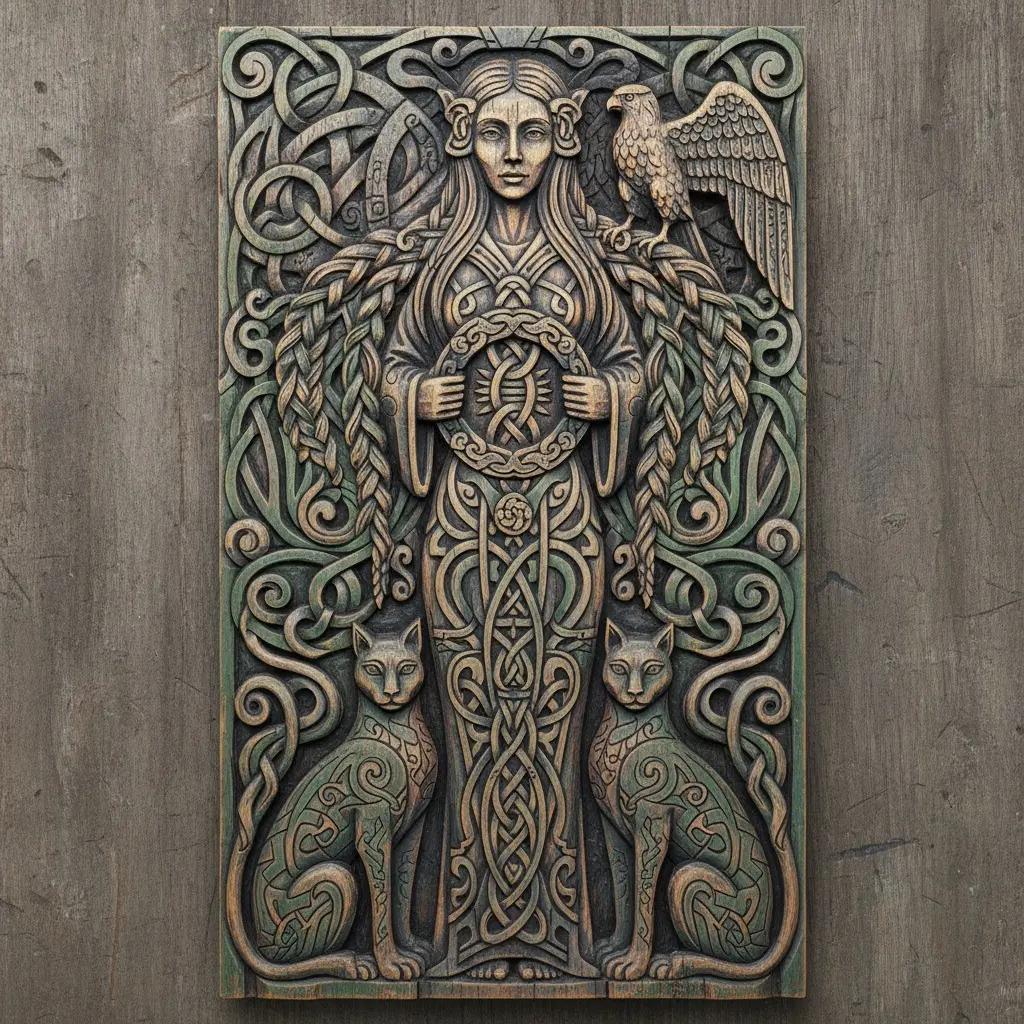
Freyja is one of the best known and most popular goddesses in the Norse pantheon, especially among women in the Viking Age. She appears not only as a central figure in the mythology, but also as a goddess associated with cult and rituals that may have held great significance for women and the household.
Freyja's unique status in Norse mythology
Among the many Norse gods and goddesses, Freyja is one of very few to have her own song in the Poetic Edda – more precisely the poem Hyndluljóð. This points to a special standing in relation to other goddesses, and at the same time suggests that she was particularly popular, not least among women. The mythologist Snorri Sturluson and several modern researchers single out Freyja as one of the most significant goddesses, together with Frigg. But while Frigg belonged to the more "official" Æsir gods, Freyja held a special position as a Vanir goddess with strong connections to fertility, magic and war.
Even though the Norse myths are preserved today through texts written down by Christian men several hundred years after the end of the Viking Age, they nonetheless reflect fragments of an old pre-Christian faith. These texts, even filtered through a Christian lens, give us a certain insight into Freyja's significance for the people of the Viking Age.
Freyja as a recipient of cult and sacrifice
Freyja stands out as one of the few goddesses directly named as a recipient of sacrifices in the surviving sources. The poem Hyndluljóð contains a rare and clear description of a sacrifice to Freyja, in which an altar stone is reddened with the blood of an ox as a sign of faith and devotion. This indicates that she had not only a mythological role, but also a concrete cultic function tied to sacrifice and ritual.
Sacrifice practised to Freyja appears as an important part of her cult, which may support the hypothesis that she had her own cult with rituals dedicated to her in the Viking Age. In addition she is referred to as "husFrøya" – the lady of the household – which points to a central role in the private sphere, especially in the world of women.
Seiðr and the goddess of magic
One of the most distinctive characteristics of Freyja is her acquired expertise in seiðr – a form of Norse magic associated with divination, fate and spiritual communication. It is said that Freyja was the one who taught this magic to the Æsir, including Odin himself, who later became a "master" of seiðr. She is thus described as the original owner and teacher of this form of magic.
In the myths she is described as a powerful sorceress, and she has magical objects associated with her, such as the feather cloak that grants the ability to fly. The practice of seiðr was especially connected with women, who prophesied and performed ritual acts in both mythological and human settings.
In the Saga of Erik the Red, a practitioner of seiðr is portrayed, the völva Thorbjörg, who dressed in garments and objects that could symbolise Freyja's connection to seiðr – among them a staff, fur and cat skin; Freyja's cats were famed as the animals that drew her chariot. This hints at Freyja as a model and spiritual protector for female magicians.
Freyja as a goddess of death and ruler of Folkvang
Freyja also has a central role in matters of death; she receives half of the fallen warriors in her hall, Folkvang, while Odin takes the other half to Valhalla. This gives her a singular status as a goddess of life, fertility and death alike, and underscores her power over fate and battle.
She is thus placed on equal footing with Odin within important cosmic functions. Her role as a goddess of death also indicates that she governs an important transition in the human life cycle, and has a worldly cult that includes these aspects.
Leadership in the women's sphere and connection to the Dísir
Freyja is also connected with the dísir – female protective spirits or demigoddesses associated with family life, fate and protection. She is referred to as Vanadís, that is, the queen of the dísir, and may have held a leading role in the cult of the dísir, which belonged especially to the private and women-oriented part of society.
Dísablót, a sacrifice to the dísir, was a significant festival timed to the winter month of the Viking Age, and an occasion for female rituals and sacrifice within family and home. It may be assumed that the cult of Freyja, as leader of the dísir, lay close to the private rituals of the household, which may explain her popularity especially among women.
Archaeological indicators of Freyja's cult
There are traces in archaeological finds that may be interpreted as signs of a cult of Freyja. For example, a female figure holding a staff on a runic inscription from the Isle of Man may be a symbol of cultic connection to seiðr and thus to Freyja. The Oseberg tapestry from Norway, in which women with animal heads are shown, may represent followers of Freyja, much like the male berserkers who were Odin's followers.
Similar finds, such as the Tissø figure in Denmark, where jewellery is depicted that may be Brísingamen, Freyja's famed necklace, provide further support.
Nevertheless there is uncertainty surrounding the interpretations, and more research is required before it can be established whether these finds concretely represent the cult of Freyja.
Women's role as cult leaders and seiðr practitioners
There are indications that women of the Viking Age could take on roles as cult leaders, referred to as gyðja or hofgyðja, who were responsible for temples (hof) and ritual acts. Although such women were probably fewer than the male officiants, finds of distinctive objects such as staffs, amulets and magical miniatures in female and especially elite graves point to women having been active practitioners of magic and leaders in religious rituals.
Freyja's established role as goddess of magic and leader of the dísir may have made her a natural model for these women in their ritual practice. For lower social strata, such ritual equipment may have been inherited, which means it often does not accompany grave finds.
Freyja's lasting influence
Even after Christianisation, it appears that Freyja still held significance, especially in the sphere of women and the household. Her cult may have survived in a private sphere long after official worship of the gods had changed.
However, modern research has had difficulty uncovering and appreciating female functions in Norse religion, partly because the sources are largely written by and for men, and archaeological finds of female ritual objects have received less attention.
This creates a need for further research with an increased focus on women, their roles and connections in the religious life of the Viking Age, especially in relation to Freyja.
Freyja emerges as a complex, powerful and highly respected goddess with an important place in Viking Age mythology, cult and the religious life of women. She was a teacher of magic, a recipient of sacrifice and a leader of protective spirits and the dísir, and a goddess of death responsible for selecting the fallen warriors.
Freyja's connection to the women's sphere and her probable role as a cult leader in both mythic and human settings make her a key figure for understanding women's cult and magical practice in pre-Christian Scandinavia. Archaeological and literary traces testify to her significance, even though many aspects remain unclear and under-researched.
Future research focusing on female finds and rituals connected to Freyja may help to shed new light on the private and public cult of the Viking Age, and to better recognise her central role in this culture.
Freyja in modern times
In modern times Freyja is experiencing a new spring through a growing interest in Norse mythology, spiritual practices and a deeper connection to nature and female power. Many today seek to rediscover and honour Freyja as a symbolic figure of love, fertility, magic and strength – aspects that still hold great relevance, especially within feminist and spiritual circles. She is venerated not only as a mythological figure, but also as a living goddess in modern pagan traditions such as Ásatrú and other nature-based religions. Through ceremonies, rituals and personal meditation, practitioners offer gifts, prayers and rites to Freyja, often with the aim of connecting to her energies of protection, creation and transformation. At the same time, Freyja's stories are used as inspiration in feminist art, literature and music, where she represents both power and vulnerability in the world of women. This testifies to how Freyja still lives as a powerful symbol of female autonomy and connection to the mystery of nature in our modern age.
Sources
Friedlander, J. (2022). The Mythology and Cult of Freyja and Her Importance to Viking Age Women. Scandia: Journal of Medieval Norse Studies, 5.
Crawford, J. (2015). The Poetic Edda: Stories of the Norse Gods and Heroes. Hackett Publishing.
Snorri Sturluson (2017). Heimskringla / The Prose Edda. Translations and editions.
Davidson, H.R.E. (1998). Roles of the Northern Goddess. Routledge.
Ljungqvist, J. (2008). Mistresses of the Cult – Evidence of Female Cult Leaders from an Archaeological Perspective.
Price, N. (2019). The Viking Way: Magic and Mind in the Late Iron Age. Oxbow Books.
Raudvere, C. (2012). Popular Religion in the Viking Age. In S. Brink (Ed.), The Viking World. Routledge.
Näsström, B. (2003). Freyja, the Great Goddess of the North. Clock & Rose Press.
Simek, R. (n.d.). Rich and Powerful: The Image of the Female Deity in Scandinavia.
Sundqvist, O. (2012). Cult Leaders, Rulers and Religion. In S. Brink (Ed.), The Viking World. Routledge.
Wylie, E.B. (2019). A Full(a) Roster: Re-addressing the Ásynjur in Snorra Edda and Beyond. Academia.edu.
Nordvig, M. (2022). Old Gods 1. Coursera lecture series.
-1.avif)
-1.avif)