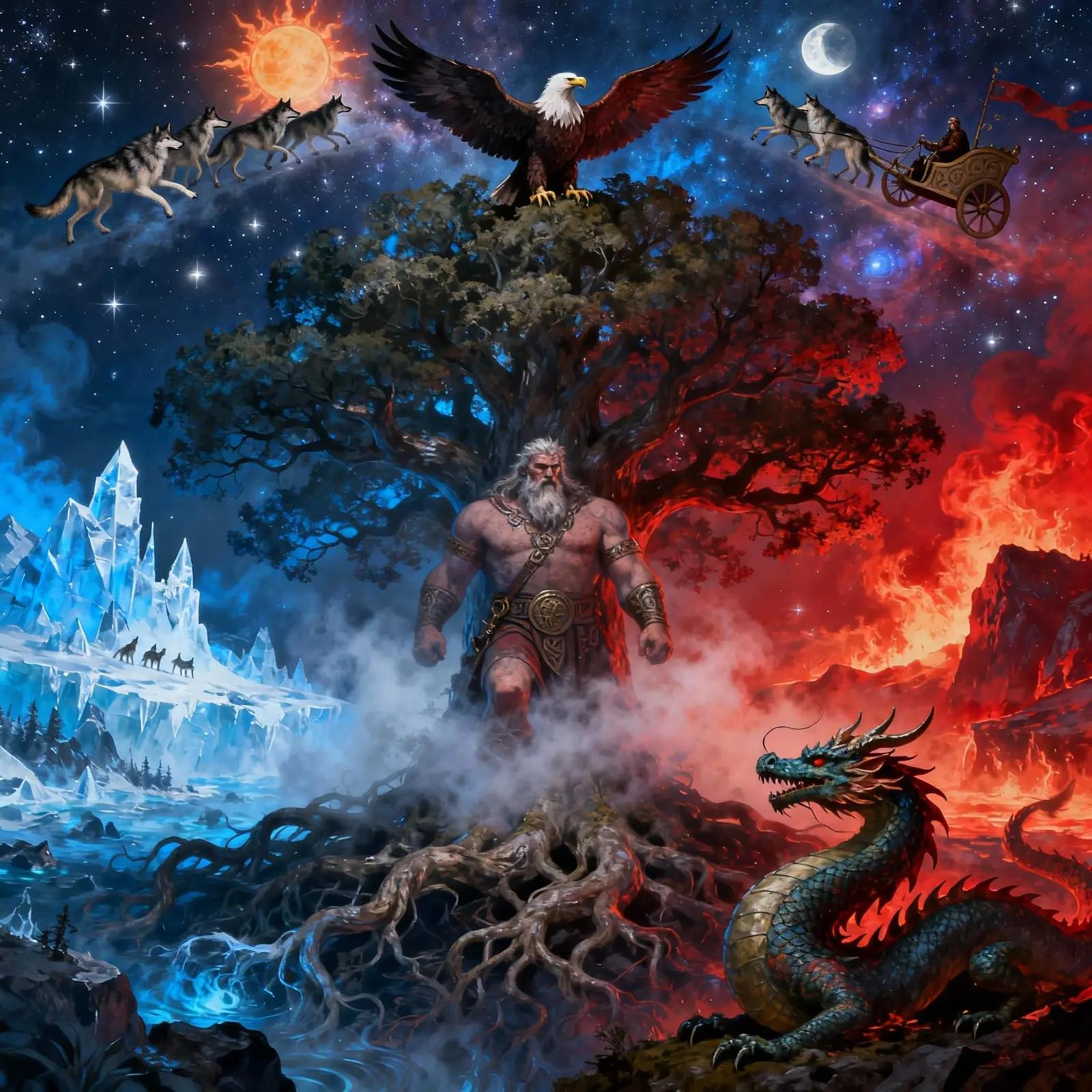
Imagine the beginning of everything. Not just the dawn of time, but before time really existed. No trees, no birds, no mountains or seas – only an incomprehensible, eternal darkness. Here there was absolutely nothing: no sound and no image, no space, no life. This dark, boundless void bore the name Ginnungagap, a word that still resounds with mystery and adventure.
But even within this seemingly empty space, powers lay hidden. In the north lay Niflheim, home of the ice-cold mists and frost. Here poisonous rivers crept slowly through the landscape, and the ice grew thick and blue. In the south lay the direct opposite: Muspelheim, a place where everything burned, where sparks struck through the air and the weaver of fire – Surtr – kept the flames alive. This was not just heat, it was a fundamental, all-encompassing energy, dangerous and life-giving at the same time.
Neither of these forces could create anything on its own. But in the fragile balance, where the cold mist clouds from Niflheim crept gently in toward the warmth of Muspelheim, something happened that changed everything forever. When the cool drops met the burning sparks, the ice began to melt – and in this primordial broth the first being arose: Ymir.
Ymir – The First Monster
Ymir was no hero. He was huge, he was terrifying, and he was alone. But in that strange, formless darkness he became the forefather of more terrifying creatures. Every time Ymir slept, his sweat streamed out into Ginnungagap, and from the drops new giants arose. These jötnar, or frost giants, carried the world's primal forces – wild, primitive, always in conflict and unrest. In Ymir's armpits humans grew forth, from his legs came new beings, and his evil spirit was like a mirror image of the chaos he came from. Ymir was of both sexes, both man and woman in the same body, and nothing about him was "ordinary" or comprehensible to a human being.
But how did Ymir get food in this prehistoric darkness? Well – together with him a mysterious cow, Audhumbla, was born out of rime and ice. She had a strange ability: she could lick salt and rime from stones and in this way nourish herself. From her udder came rivers of milk, enough for both Ymir and eventually all the giants he gave rise to.
Audhumbla was not only Ymir's foster mother, but also the grandmother of the gods. As she eagerly licked at a stone, the form of a man began to emerge. First only a few strands of hair, then a face, and finally – on the third day – Buri stood ready. Buri was the primeval man, beautiful and mighty, and he became the father of Bor, who in turn had three sons with the giantess Bestla. These sons were Odin, Vili and Ve.
The First Gods and the World's Struggle
Over time Ymir's kin grew. They were many, and they were not good. The jötnar loved chaos, and the world bore the mark of this unruly, violent society. But with Odin's line, and his brothers Vili and Ve, came order and purpose. These three were not only mighty – they were wise, decisive and carried a yearning to shape a better world.
When the world's chaos threatened to swallow everything, the three brothers realized that something had to be done. They gathered courage and strength and carried out one of the greatest and most dramatic killings in the history of myth: they killed the primeval giant Ymir. A sea of blood streamed out, and almost all the jötnar drowned in this flood, except for one – Bergelmir – who together with his wife survived by hiding in a hollow tree trunk that drifted out on the stream of blood. From him descend all later giants, and he and his kin were the eternal enemies of the gods.
The Origin of Humans and Nature
With Ymir dead, his body lay there, shapeless, enormous and full of potential. Odin, Vili and Ve carried him out into the middle of Ginnungagap. There, in the great void, the creation of the world as we know it began.
His flesh became the earth's lands and plains, his bones became mountain ranges and rocky heights, his blood flowed out and filled rivers, lakes and the world's seas. His skin and hair became grasslands, bushes and endless forests, and his teeth and crushed bones rolled out as stones and boulders across the earth. His head was raised high – and it formed the vault of heaven, the very arch over all that had been created.
To prevent this vault of heaven from falling down and crushing all life, the gods placed four dwarves: Austri, Vestri, Nordri and Sudri – one in each corner of the world to hold up the sky. The brain they threw up, and it broke into small pieces – and so the clouds came into being, and their shape has never been the same since.
Sparks and glowing pieces of coal the gods fetched from Muspelheim and fastened to the vault of heaven; and so we got the sun, moon and stars. The heavens grew, and the light spread across the earth. The sun and moon were set in their orbits, day and night were given their appointed times, and the year divided itself according to the rhythm of the starry sky.
Yggdrasil – The World Tree
In the middle of the cosmos, where all things meet, the greatest of all trees was planted: Yggdrasil. This tree of life has roots both in heaven and in the underworld, in ice, fire and the earth itself. Its trunk stretches through all nine worlds; up to the gods in Asgard, through the realms of humans and down to the realm of the dead in Hel. In its branches sits an eagle that knows everything, and down by the root the dragon Nidhogg gnaws, always ready to destroy or shorten the life of the tree itself. A small, spiteful squirrel, Ratatosk, runs back and forth between the eagle and the dragon, spreading gossip and unrest.
Yggdrasil is not just a tree – it is the very fabric of the universe, binding everything together, giving every being its rightful place in the cosmos and reminding us that everything is connected, even what we cannot see.
Dwarves and Other Beings
Not all life came into being by chance: The dwarves, small and cunning creatures, crept out of Ymir's dead body like maggots and dug their way down into the earth. The gods gave them reason and form and made them the earth's most talented smiths and craftsmen. Many of the great, magical objects in the world of the gods – such as Thor's hammer, Odin's spear and the gold ring Draupnir – were made by the dwarves' cunning and precision.
There are also elves: the bright, beautiful ones who dance over the flower meadows, and the dark ones, who live beneath the ground and bring sickness and misfortune. They live close to humans and gods, and their influence on the world is always strange and unpredictable.
Sun, Moon and the World's Rhythm
Light was not enough – it had to be set in motion and put in order. Two children, Sol (Sun) and Mani (Moon), were placed in the sky. The gods fastened them behind their chariots and let them travel across the heavens day and night, chased by two wolves that always threatened to swallow them. So the days pass, always in flight, but always returning to begin anew. So the year came into being, and the rhythm of the earth was set.
The seasons were given their guardians, with summer's friendly god Svasud and winter's bitter Vindsval. All this was necessary so that the balance of nature could be maintained – nothing could remain untouched, everything changed, and the course of nature was woven deep into the very structure of the world.
The Creation of Humans – Ask and Embla
When the world had come into being, forests stretching toward the horizon and the sea in place, one thing was missing – life that could think and understand, that would admire and fear both nature and the gods. One day Odin, Vili and Ve wandered along the shore and found two logs of driftwood – one of ash, one of elm.
They picked up the logs and gave each of them their own gifts. Odin breathed life into them and gave them spirit and will. Vili gave them movement and understanding, while Ve gave them human form and speech. These were the first humans: Ask and Embla. They were given Midgard to live in, the world between the gods in Asgard and the underworld of Hel. From here descend all humans, and so we got our place in the great, living fabric that is the world.
The World's Order, Power and Unrest
With the world in place, the gods took hold of the new order. They created laws, divided the year into days, raised the golden halls of Asgard and gave everything its name. But the world would never become entirely safe. The jötnar, giants from the old chaos, kept growing in strength in their own lands beyond the world's seas, and the resentment after Ymir's fall was never forgotten.
Many of the world's greatest adventures, heroic deeds and tragedies play out in the struggles between gods and giants: between that which seeks to create balance and order, and that which wants to pull everything back into the original chaos.
What Do We Learn from the Creation Myth?
The Norse creation myth is about more than the struggle between chaos and order. It tells us that everything new must be built upon the old; that destruction is sometimes the necessity for something to grow forth. Humanity is only one part of this cycle, but we still carry the gods' gift – the ability to choose, to think, to love and to hate, to create and to destroy.
Yggdrasil still stretches through the universe, and in its shadow both gods and humans search for meaning – every day, in a world that is always changing, but that always spins back toward the old mysteries.
Norse mythology does not give us clear answers, but it opens doors. Who knows what hides in the darkness of Ginnungagap, or what really happens when the wolves catch the sun and moon, and Ragnarök comes? Perhaps the universe is greater than any book – or myth – can explain. But one thing is certain: these are tales that will continue to tease the imagination and ask difficult questions, as long as someone lifts their gaze toward the stars and wonders – where do we really come from?
Sources
Laabidi, Oussema. The Myth of Creation in Norse Mythology.
Snorri Sturluson: The Younger Edda (Prose Edda). 13th century, Iceland.
The Elder Edda (Poetic Edda)
Walther, S.H. "Askr and Embla: The Creation of Man from Trees." bonndoc (2023).
E. Heide. "Contradictory cosmology in old norse myth and religion." MOM (2014).
T.M. Antón. "Voluspá, the Uncertainty of Norse Creation Myths." Ruidera (year unknown)
"The Norse Creation of the Cosmos." EBSCO Research Starters (2013)
Kozák, J.A. "Parallels between Old Norse Cosmogony and Eschatology." Temenos (2021).
Wikipedia
-1.avif)
-1.avif)