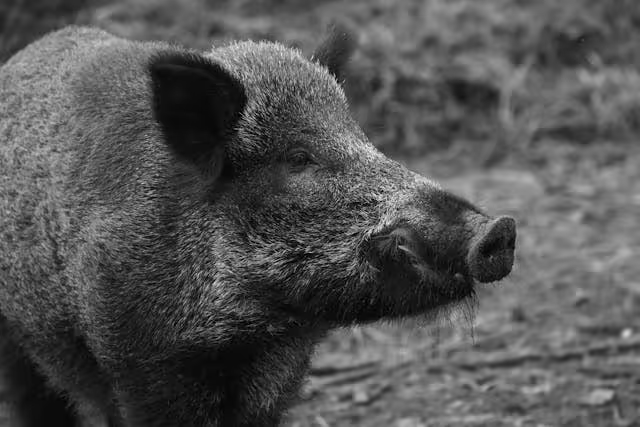
When we think of the pig today, it is often as a farm animal - a slightly comical creature grunting in the barn, or as a symbol of gluttony and earthy abundance. In the Norse world the pig - and especially the boar - held a far more complex and powerful role. For the people of the Iron Age North, the pig was not only a source of food, but an animal steeped in symbolism: warrior strength, magical power, gatekeeper of death and the mark of royal power.
The boar's double face
Norse mythology and literature show us a twofold image of the swine. On the one hand we find the fearsome wild boar - a wild and untamed animal that could be the enemy of heroes, a creature that stood for raw strength and deadly resistance. On the other hand we see the pig as an ally, a sacred companion animal for gods and humans, borne as a symbol on helmets, shields and banners. This duality - between the threatening and the exalted - made the pig a deeply meaningful being in the Norse world of belief.
Freyr, Freyja and the shining boars
The most famous swine in mythology are without doubt Freyr's Gullinbursti and Freyja's Hildisvíni. Gullinbursti, forged by the dwarves and adorned with golden bristles, could run faster than a horse through air and water, and shine so brightly that it lit up the darkness. He was seen not only as a sign of wealth and honor, but also as a symbol of invincible power in battle.
Freyja, the goddess of love and war, had her own boar - Hildisvíni, the "battle swine." The name points to the animal's connection to combat and heroism, not only fertility as many later researchers have assumed. The bond between Freyr and Freyja thus shows how the boar's role extends into war, magic and divine status.
The sacred swine of the feast
In Valhalla, the warrior's heaven, the boar Sæhrímnir was slaughtered and eaten every evening, only to rise again the next day. This eternal meal gave not only food, but also bore a deep religious symbolism: the pig became a bridge between death and life, an animal that could be sacrificed again and again, and yet rise. In this context the pig appears as an animal closely tied to the transitions between worlds, to death and rebirth.
Sacrifice, magic and seiðr
Archaeological finds show that pig bones often appear in graves and cultic contexts. Kovárová's research points to the fact that the boar's sacrifice was closely tied to magical rituals - perhaps especially seiðr - rather than to fertility cult alone. Where oxen could be sacrificed in legal and societal contexts, the pig sacrifice seems to have had a more ritual, magical and personal function.
The boar's place on the battlefield
A fantasy drawing of the battle swine
In the Iron Age the boar's image was found on helmets, weapons and banners. Warriors could identify with the boar, in the same way that berserkers identified with the bear or the wolf. The boar became a kind of totem animal, a warrior spirit that could give strength and fearlessness. Even the battle formation svínfylking - the swine array - bore the animal's name, and described a wedge formation in which the warriors charged forward like an angry herd of boars.
From totem to royal symbol
Especially in Sweden, and particularly in the Vendel and Viking periods, the boar's image became a mark of royal power. It was not only a sacred animal for the gods' retinue, but also an emblem of earthly authority. Archaeological finds of helmets and picture stones show the boar as a symbol of ruling power, related to the lion in other European realms.
Between paganism and Christianity
With Christianity, the pig's role gradually became more ambiguous. In the Bible the swine is associated with uncleanness, gluttony and demonic possession. This may have colored the view of the animal in later times, and contributed to the domestic pig acquiring a more negative ring, while the memory of the wild boar as a noble and fearsome animal lived on in sagas and folk memory. We must of course also take into account that the source writings we have about Norse belief are mainly written by Christians.
The pig in Norse belief is an animal with many faces: feared enemy, faithful companion, sacrificial animal, war symbol and royal mark. It was never merely "a fertility animal," as it has often been interpreted in the past. Instead, the Norse tradition shows us a pig that stood in the midst of the forces of life and death - an animal that could symbolize both food and magic, both earth and the world of the gods.
Where we today look at the pig with a smile or a shrug, the old Norsemen looked into the eyes of a creature that carried the very hidden forces of the world. That is something to think about the next time you eat ribbe.
Sources
Kovárová, Lenka (2011). The Swine in Old Nordic Religion and Worldview.
Beck, Heinrich (1965). Das Ebersymbol in germanischer Religion und Kultur.
Davidson, Hilda R. Ellis (1964). Gods and Myths of Northern Europe.
Simek, Rudolf (1993). Dictionary of Northern Mythology.
Turville-Petre, E. O. G. (1964). Myth and Religion of the North.
Jennbert, Kristina (2011). Animals and Humans: Recurrent Symbiosis in Archaeology and Old Norse Religion.
Sundqvist, Olof (2002). Freyr's Offspring: Rulers and Religion in Ancient Svea Society.
-1.avif)
-1.avif)