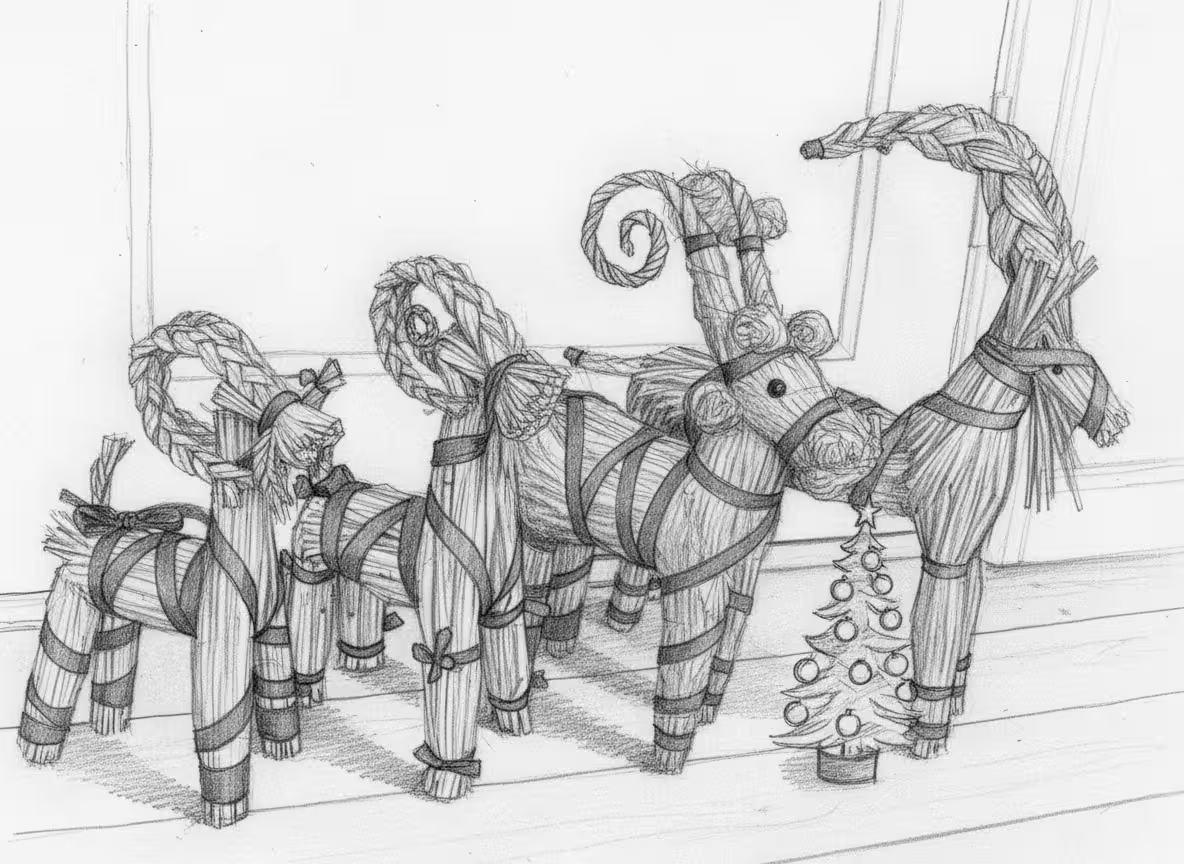
Christmas, as we know it today, is a composite cultural and religious layering of traditions with roots both in pagan pre-Christian rituals and Christian celebrations. To celebrate a pagan Yule is about reviving and honoring the old winter solstice and midwinter festivals (Yule/jól), as people in the North did for millennia before the introduction of Christianity.
Pagan Roots and Ancient Meaning
The name "jul" (Old Norse jól) derives from the ancient Germanic festival that marked the winter solstice or midwinter, a time when the return of the light was celebrated in the darkest period of the year. Exactly where and when the pre-Christian Yule was celebrated varies somewhat in the sources, but in Norway it was traditionally celebrated in the middle of January, which is tied to the lunar year and the phases of the moon. These festivals included sacrifices and blót (offerings) to Norse deities such as Odin (Jólnir), Thor, Freyr, and in Sweden also the god Ull. The winter solstice festival could last for several days with communal meals, rhythmic dances and rituals in honor of ensuring a good harvest, fertility and protection against the dangers of the darkness.
Although Christianity took over the Yule celebration, many of the pre-Christian traditions have lived on in various forms, often camouflaged in new customs.
The Yule Goat – Paganism in Living Olden Days
One of the strongest and most symbolic pagan Yule traditions in Norway is the Yule goat (julebukk). Originally the Yule goat was probably a billy goat that was slaughtered as a sacrifice to ensure a good new year, associated with the god Thor and fertility rituals.
In the tradition of "going julebukk," which was very widespread in Norway, Sweden, Denmark and Finland, people dressed up in skin furs and went around during the days after Christmas with goat or animal masks. They sang, played games, and received food and drink from the farms they visited. The masks could be grotesque, with horns, red cloth and goat hair, to frighten evil spirits and symbolize the goat. This practice has survived as a children's game in some areas, but the Norwegian Museum of Cultural History documents that the julebukk tradition was a social and ritual part of the days after Christmas until the latter part of the 20th century.
Behind the costumes lay a deeply ritualized play with identity, in which the players went into hiding and created excitement in the encounter with the mysterious – an echo of both blót and the capricious spirit forces of the dark season. This created social cohesion and connected the celebration to the forces of nature and the spirit of the ancestors.
Today one can use the Yule goat as decoration in the home, preferably in the form of decorative straw goats, and invite reenactments or costumes as a living reminder of the original meaning.
Decorative Objects with Pagan Origins
To create a more pagan Yule one can bring in a broad range of traditional decorations that give the celebration depth and a connection to nature and old faith.
Straw Goats
As mentioned, straw goats often hang in Norwegian homes at Yule. They are not merely decorative, but carry with them appeals to the god Thor and to fertility.
Juniper and Spruce
The use of evergreen branches such as juniper and spruce was common in pagan rites and served as symbols of the eternal power of life and protection against evil forces. Decorate the house or the altar with juniper wreaths.
Strew Straw on the Floor
In the old pagan Yule celebration it was common for the owners of the house themselves to lie down to sleep on the floor, which was often strewn with straw. This was done to give the ancestors room to sleep in the beds that were made up for them. It was believed that the ancestors actually returned on Yule night and used the beds to rest in, while the living themselves took their place on the floor. The custom of leaving the beds empty and the food set out throughout Yule is part of this ancestor worship, in which one honored the dead who were believed to visit the home during the holiday. The owners of the house were to sleep on the floor, while the ancestors were to have the beds.
Light
The lighting of candles was essential to honor the return of the sun. Instead of commercial candles, one can use beeswax candles or incense for a more ritual atmosphere.
Norse Symbols and Runes
Hang up runes or symbols tied to the gods of Yule, such as Odin (ravens, spear), Freyr (dwarf, sun symbol) and Thor (the hammer Mjölnir).
The Yule gnome as pagan protector: In modern versions one can view the gnome (nisse) as a continuation of the old farm spirit, the watchful barn spirit, to whom it was important to give gifts to ensure the protection of the farm.
Jòlaeld
In the northern traditions one could light a fire in the darkness to symbolize the rebirth of the sun, something that can also be recreated in modern contexts with fire or living candles outdoors.
Extinct and Forgotten Traditions
Many pagan Yule traditions have been lost, but we know of several customs that can be brought back to life.
Drinking Yule Ale
It was mandatory to brew ale for Yule, to drink it as a sacred offering to the gods and to ensure peace and good growth in the coming year. Brewing ale and sharing it can be an important part of a modern pagan Yule celebration, preferably with a blessing of the ale.
In the old Scandinavian Jòl celebration, the feast was a central part of the holiday. Yule was not only a time for private family gatherings, but also for open, ritual assemblies in which one invited friends, neighbors and kin to communal meals, drinking and sacrifices to the gods and the ancestors. These feasts could last for several days, often from the winter solstice and onward through the days after Christmas or all the way to the middle of January.
Holding a feast (often called jólablot or Yule blót) was a way to strengthen social bonds, honor the forces of nature and the ancestors, and ensure fertility and peace in the year to come. Food and drink, particularly mead and ale, had a sacred status and were used as offerings to the gods, especially Odin, Thor and Freyr. The guests often brought food with them, so that the meal became a shared contribution of good gifts and community. It was also common to set out an extra place setting after one had finished eating, to honor the dead relatives who were believed to visit the homes at Yule.
As for the holy days, the winter solstice (around 21 December) was the very starting point of the Yule celebration in Norse times. But the celebration lasted long beyond Yule night and could be extended to several important dates in the days after Christmas and in January.
A particularly important day was Eldbjørg Day (traditionally 13 January), which marked the end of the winter solstice period in the old lunar calendar. Then the guests were sent home. Eldbjørg Day was tied to protection and gathering around fire and warmth, as the cold was still strong and the family gathered to keep the fire alive and celebrate that the light was slowly returning. This day was also associated with rituals to protect houses and farms against dangers and evil spirits. On this day one could also celebrate by beating on bells, pots, drums and instruments to make noise that would scare evil forces away.
In addition, it was common to have several holy days in the period after Christmas that offered rituals, sacrifices and feasting – among them Jólagjǫf (the exchange of Yule gifts), and several days devoted to remembering and honoring the ancestors through food offerings, the lighting of candles and silence to open space for the presence of the dead.
Through such feasts and holy day celebrations, one expressed deep respect for nature, the passing of the seasons, and the community between the living and the dead. Reintroducing these rituals and holy days can enrich a modern pagan Yule celebration with meaning, history and cohesion.
Ancestor Worship
The customs of leaving food out for the dead or leaving the beds empty so that the ancestors could lie there gave a concrete connection with the ancestral atmosphere at Yule.
Oskoreia – Åsgårdsreia
A little less well known, but an old Scandinavian tradition about a terrifying spirit host that rides across the sky on Yule night. One could protect oneself against these by certain magical acts or symbols.
New Year's Goat
A continuation of the Yule goat tradition that takes place after Yule, preferably around 13 January. This too can be included in a pagan calendar extension.
The New Year's Goat was a continuation of the Yule goat tradition, and was practiced on select holy days toward the end of the Yule season, particularly on the 13th day of Yule (6 January) and the 20th day of Yule (13 January) in several Norwegian districts. The person who went as the New Year's Goat dressed up with a mask, horns and skin fur – just as with the julebukk – and went from house to house together with a costumed entourage. The aim was, as with the julebukk, to provide festivity and fun, to receive food, drink and gifts, while the procession also had roots in older ritual conceptions of protecting against evil forces and marking the transition into the new year.
The goat mask was often grotesque, made of wood or straw, painted red on the inside, and could have sparks in its jaws or other frightening effects. In Hallingdal and other rural communities one could make ingenious masks with horns, teeth and "a jaw full of embers." It was important to make the figures unrecognizable in order to create excitement, and according to folklore scholars the goat was meant to be the most frightening of all.
The New Year's Goat itself was a last chance for those who had not managed to go julebukk earlier, and the tradition was especially tied to the transition between the old and the new calendar, or into the new year. The procession helped to extend and conclude the Yule celebration with play, fellowship and a ritualized marking of the end of the dark season, and could last all the way to the 20th day of Yule.
The Yule Goat in Detail – Norwegian Museum of Cultural History
The Norwegian Museum of Cultural History has documented the julebukk tradition as it was in Norway in the 20th century, with roots reaching far back to the Middle Ages and earlier times. People dressed up as goats or other beings, often with homemade masks and skin furs, and visited houses to sing and receive food and drink.
This was both a social game and a symbolism of a rite of passage, in which the costume for a time concealed the person's identity, and the play between the familiar and the mysterious gave the celebration particular power. It was important to behave with moderation so as not to reveal oneself, and song and dance were a common part of the encounter with the hosts.
Toward the end of the 1800s the goat as a physical figure often disappeared, but the costumes and masks continued. From the middle of the 20th century, children became the main bearers of the tradition, and today's Yule goats often go about dressed in gnome costumes, whereas it was originally more frightening and wild.
The distinction from Halloween is interesting; while Halloween is commercialized and is about bought costumes and candy, the julebukk has a more traditional, ritualized and collective character. Although the tradition has been in retreat, there are still active circles that go julebukk.
How to Arrange a Pagan Yule at Home
To create a closer connection to the old traditions, one can:
Decorate with straw goats, spruce and juniper branches, and use living candles.
Have a communal meal that includes ale or other drink that can be used to "drink Yule" – that is, a blessed Yule meal in honor of the gods and ancestors.
Leave food out overnight, and think of the presence of the ancestors.
Learn and sing old Yule songs that were originally connected to the rites of Yule.
Carry out a julebukk procession among family and friends, where costumes and play create atmosphere and cohesion.
Respect the contrast of darkness and light, perhaps by lighting a fire or large candles outdoors, and make room for reflection and silence.
Read about and mark important holy days in the pre-Christian calendar, from for example the winter solstice to midwinter day.
Sources
Grønvik, Ottar. Jul i norrøn tid. University of Oslo, 2001. A thorough study of pre-Christian customs tied to Yule in Norway.
Pentikäinen, Juha. Oral Repertoire and World View. Studies in Scandinavian mythology and rituals, Helsinki University, 1996.
Sigurðsson, Jón Hnefill. Brennu-Njáls saga and pagan rituals. Icelandic medieval study with a focus on winter solstice rituals, 2007.
Nordberg, Andreas. "Jól and Old Norse Religion: The Pre-Christian Roots of Christmas." Scandinavian Studies, vol. 85, no. 3, 2013, pp. 341–368.
Danish Folk Museum. Yule traditions and folk culture in the North. Report published 2018 with fieldwork and interviews on traditional Yule celebration.
Norwegian Museum of Cultural History. Yule celebration in the old rural society, documentation and exhibitions, 2025.
Simek, Rudolf. Dictionary of Northern Mythology. D.S. Brewer, 2007. Provides an overview of Norse deities and rituals tied to the winter solstice.
Herschend, Frands, et al. Nordic Archaeology and Christianity: Interaction and Conflicts. Routledge, 2021. Includes chapters on Scandinavian memorial rituals in the winter season.
-1.avif)
-1.avif)