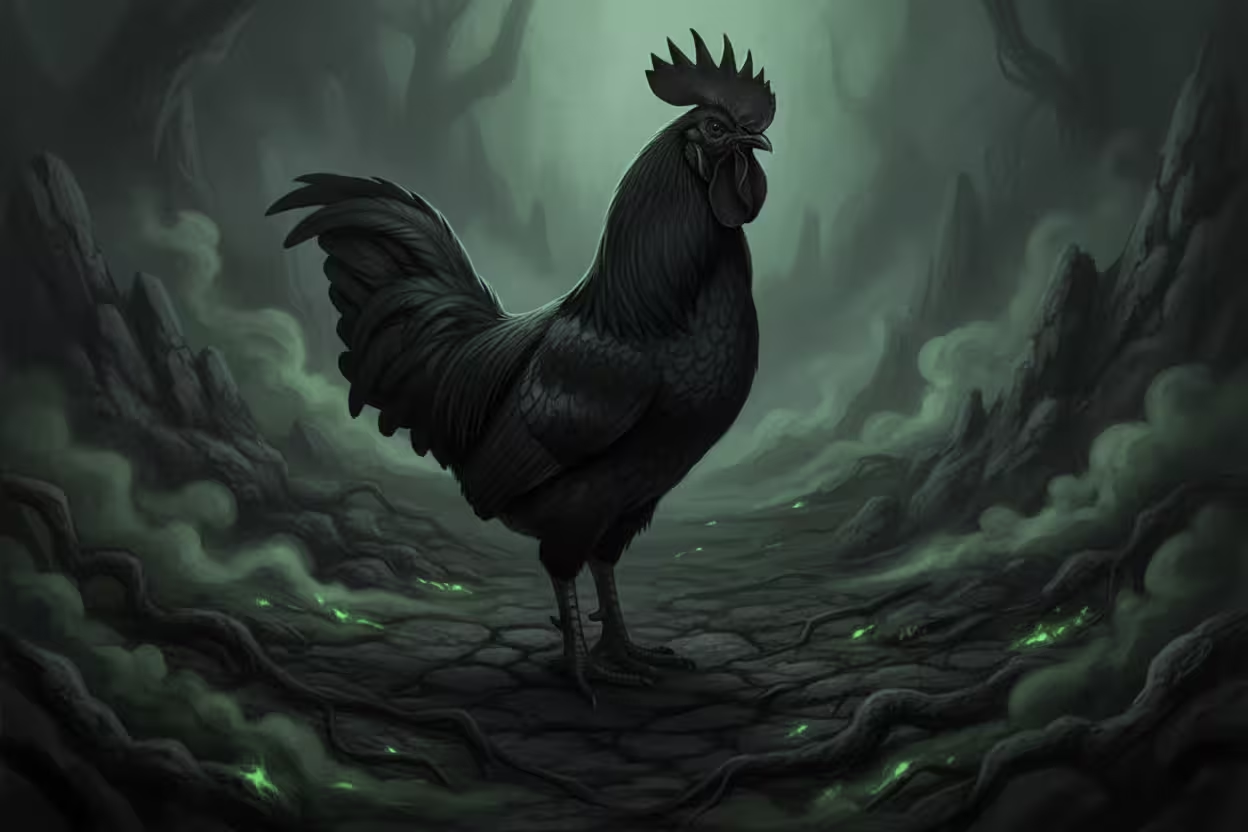
Through the centuries the rooster has been a symbol of transition and awakening, but in Norse mythology it holds a far deeper and more fateful role. Here the rooster is not merely the bird of the farmyard; it is the guardian of the world. With its voice it carries messages through the nine worlds, and its crowing marks both beginning and end, life and death, calm and Ragnarök.
When the rooster crows, it is not only the day that awakens. In the old understanding of the world, the cosmos itself is shaken. For in the Norse conception of time, time was not linear, but circular — an eternal cycle between creation and destruction. The rooster is the voice that sets this rhythm in motion, the link between night and day, between the worlds that live in fragile balance between light and dark.
Gullinkambi
In the brightest place in all the cosmos, in Valhalla, crows Gullinkambi – the golden rooster. The name means "golden comb", and it is said that he sits on the roof of the gods' hall, surrounded by the einherjar – the fallen warriors Odin has chosen for himself to fight on the last day of the world. When Gullinkambi crows, he calls the warriors to arms, and at his cry they rise, ready for battle.
But Gullinkambi is more than a herald of war. He is the very image of life force and awakening. His golden plumage reflects the morning sun, and his song clears the way for the light. The rooster is a living expression of the sun's eternal return, its daily victory over the dark – a symbol of hope in a universe where even the gods are doomed to die.
Thus Gullinkambi becomes the guardian of the light. He holds the night in check with his golden cry and reminds the world that life and light must be called forth anew each day.
Fjalar
In the world that stands closest to the gods, yet still on the outside, dwells Fjalar – the rooster with the glowing-red plumage. His name means "the lurking one" or "the one who hides something", and he belongs in Jotunheim, the realm of the primal forces and the giants.
When Fjalar crows, the world trembles. His red feathers glow like the fire beneath the mountain; he is the warning of the flame that shall consume everything at Ragnarök. In the Völuspá the rooster is described as red, and that is no coincidence. Fire and blood – the warmth of life and the wrath of death – merge in this symbol.
In the Norse imagination the red rooster was also an expression of fire. When a farm burned, people said that "the red rooster has settled on the roof". This shows a deep connection between the rooster and the spirit of fire – the destructive, but also cleansing, force. Fjalar represents this element: he is the fire that hides beneath the ice, the ember that smoulders in the darkness of chaos.
Where Gullinkambi stands for the awakening of the sun and the cycle of life, Fjalar is the primal fire that breaks the balance, brings change and leads to the end of the world. He is the brother of light, but also its dangerous twin. So when Fjalar crows, it is not to bring the morning light, but to cry the voice of fire through the worlds. It is the warning that the boundary between order and chaos shall be torn down, and the slumbering forces in Jotunheim begin to stir again.
The soot-dark rooster in Hel
Deep beneath the world, in Helheim, where the dead rest in the silence of the shadows, crows the third rooster. It is soot-dark, blackened by ash and night, and its song is not for the living. It wakes the dead, those who have slept in oblivion since their passing.
This rooster is the world's other extreme – the counterpart to Gullinkambi. Where the rooster of light wakes life, the dark rooster calls upon death. Where Gullinkambi brings sun and clarity, the soot-dark rooster brings silence and an ending.
But even here it is not only about destruction. For in the Norse understanding, Ragnarök is not an endless darkness, but the end of a cycle before new creation. The soot-dark rooster thus represents the transition to the next great cycle. His crowing reminds all life – gods, humans and giants alike – that nothing is eternal, and that the realm of death is a necessary part of the world's breathing rhythm.
The three roosters therefore make up a cosmic triad: Gullinkambi in Asgard, Fjalar in Jotunheim, and the soot-dark rooster in Hel. Their song is not random sound, but the pulse of the world – three notes in the great song of fate.
The three roosters at the end of the world
In the Völuspá it is described how these three roosters crow at the world's destruction – the first sign that Ragnarök is approaching:
Gullinkambi crows in Valhalla and wakes the dead heroes.
Fjalar, the red, crows in Jotunheim and summons the giants to battle.
The soot-dark rooster crows in Helheim and wakes the dead in the realm of death.
Their threefold crowing pierces the universe like three notes of fire. It is the sound of fate itself awakening. The fire stirs beneath the ice, and both gods and humans understand that the time for order is past.
Each rooster carries an element: Gullinkambi stands for air and light, Fjalar for fire, and the soot-dark rooster for earth and night. Together they usher in the great dissolution, when all shall burn, fall and be raised anew.
Between sun and flame
To understand the rooster's role in these myths, one must see how fire and light are connected in the Nordic understanding of the world. The light was never safe; it had to be born each day, fought forth and preserved in the encounter with the dark.
Fjalar's fire and Gullinkambi's sun are two sides of the same force – the life energy that can also destroy. When Fjalar's red feathers glow, it recalls the sun's own flames, but also the cleansing fire at the end of the world. The red rooster is both threatening and liberating: he burns the old, so that the new can sprout after Ragnarök.
Even the soot-dark rooster in Hel is part of this cycle. After Ragnarök it is said that a new earth shall rise from the sea, green and beautiful, with a new sun in the sky. Before this can happen, all the ashes of the old must be spread over the earth – and the ashes come from the realms of fire and death, from Fjalar and the soot-dark bird's call of doom.
A symbol of sound and spirit
The rooster in Norse mythology carries not only colour and flame, but also the power of sound. Its crowing is magical – a creative sound that moves worlds. In many Norse texts, sound and speech have creative power: galdr, rune-song, calling and the invoking of names are means of changing reality.
When Gullinkambi, Fjalar and the soot-dark one crow, it is the same creative and destructive voice that sounds in three notes. The three birds become the primal sound of the world – the first and the last resonance. It is the sound of the world's heartbeat: life being born, flame burning, silence returning.
The rooster's role in the world of humans
In Norse and later Nordic folk tradition the rooster lived on as a protective bird. It kept evil spirits away and announced the safety of dawn. But behind these folk beliefs lies the echo of the old myth: that the rooster protects because it is the gatekeeper between night and day, between spirit and matter.
The rooster could be seen as a symbol of the human being's own consciousness — the inner crowing that awakens the light of the mind. In this perspective, Gullinkambi is the human being's awakened spark, Fjalar the burning will, and the soot-dark bird the sleep that follows all life, the silence one must pass through to be born anew.
The echo of fire – the song of the red rooster
The red rooster's connection with fire holds a deep poetic dimension. Fire is both destruction and life-giver. It gives warmth, melts metal, creates tools – but it can also lay everything to waste. Fire is the most alive of all the forces of nature, and Fjalar is its bird.
It is therefore understandable that in folk belief people continued to use the expression "the red rooster" for fire. When the farm burns, and the flames lick at the roof, it is as if Fjalar himself has landed there – a heavenly fire-bird that reminds humans how fragile their existence is.
This link to fire shows how the Norse people saw the forces of nature as living and conscious. Fire was not an element, but a spirit – and the rooster was its voice. When the world one day is to be renewed, it will not happen in silence, but with the song of the blaze.
A myth of transitions
The three roosters in Norse mythology form a dramatic but profound whole. Each sings its own note in the music of the world:
Gullinkambi: the being of light, the guardian of the sun and the dawn.
Fjalar: the spark of fire and passion, the blaze of change.
The soot-dark rooster: the breath of the realm of death, the ending and the calm.
Together they remind us that all life is transition, movement, circle. The light is born, burns, fades – and is kindled again. That is why the rooster is a powerful symbol in the Nordic spiritual tradition: it is the voice that always awakens, even after the death of the world.
The song that carries everything
When the old poems describe how three roosters shall crow at the end of the world, it is not only a warning of doom or strife. It is a poetic image of how power moves between worlds.
The golden rooster calls upon the light of life, the red calls upon the transformation of fire, and the soot-dark calls upon the fragility of death. Together they proclaim one and the same message: that everything is connected in an eternal cycle.
The rooster is therefore not merely a bird that crows at dawn, but a symbol of the very breath of the world – of the rhythm between breath and silence, between flame and ash, between creation and decay. Each crowing reminds the human being to be awake, alive, taking part in the eternal song of the universe.
And when night and day once again change places, and the fire dances in the dark, one can almost hear the old echo from the morning of the world: the voice of the rooster singing through the mist of time.
Note: The descriptions above are based in part on Norse sources, but the whole reflects Sjamanistisk Forbund's own interpretation and symbolic understanding of the role of the roosters in the myths. Elements connected to cosmic cycles, light and fire, as well as the expanded meaning of the three roosters as a unified triad, are interpretations that go beyond what is directly stated in the Eddic poetry. The text is therefore a meeting between historical mythological material and our own spiritual and poetic tradition.
Sources:
Völuspá
Gylfaginning
Grímnismál
-1.avif)
-1.avif)