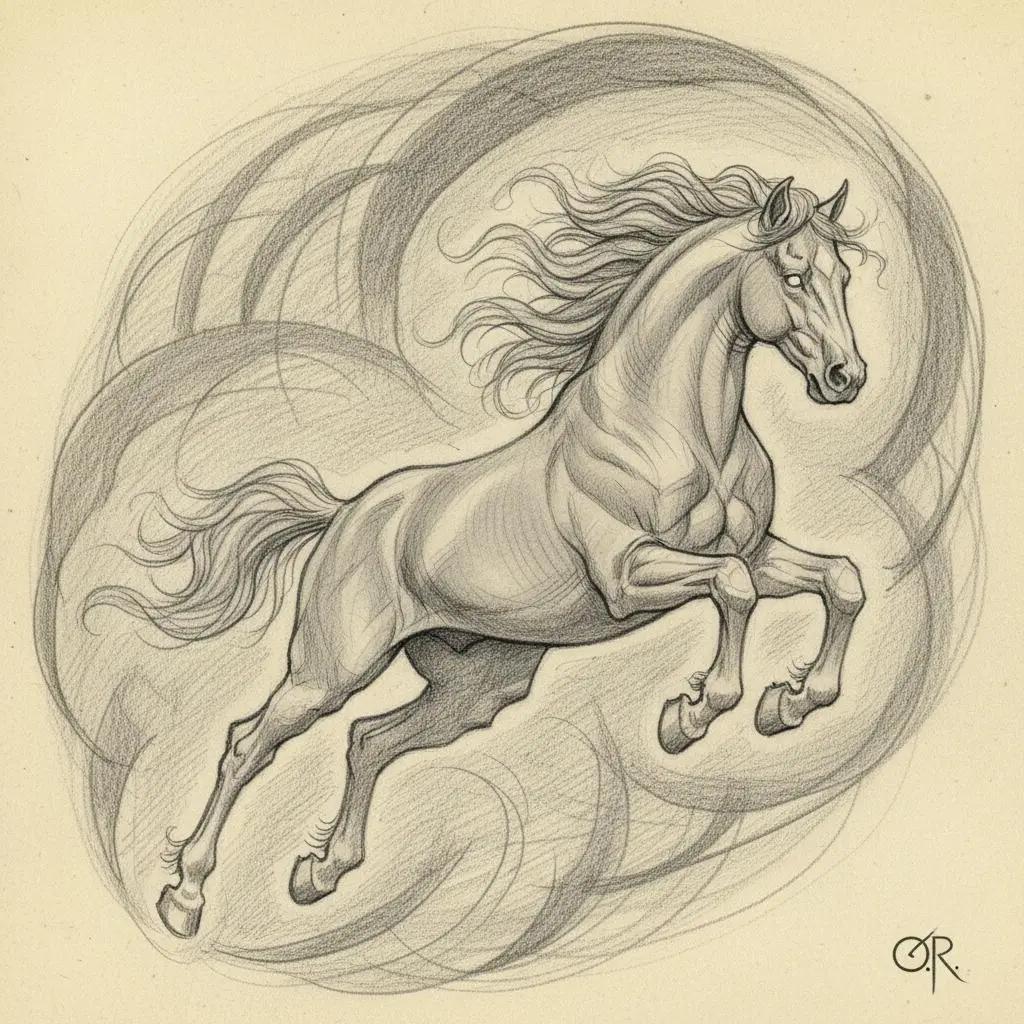
Imagine a time when the horse was not merely an animal in the stable, but a key to other worlds. For the Norse peoples the horse was a companion in life, an escort in death, a sacrifice to the gods - and a being with mysterious powers.
In this article we will take a closer look at the horse in Norse culture, both in everyday life, in burial customs, in the sagas and in the great myths. At the same time we will hear the voices of the old sources themselves - from poems, sagas and myths that lived on in oral tradition before they were written down.
The horse in everyday life
In Iceland and Scandinavia the horse was essential for survival. It carried hay and firewood, transported fish and goods, and helped gather sheep in the mountains. It carried farmers and chieftains to the thing, and was a sign of status and power.
As Snorri's Heimskringla says of King Adils in Uppsala:
"Adils konungr var at dísablóti ok reið hesti um dísarsalinn. Hesturinn drap fótum undir honum ok fell, og konungr brast haussinn mot stein." (Ynglinga saga, ch. 29)
"King Adils was present at the dísablót and rode a horse through the hall of the dísir. The horse stumbled, fell, and the king struck his head against a stone and died."
Here the king's death is tied to a horse ride in a religious ritual - an example of how the horse could be a focal point both in everyday life and in cult.
Even entertainment was tied to horses. Horse fights were a popular sport, but could end bloodily. In Brennu-Njáls saga, Njál foretells that a horse fight will have serious consequences:
"You will win the next horse fight, Gunnar, but it shall cost many men's lives." (Njáls saga, ch. 59)
And so it was - a simple horse fight unleashed a blood feud.
The sacrificial horse
The horse was one of the most valuable sacrifices one could give to the gods. It was especially connected to the fertility god Freyr.
In Hrafnkels saga we meet the chieftain Hrafnkell, who had a horse he called Freyfaxi. This horse was so sacred that Hrafnkell swore an oath:
"I loved this horse so dearly that I took an oath to kill the man who sat on his back without my permission." (Hrafnkels saga Freysgoða, ch. 2)
When a young herdsman breaks the prohibition and rides Freyfaxi, he is killed - as the oaths demanded. For Hrafnkell the horse was more than an animal; it was a sacred link to the god Freyr.
The grave horse - journey to the next life
Archaeological finds show us that many were buried with horses. In the Oseberg find from the 9th century, not only were two women laid in a magnificent ship - but also several horses, as if they were to accompany them on the journey.
Snorri tells in Ynglinga saga that Odin himself laid down the law that the dead should be burned with their possessions:
"All dead men should be burned on the pyre with their possessions. What they had brought with them, they would enjoy in Valhalla." (Ynglinga saga, ch. 8)
It was therefore natural to give the dead a horse as well - saddled and bridled, so that the rider could ride on in the realm of the dead.
In Egil Skallagrímsson's saga we hear that Egil's father, Skallagrim, was buried with his horse. This was not unique, but part of a broad tradition that shows how strongly the horse was tied to life after death.
The horse as the messenger of death
In the sagas we meet horses that foretell death. Dreams of horses could be interpreted as evil omens.
In Vatnsdæla saga, Þorkell silfr dreams that he rides a red horse. He interprets it positively, but his wife Signy says:
"Sýnisk mér þetta illr draumr ... en marr er manns fylgja. Rauða sýnask ef blóðug yrði. It may be that you will fall at the thing." (Vatnsdæla saga, ch. 42)
"This seems to me a bad dream ... a horse is a person's fetch. It appears red if it is to become bloody. Perhaps you will fall at the thing."
And she is proved right - Þorkell is killed. The horse in the dream was not a good sign, but an omen of blood.
In Gísla saga Súrssonar the hero meets a dream interpretation even more clearly. He dreams of a woman who rides a gray horse, and she invites him to "come home with her." Gísli understands that this is a sign of his own death.
The gods and the horses
In the myths the horses are even more important. The gods themselves ride horses daily as they cross Bifröst, the rainbow bridge that leads to the thing-place.
The most famous horse is Sleipnir, Odin's eight-legged steed. Snorri describes him thus:
"Best is Sleipnir, he is Odin's horse, and he has eight legs." (Gylfaginning, ch. 15)
Sleipnir could travel between all worlds - through air and fire, to the realm of the dead, Hel, and back. He was the link between life and death.
When Balder dies and the god Hermod rides to Hel to ask for his release, it is Sleipnir he rides. Sleipnir is thus the very symbol of the journey between life and death.
The world tree Yggdrasil is also connected to the horse image. The name can be interpreted as "Odin's horse." When Odin hanged himself in the tree to win wisdom, the tree was spoken of as his "horse." Here we see how the horse image extends all the way to the cosmos itself.
The valkyries on horseback
On the battlefield came the valkyries - the goddesses of fate who rode to fetch fallen warriors to Valhalla.
In Vǫluspá the sight is described thus:
"She saw the valkyries come from far and wide,
ready to ride to the people of the gods.
Skuld bore the shield, Skögul another,
Gunnr, Hildr, Göndul and Geirskögul" (Vǫluspá, verse 30)
The völva sees them "ready to ride" to the gods. Their horses were swift and mighty, and they carried the fallen warriors to Odin's hall.
There awaited an eternal life where one rode out to mock-battle each day and returned to drinking feasts in the evening. The horse was thus not only part of the journey to death, but also part of the life after death.
The horse as a boundless creature
All this points toward one idea: the horse was a crosser of boundaries. It lived on the farm, but could also move in the myths, in dreams, in the realm of the dead.
It could bring prosperity and fertility, but also death and destruction. It could be a friend and companion, but also a deadly enemy.
As the researcher Katrín Sif Einarsdóttir expresses it in her study:
"The horse served not only as a means of transport for the living and the dead, but as a shaman in Norse culture - a being that could move between the mortal and the mythological, between the conscious and the supernatural."
The horse's legacy
When we look at the sagas, the poems and the finds, the picture becomes clear: for the Norse peoples the horse was not merely an animal. It was a key to the understanding of the world and all that lay beyond.
From Freyfaxi in the sagas, to Sleipnir in the myths, to the horses that rest in the ships at Oseberg and Gokstad - everywhere the horse is present as a bridge between worlds.
And perhaps that is why we are still fascinated by it. The horse in the Norse world reminds us that the boundaries between life and death, dream and reality, have always been more fluid than we think.
Toward the end of the Viking Age a great change took place: both ritual horse sacrifice and the eating of horse meat were gradually forbidden in the North. This happened in parallel with the Christianization of Scandinavia, especially from the year 1000 onward.
Church prohibition against horse meat
With the arrival of Christianity, the church wished to suppress pagan customs - and the horse had held a central role in pre-Christian religion, both as a sacrificial animal and in cultic meals. As early as the year 732, Pope Gregory III introduced an explicit prohibition against newly converted people eating horse meat, because it was seen as a "pagan" food tied to old rituals. This prohibition later spread to Norway and Iceland when the countries were Christianized - and Olav Tryggvason is known for having punished those who ate horse meat during Yule or other festivals.
Legal and social consequences
The prohibition against horse meat was also written into the law. The Gulating Law established that all domestic animals could be eaten - "with the exception of horse, cat and dog." Eating horse meat became associated with paganism and could lead to expulsion or milder forms of exile, according to the sagas and laws of the Middle Ages.
Persistent practice and gradual decline
Despite ecclesiastical and legal prohibitions, archaeological finds from throughout the Middle Ages show that many continued to slaughter and eat horse in secret. Bones from horses found in towns and settlements bear traces of slaughter and food preparation, which suggests that old traditions continued for a long time beneath the surface, in some places all the way into more recent times.
The prohibition against horse meat was first lifted in the 19th century, when famine and social changes led to a new acceptance of the horse as a food resource.
Sources
Einarsdóttir, Katrín Sif. The Role of Horses in the Old Norse Sources: Transcending worlds, mortality, and reality. Master's thesis, University of Iceland, 2013
Davidson, H. R. Ellis. Gods and Myths of Northern Europe. Penguin Books, 1964.
DuBois, Thomas A. Nordic Religions in the Viking Age. University of Pennsylvania Press, 1999.
Andrén, Anders. Old Norse Religion in Long-Term Perspectives. Nordic Academic Press, 2007.
Price, Neil. The Viking Way: Magic and Mind in Late Iron Age Scandinavia. Oxbow Books, 2002.
Jochens, Jenny. "The Horse in Old Norse Culture." Speculum 74, no. 3 (1999): 627-637.
Loumand, Ulla. "Riding Graves: The Burial of Horses in Viking Age Scandinavia." Acta Archaeologica 76 (2005): 1-32.
Karlsson, Gunnar. The History of Iceland. University of Minnesota Press, 2000.
Oexle, Otto Gerhard. Memoria als Kultur. Göttingen: Vandenhoeck & Ruprecht, 1984.
Turville-Petre, E. O. G. Myth and Religion of the North. Greenwood Press, 1964.
-1.avif)
-1.avif)