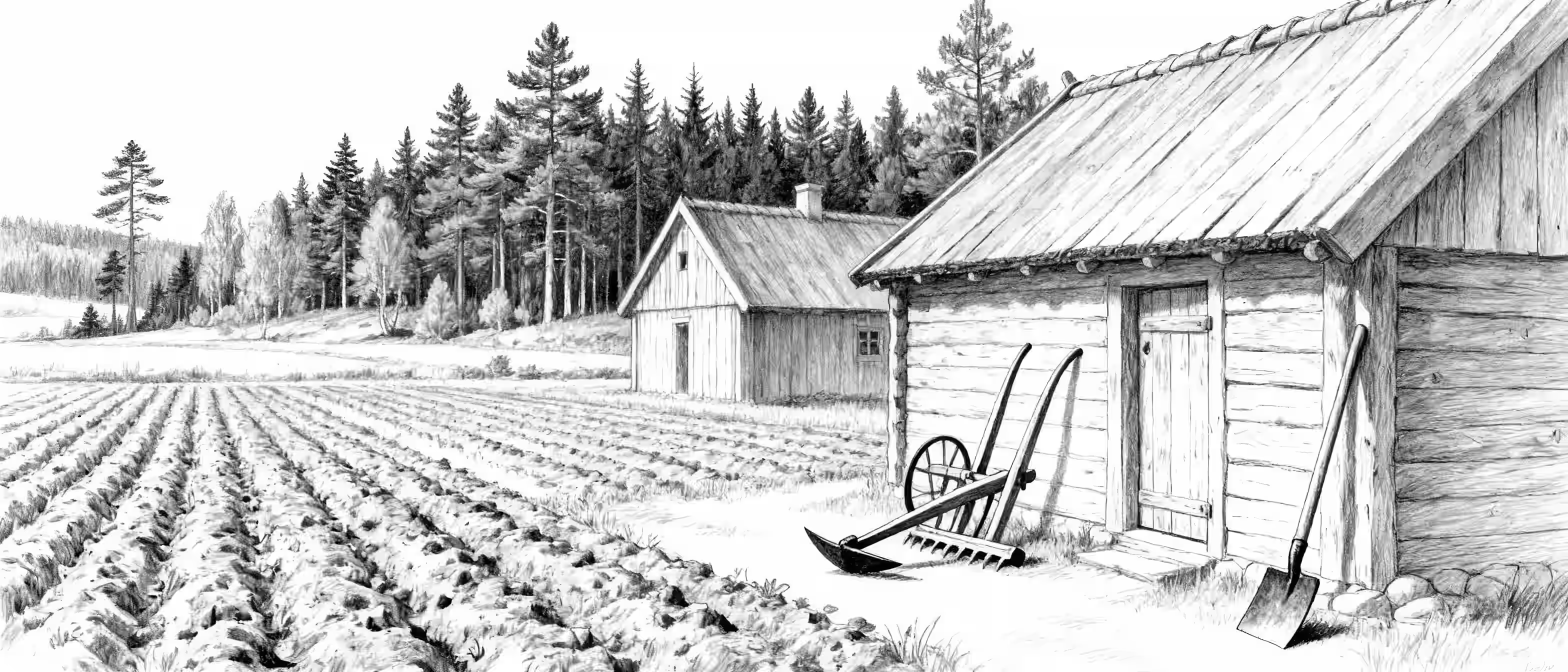
Imagine a journey back to the Viking Age of the North. The forests are deep, the sea endless, and over burial mounds the spirits of the past hover in the twilight. Together with ordinary people – farmers, fishermen, craftsmen – there exists a powerful but diverse spiritual practice, which for centuries has been called "paganism." But how do we really know what they believed in, and who has told us the story?
When Power Wrote the History of Religion
As early as the 11th century the Nordic peoples encountered Christian missionaries who saw pagan faith through the lens of the gospel. Adam of Bremen described, among other things, the sacrifices at Gamla Uppsala as brutal, with heads and corpses scattered in sacred groves for the sake of fear and disgust. His depiction was not merely a report, but a powerful political and religious message to his superiors. These were people whom it was morally right to Christianize, by force if necessary.
Behind such accounts lay more than curiosity. They served a purpose – to justify mission, conversion and ultimately the king's and the church's introduction of new laws and institutions. Adam as a source was never free of political motives, and his narrative set the frame for both contemporary and later views of Norse faith.
Research as Myth-Making
In time, the gaze upon the old faith was taken over by kings, bishops, aristocrats and educated antiquarians such as Ole Worm and Olof Rudbeck. The former aimed to give Denmark a magnificent prehistory by interpreting runestones and burial mounds, but allowed himself to be steered by King Christian IV's national agenda, and gave space to fanciful "folk traditions" that fit the desired story of the country's greatness.
Rudbeck went even further. With King Karl XI as spectator, he wished to prove that Gamla Uppsala was Atlantis – the primal source of all culture. The evidence was tailored to the hypothesis, and the excavations bore the mark of a hunt for legends rather than sober science. Here the burial mounds were not merely the resting place of the dead, but a symbol of national identity built on biased maps, biblical references and wishful thinking.
When Ordinary People Did Not Get Their History
The Christianization of the North is often told as the work of kings and saints – powerful men and martyrs – recorded by priests and officials. What about all the ordinary people? Many archaeological finds suggest that Christianity in reality crept in through trade, marriage and cultural encounters for a long time before the massive royal conversions.
Frequently the process involved incorporating local customs and symbols so that the transition between "paganism" and Christianity became gradual. Nevertheless there is little documentation of this process, precisely because written culture was introduced with Christianity, and the narratives of officialdom became the ones deemed worth preserving. The religious history of ordinary people – life on the farm, in the fisherman's hut, under the midnight sun – therefore often disappears behind the narratives of the elite.
The Court Records' Judgment on the Old Faith
A powerful example is found in the trial of Poal-Ánde/Anders Poulsen, a noaidi from Varanger. In 1692 he was brought before the court, and his rune drum was confiscated. He explained that his prayers to "God the Father" and the Holy Spirit were in fact mixed with full respect for the spirits of nature and old customs. His faith was integrated and lived out in everyday life. But for the judges and missionaries this was a lifeworld that had to be demonized and removed, and rune drums, taken by force – the very symbol of contact with the spirit world – were burned at the stake or given away as exotic souvenirs to great men, to mark the triumphant advance of Christianity.
The story of Poulsen tells us that it was not the "heathen" himself who wrote his story. The court records became the voice of the elite. And the everyday religion, in which animism and Christianity went hand in hand, was not recognized as valid faith or worthy of preservation.
Cult Specialists Without Privileges
The Norse peoples did not have a professional priestly class such as Christianity acquired. The Gode and Gydja led rituals in the hof, but were not necessarily the nobility of society. Their role is sparsely described in rune fragments and archaeological finds, but most of what we know about them comes by way of the sagas – and through Snorri Sturluson, the Icelander who wrote the classic Edda texts several hundred years after the Viking Age and with a Christian worldview as his frame.
This means that what we think we know about Norse religious practice is often filtered through a Christian worldview – from Snorri's rationalization of the gods as humans, to the sagas' named kings and ancient lineages, in which the faith of the farmer, the woman and the craftsman is cast into shadow.
When Rituals Are Given the Face of an Enemy
In several of the Christian writings, Norse rituals are portrayed as indescribably cruel. Blót and sacrifices are depicted as bloody and as bringing death to both humans and animals. What was the aim of such descriptions?
Often they were a rhetorical weapon in Christianity's struggle for souls. By painting the original faith as frightening and incomprehensible, it became easier to justify both legislation and forced conversion. The elite had no interest in understanding the original meaning of the rituals, as long as they could be classified as "pagan barbarities." In this way the faith of ordinary people was also demonized and seen as an obstacle to "proper" social development.
Archaeology's Silent Testimony
Today archaeology gives us insight into the rituals and faith as they were lived by ordinary people. The finds of bog bodies, amulets, cup marks and mound dwellers tell of a diversity of practices tied to both supernatural beings and the spirits of the lineage. The Tollund Man, for example, gives us traces of human sacrifice in Scandinavian bogs – not as a uniquely barbaric ritual, but as part of the worldview of the time in which the spirits were alive among the people.
Weapons, jewelry and objects sunk in lakes, as at the Illerup find, can be interpreted as sacrificial acts to preserve the balance of society – far more than blood-dripping grotesqueries. But such concrete traces give us only hints. They say little about the myths, songs and symbols that were important to ordinary people – all of this is filtered out or altered by those who wrote the "official" history.
Snorri and the Sagas in Christian Garb
Snorri Sturluson writes in the 13th century, long after Christianity had become dominant, and with an agenda to weave the sagas into an understandable, (for his contemporaries) Christian world history. The gods are given roles that partly reflect Christian saints, rites are ordered according to Christian moral concepts, and the deities are rationalized away from chaos and sexuality.
We see this clearly in the sagas' toning down of the uncontrolled power of women and of the gods – it would have been too destabilizing for the church's social order. The Finns and the Sami, the peoples who lived in the borderland between the Norse and the Russian Orthodox worlds, also do not have their stories fully told. They constitute a backdrop for the elite's narrative of kings, priests and nation-building.
New Perspectives and Forgotten Wisdom
The methodical gaze of modern archaeology has made it clear that the narrative of the elite and of Christianity has long determined which parts of Norse faith were to be preserved and interpreted. Research now turns its gaze away from the narrative of the church and the king toward the rituals, symbols and objects of ordinary believers.
Through excavations and interpretations of stone, bone and runes we can gradually bring forth the lives that were never written down, and give voice to all those whose religion was alive but never "official." Norse society was not merely a story of the conversion of kings and battles between gods. It was also the magic of everyday life beneath the stars, lost in silence, but preserved in the deep darkness of the burial mound.
Sources
Main, Austin. "The Roots of Old Norse Religious Studies: The Eclipse of Archaeological Empiricism over Nationalism Christocentrism." (2015). Bachelor Thesis, Washburn University. [Attached report]
Andrén, Anders. "Behind Heathendom: Archaeological Studies of Old Norse Religion." Scottish Archaeological Journal, 27, no. 2 (2005).
Anderson, Sven Axel. "The Attitude of the Historians Toward the Old Norse Sagas." Scandinavian Studies and Notes 15, no. 8 (1939): 266-274.
Bugge, Sophus. "The Home of the Eddic Poems, with Special Reference to the Helgi-Lays." London: David Nutt, 1899.
Cawley, Frank Stanton. "The Figure of Loki in Germanic Mythology." The Harvard Theological Review 32, no. 4 (1939): 309-326.
Olsen, Olaf. "Hørg, Hov og Kirke: Historiske og Arkæologiske Vikingetidsstudier." Copenhagen: G.E.C. Gad, 1966.
Pontoppidan, Erich. "Den danske Atlas I." Copenhagen, 1763.
Rudbeck, Olof. "Atlantica" (1679).
Worm, Ole. Various Letters and Antiquarian Works (early 17th century).
Gardela, Leszek, and Carolyne Larrington. "Viking Myths and Rituals on the Isle of Man." Nottingham Centre for the Study of the Viking Age, 2014.
Lindqvist, Sune. "Uppsala Högar och Ottarshögen." Stockholm: Wahlström & Widstrand, 1937.
Nerman, Birger. "Vilka konungar ligga i Uppsala högar?" (1913).
Jensen, Ola W. "Earthy Practice Towards a History of Excavation in Sweden, in the 17th and 18th Centuries." Current Swedish Archaeology 12 (2004): 61-82.
Trigger, Bruce G. "A History of Archaeological Thought." New York: Cambridge University Press, 1989.
Byock, Jesse L., translator. "The Prose Edda" by Snorri Sturluson. London: Penguin Group, 2005.
-1.avif)
-1.avif)