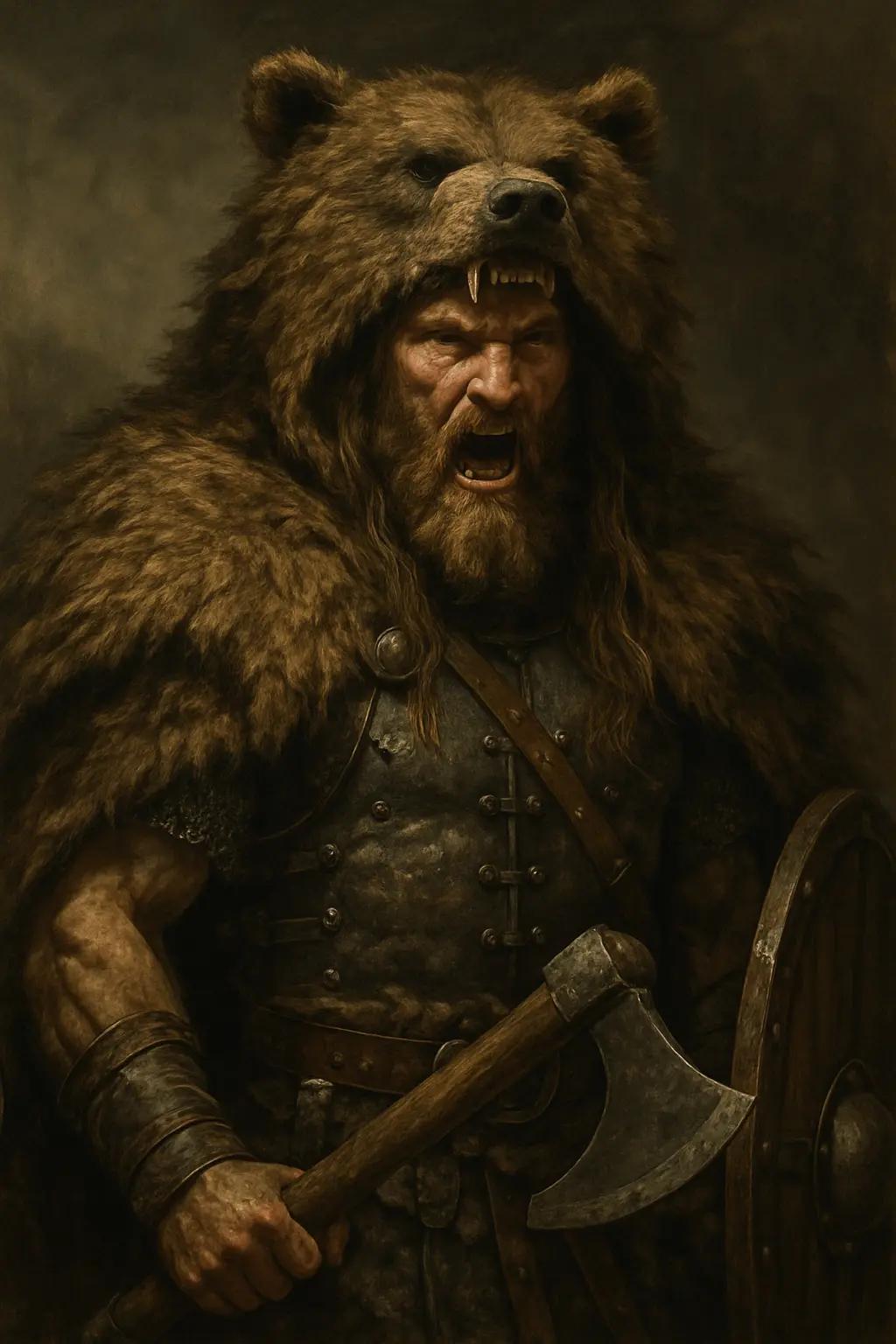
The bear in the realm of saga and spirits
Nordic sagas are full of heroic deeds, honorable battles and strange beings, but few stories are as gripping and mysterious as the passage in Hrólfs saga kraka where a giant bear suddenly leads the Danish forces against the enemy. What at first appears as a classic example of supernatural strength and magic reveals deeper roots - not only in Norse folk poetry, but also in Sami religious notions and rituals connected to the bear. How does such a bear mythology arise in an Icelandic saga, and what traces of Sami shamanism and culture can be traced in the saga's reworking of this material?
To understand this we must move from the literary universe of the saga back to a time when nature, spirit and human were inseparable components of the worldview for most people. We will follow the story of Bødvar Bjarke from birth to death, searching for similarities and borrowings between Sami bear cult, Eurasian shamanism and Nordic berserker rage.
Bear shape, soul journey and battle
In Hrólfs saga kraka, preserved in 17th-century manuscripts but thought to have been written in its present form around late-medieval Iceland, we meet Bødvar Bjarke ("little bear"). During a decisive battle against Hjǫrvarðr, it is told that an enormous bear fights side by side with King Hrólfr's men. The saga describes how the bear strikes enemies dead with its paw, withstands weapons, and instills fear in the enemy ranks. However, it turns out that this bear is not merely an unusual animal, but a manifestation of Bødvar Bjarke's free soul on the battlefield, while his body is at the same time in deep trance elsewhere, clearly rooted in something far older: shamanic ecstasy and so-called shape-shifting.
Such notions have parallels in Eurasian shamanism, where the shaman can send out his soul in animal form while the physical body lies motionless behind. Tolley points to similar ideas among the Sami, where the bear holds a central place in religion and rites. More important than the notion of the berserker who transforms into an animal in battle is the connection to the notion of the soul's ability to take animal form - an idea that dominates shamanic religions, but which is apparently far more peripheral in Germanic tradition. Thus the saga points to cultural transmission rather than direct descent from Norse folk religion.
Bødvar Bjarke - half bear, half human
The background to Bødvar Bjarke's bond with the bear is elaborated later in the saga. His father, Bjǫrn ("Bear"), is transformed into a bear by Sami sorcery cast by his Sami stepmother. He lives a double life as a bear by day and a man by night. His beloved, Bera ("She-bear"), seeks him out in bear shape and spends time in a cave, where she eventually bears his child. When Bjǫrn dies, she takes with her the ring he has hidden beneath his left shoulder - a motif also found in Sami bear tales and cult practices where a "ring" or symbol forms the connection and inheritance between generations and animal power.
Bera has three sons: one with elk-like features, one with dog-like features, and Bødvar, the human one, but with the bear's strength and nature. That the union between bear and human ends with the offspring becoming both human and animal has parallels in various indigenous traditions, including among the Sami and indigenous peoples of Siberia and North America.
Ritual, totem and myth
The bear held - and in part still holds - a unique position in Sami religion. It was not only a feared predator, but a sacred totem animal, often regarded as a forefather of certain families or clans. Bear hunting was accompanied by an extensive ceremonial practice and taboo rules: the bear had to be treated with respect before, during and after the slaughter, with ritual washing and division, particular sacrificial acts and songs, and special restrictions for women and children.
In the classic ethnographic work of Pehr Fjellström, the priest who in the 18th century documented living bear rites among the Sami, a mythic narrative is described in which an outcast sister seeks shelter in the bear's cave, the bear takes her as wife and has children. When the bear at last allows itself to be hunted and killed in the snow, it demands that a piece of brass be fastened to its forehead "so that the son shall not come to kill him." The sister's sons also demand their share of the meat, and when it is denied them, they threaten to wake their father by striking the bearskin - whereupon the meat boils over in the pot (an echo of animistic practice). According to the rules, women must view the bear hunt/feast through brass rings, and contact with the bear meat is taboo. This ritual has analogies far into Siberian and Uralic bear cult, and its similarity to the saga's motifs is striking.
There are also examples of bear tales in northern Sami and Finnish folk belief where animal ancestors give rise to particular groups/clans, something similar to the elk and wolf motifs in the saga.
How did the bear rites merge with Norse storytelling tradition?
Why do we find remnants of Sami bear ideology in an Icelandic saga? The contact zone between Norwegians and Sami was particularly active throughout the Viking Age and the Middle Ages. Norwegians had - especially in northern Norway and Trøndelag - long and close contact with Sami religion and magical practice, which resulted not only in Norse notions of "Finn magicians" (the term used for the noaidi at the time), but also in direct cultural transfers regarding belief in shape-shifting, power animals and power objects.
That the saga further, as Tolley points out, presents this passage as fantastical and with magical borrowings from both folk tradition and religious rituals, supports the idea that the author did not necessarily have deep knowledge of all the layers, but knew the motifs, perhaps through oral tradition from Norwegians who once lived near the Sami.
Ritual, initiation and loss
As the saga presents it, Bødvar Bjarke's bear episode can be read both as an exemplification of an initiatory transition (from childhood to manhood, from human to superhuman/animal) and as a dramatic tale of strength, transformation and loss. The bear's death and division can be interpreted literally, as an initiation into magical powers or a transfer of qualities from animal to human, as is found in totemistic religious systems.
In the Icelandic milieu where the saga was shaped, the bear was no longer a religious totem, but the saga preserves some of the old functions - for example the magic ring hidden beneath the bear's body (a symbol of power, inheritance and identity), and taboos surrounding the consumption of bear meat. This reflects both foreignness ("the other") and nostalgia for lost magic and heroism.
Between Norse berserker rage and Sami shamanism
The berserker - the ecstatic warrior - is a central theme in the sagas, but in contrast to the bear shape of the free soul, little has been found in Germanic tradition that suggests a formal "soul journey" of the shamanic type. How much of the "berserker rage" in the sagas is then an attempt to explain the primitive and animal in battle? Perhaps Norse poets, through continuous contact with Sami culture, incorporated elements that made sense in a new, more Christianized and at the same time folkloristic storytelling tradition, without understanding or transmitting all the rituals behind them.
From saga to world literature
The myth of the bear transformation and the ecstatic warrior exists in various forms across all of Eurasia and North America: from the Finnish bear hunt to the Siberian bear masquerade and the North American Tlingit tale in which a woman marries a bear, and their sons become half-bears, half-humans. This is not a matter of direct transmission, but of a universal world of motifs in which nature and society are interwoven in ritual, myth and magic.
Hrólfs saga kraka as a cultural encounter
Hrólfs saga kraka is not merely a tale of heroism and supernatural powers. Through its mythic-folkloristic reworking of Sami (and typically Eurasian) bear rites, the saga exemplifies a rare glimpse into a multicultural, cross-ethnic encounter of the past between Sami animism, Nordic heroism and the intangible magic that arises in the borderland between traditions. The localization the saga makes - with the Sami princess as antagonist - shows that Nordic storytellers had both contact with and respect for the power of the Sami bear myth.
The saga leaves no doubt that behind today's literary tale lie millennia of ritual, belief and practice. To understand the saga as a cultural artifact requires that we see beyond the heroic action and to the core of what the bear was: bearer of life, death, spirit and power - and, in keeping with Sami tradition, eternally reborn and recycled in the world's natural and supernatural order.
Hrólfr kraki is today regarded mainly as a legendary, non-historical figure, whose life and deeds live primarily in sagas and legends rather than reliable historical sources. Nevertheless, it is clear that the stories of Hrólfr and his men draw inspiration from real events, people and milieus in the early Middle Ages, and that the sagas combine historical reminiscences with mythic and folk motifs.
Sources
Tolley, Clive (2007). "Hrólfs saga kraka and Sámi bear rites." Saga-Book, Viking Society for Northern Research, vol. XXXI.
Fjellström, Pehr (1755/1981). Kort berättelse om Lapparnas björna-fänge.
Edsman, Carl-Martin (1994). Jägaren och makterna: samiska och finska björnceremonier.
Honko, Lauri et al. (1993). The Great Bear: A Thematic Anthology of Poetry in the Finno-Ugrian Languages.
Pentikäinen, Juha (1999/2007). Kalevala Mythology / Golden King of the Forest.
Simek, Rudolf and Pálsson, Hermann (1987). Lexikon der altnordischen Literatur.
Karsten, Sigfrid Rafael (1955). The Religion of the Samek.
Norman, Howard (1990). Northern Tales: Traditional Stories of Eskimo and Indian Peoples.
-1.avif)
-1.avif)