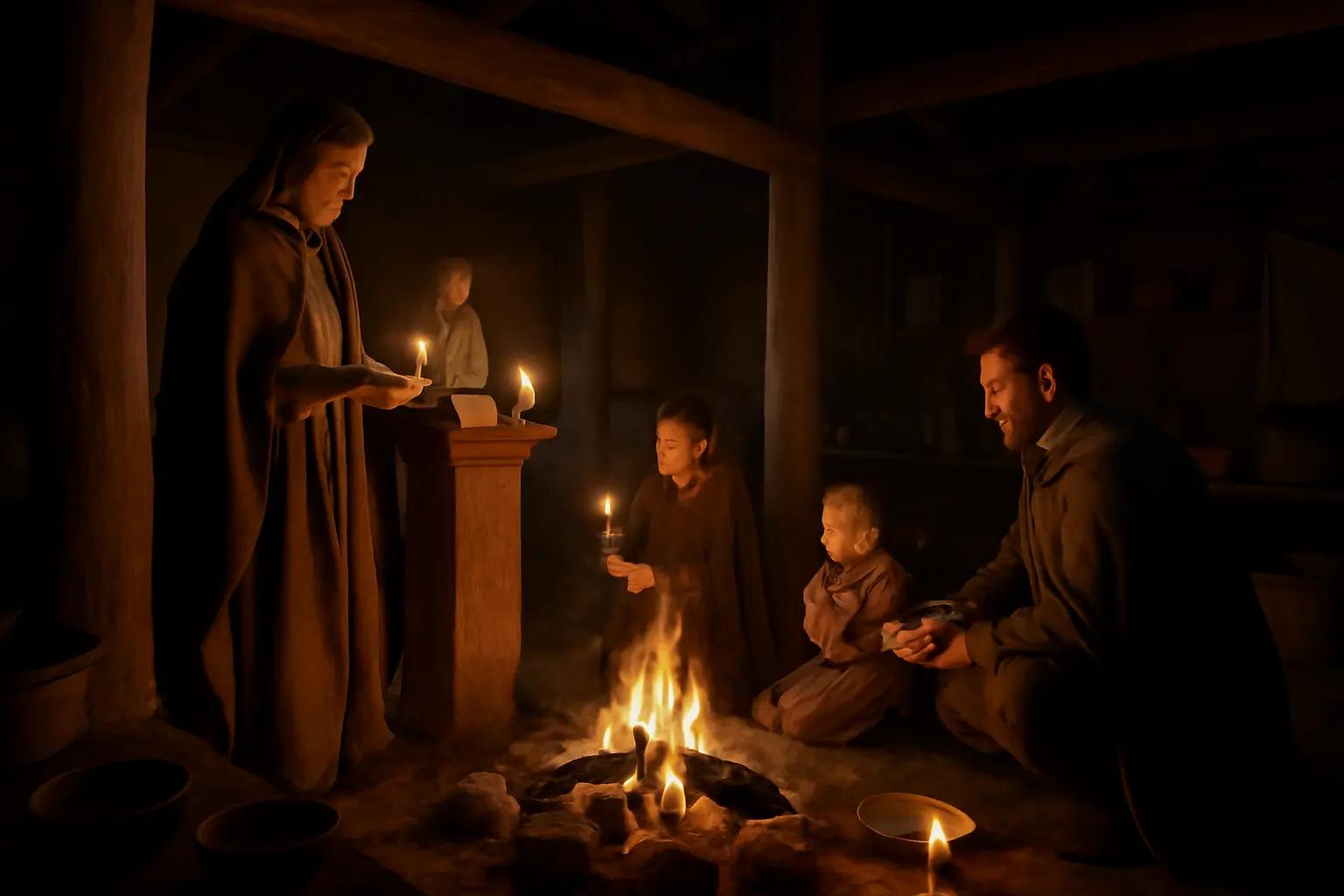
In encountering the fascinating and complex world of pre-Christian belief in Scandinavia during the late Iron Age and Viking Age, the stories of the grand cult sites and the mythic gods tend to dominate. Amid the shining hall-light of the sagas and on the vast sacrificial sites at Gamla Uppsala and Hlaðir, it is easy to be swept away by images of grand ritual gatherings in honor of gods such as Óðinn, Þórr and Freyr. But what about the ordinary farmer? What was the faith and cult of the farm family who lived a life deeply tied to soil and nature, far from the political and religious centers? To understand this, we must leave the public stages and enter the civil sphere of the homes and farms, where everyday life and belief often merged. Through this storytelling we gain a glimpse of how faith took shape in the small households, where rituals were tightly woven into daily life - a private sphere that traditional research has all too often overlooked.
The grand history and its shadows
In traditional research, sources dominated by heroic poetry, royal sagas and archaeological finds from ritually important places have laid the foundation for our picture of Norse religion. These sources, written down mainly after Christianization, bear the mark of the elite's perspective and often legitimize the great gods and mighty temple complexes as the most visible and important expressions of religiosity in the period. As Anders Kaliff points out, the true religious core nevertheless lay in the daily, private rituals that took place in the homes and small communities, and which meant more to the ordinary farmer than the grand public displays.
This paradox has led researchers to lift their gaze from the traces of the great cult ceremonies to the discreet, seemingly insignificant familial practices, in an attempt to reconstruct a broader and more nuanced religious landscape - a family religion or household religion that shaped daily belief and the rhythm of life at home on the farm.
More than food and work
To understand this private side of Norse belief, it is important to know the time and space of the farm family. Archaeological investigations show that the common dwelling in the Norse Iron Age was the longhouse, where the main room formed a multifunctional arena for cooking, craft, rest and socializing. The room in the longhouse was at once kitchen, bedroom, workshop and cult site. The close proximity between people's daily tasks and the supernatural suggests that ritual and piety were an integrated part of everyday life, not something separate or rare.
Such a life gathered family members, servants, slaves and perhaps to some extent hired laborers in a community, a social unit. This household, "hjú" in Old Norse, was central both as an economic unit and a religious community. It represented a dynamic composition that was not necessarily limited to biology, but also included allies, guests and subordinates, reflecting a flexible understanding of "family" in this period.
Characteristics of household religion
In contrast to the public blóts that required gatherings at central places and large-scale sacrifice, household religion was often tied to the concrete home or immediate surroundings. It usually took place in the same rooms where the trivial chores of daily life occurred, but was nonetheless deeply meaningful to the participants. The rituals were usually devoted to local spirits - the family's protectors, ancestors or nature beings near the farm - and created a connection between the human community and the supernatural landscape around them. This is highlighted in descriptions of the cult at Giljá, where the land's protector is seen as a seer with control over the animal stock, or in later texts where sacrifices to local "landvættir" are considered important for the farm's prosperity.
Another important characteristic was the woman's position as cult leader in many household rituals. Where public cult tradition is often dominated by men, we see in several accounts that women held central roles - either as priestesses, the household's spiritual guardians, or as conveyors of magic and prophecy. For example, in Vǫlsa þáttr, where the lady of the house actively circulates a ritual, mythic symbol and leads the family cult, she appears as a central religious actor. This illustrates a gender-shifting pattern in which the private sphere tended toward greater female influence than the public.
The stories from saga literature and poems such as Austrfararvísur and Þiðranda þáttr ok Þórhalls also point out that the walls and doors of the house were not only physical barriers, but symbolically important boundaries between the known and safe and the unknown and dangerous. When a blót was held for elf beings (álfar) or other local spirits, it was not permitted for outsiders to enter; the doors were often kept closed as a way of shielding the participants from evil from outside. Such rituals could not be interrupted by travelers or visitors, regardless of status or responsibility.
This strict control over who had access to the ritual underscores that household religion was associated not only with place, but with participation in the community. Among those known and close, guests could be included, as in stories where friends stay over for longer periods and take part in the religious practice. This gives a sense of a socially definable community, where the ritual is a marker of internal solidarity.
From food offering to ancestor cult
Food and drink were often important elements in household rituals, but not necessarily in the form of large, elaborate animal sacrifices as in the public blóts. They could be smaller "vegetarian" offerings, such as milk and other agricultural products, while meat was used to a lesser degree. Stories of so-called "älvkvarn" (elf mills) and the tradition of laying food offerings on sacred stones or making preliminary preparations may be examples of such practices.
Ancestor cult also played a central role. The sagas tell how deceased family members, not seldom high-status persons, continued to be honored after death and connected to the farm as spirits or "elves." This connection between past and present seems to be an important link in family and household religion, where sacrifice and ritual honor kept the contact with the ancestors living and protective.
Life's transitions
While the great rites of passage such as birth, marriage and death are important in many religions, in the Norse sources they are to a lesser degree explicitly linked to household religion as we know it from the sagas. This may be due to the aristocratic and Christian perspective of the sources, or to the fact that such events were not ritually marked in the private sphere to the same degree as later in history. Nevertheless, there are certain indications of the use of ritual acts around birth and naming in the old Eddic poems. As for death, the ritual burial of chieftains is a better-documented area, but these took place as a rule in larger communities and outdoors, often in burial mounds, outside the private setting of the home.
A new understanding of Viking Age belief
To step outside the fine saga tales of gods and grand blóts opens a richer and more living understanding of how faith lived in the near, daily life of the ordinary farmer and his family. Household religion was a living dimension of their existence, where social relations, nature and invisible forces interwove the practical and spiritual sides of life. Women's leadership, local spirits and ancestor cult constituted some of the central elements of this private faith.
This private sphere was, like many other contemporary cultures, marked by a fragile balance between the visible and the invisible, between the human and the divine, an interplay that demanded thoughtfulness, boundaries and reverence. When we look back today, it is important to make room for the fact that belief was diverse and differentiated - not only an elite-oriented religion, but ingrained in the small communities that formed the foundations of Norse society.
Sources:
Murphy, Luke John. Familial Religion in Pre-Christian Scandinavia? Ancestor-Worship, Mother-Priestesses, and Offerings for the Elves. Aarhus University/University of Iceland/Stockholm University, 2019.
Kaliff, Anders. "Offering, Society and Ritual at Gamla Uppsala." Studia Archaeologica, vol. 123, 2001.
Bodel, John, and Saul M. Olyan, editors. Household and Family Religion in Antiquity: The Ancient World Comparative Histories. Wiley-Blackwell, 2008.
Bellah, Robert N. Religion in Human Evolution: From the Paleolithic to the Axial Age. Harvard University Press, 2011.
Gunnell, Terry. The Origins of Drama in Scandinavia. Boydell and Brewer, 1995.
Jochens, Jenny. Old Norse Images of Women. University of Pennsylvania Press, 1996.
Raudvere, Catharina. "Popular Religion in the Viking Age." In: The Viking World, edited by Stefan Brink and Neil Price, Routledge, 2008.
Schjødt, Jens Peter. Initiation Between Two Worlds: Structure and Symbolism in Pre-Christian Scandinavian Religion. University Press of Southern Denmark, 2008.
Grønlie, Siân. "'No Longer Male and Female': Redeeming Women in the Icelandic Conversion Narratives." Medium Aevum, vol. 75, no. 2, 2006.
-1.avif)
-1.avif)