The autumn equinox is one of the most important transitions of the year in shamanic traditions, in Norse, Sámi and modern practice alike. This day, when day and night are equal in length, represents the balance between light and darkness. Throughout history the autumn equinox has been a time for harvest and celebration, but also for reflection and preparation for winter – both material and spiritual.
Cosmological and symbolic significance
The autumn equinox occurs around 21–23 September each year, when the path of the sun gives equal amounts of light and darkness across the whole earth. In the modern calendar this is typically 22 or 23 September. Many shamanic, heathen and pagan cultures mark this day. Cosmologically, the equinox symbolises balance, transition, change and the acceptance of nature's cycles – in which all life must pass through both growth and withdrawal.
The autumn equinox in Norse tradition
In Norse societies, the transition from summer to autumn was marked with the haustblot – an important ritual in which the gods were thanked for the year's crops and asked for protection against the winter. The gods Freyja and Njord were central to fertility and the sea. The haustblot involved sacrifices, song, storytelling and, not least, reflection on the balance between light and darkness. Although Norse rituals were not always called "shamanism," features such as communication with the spirit world and the use of ritual tools were widespread.
The blot feast was also a social occasion: everyone took part equally, and there was a tradition of feasts where the differences between social classes could be softened, and all were allowed to speak freely. The "Corn Mother" was among the spirits and nature guides who were honoured; she was believed to dwell in the last sheaf of the field. To cut down this sheaf was associated with blessings and prophecies of future good fortune.
The autumn equinox in Sámi tradition
In Sámi culture, nature's cycles are absolutely central – both to practical life and to the spiritual world. The day of the equinox itself is not always directly marked in historical sources, but the transitions of the year were deeply integrated into the Sámi understanding of time. The Sámi divide the year into eight seasons, in which autumn ("čakča") and autumn-winter ("čakčadálvi") mark the transition after the equinox.
Bieggolmai, the god of the wind, is often associated with this time, and the ancestors become more present in awareness. Through berry-picking, hunting and ritual contact with the forces of nature, it is marked that one enters a period for reflection and preparation for winter, just as the bear does when it eats its fill before hibernation.
Sámi noaidi (shamans) have traditionally performed rites of transition in step with such turning points in nature. Drum journeys and rituals for protection and balancing have had a practical significance: to secure the health of the reindeer, the safety of the community and a good relationship with the ancestors and spirit beings. The balance between human, animal, nature and spirits stands at the centre of these times of transition.
Norse and Germanic festivals
In Norse and Germanic tradition, much was about securing the next year's crop, giving thanks for the year's fruits and strengthening the bonds of the community. Great autumn feasts were held, in which goods were shared and everyone was of "the same rank." This provided an occasion for ritual cleansing and the strengthening of community.
Sacrifice and rituals
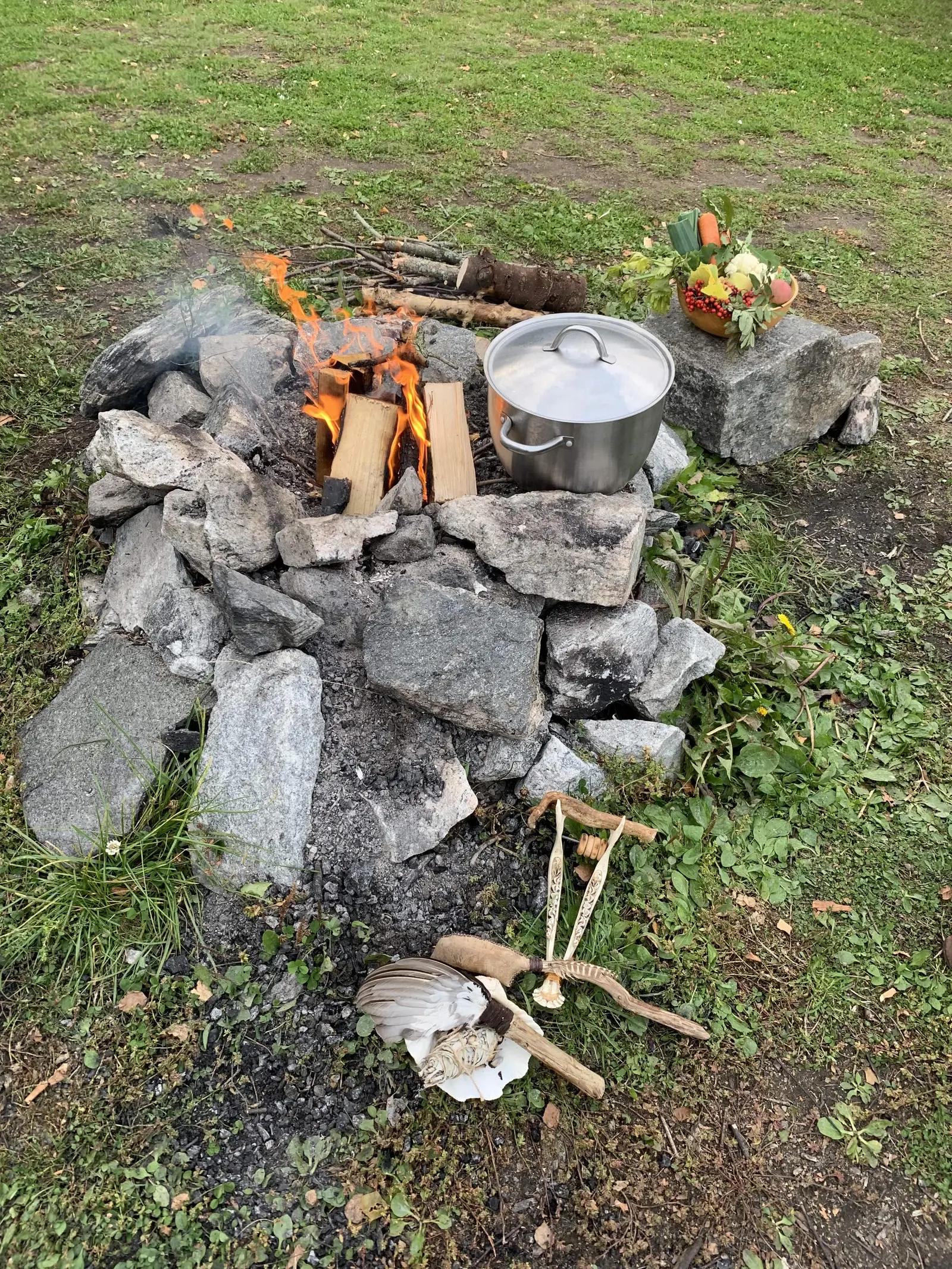
In shamanic practice, both historically and today, it is common to offer food, flowers, berries and other gifts from the year's harvest to the spirits or to Mother Earth. A modern variant is the "despacho" – a gift offering in which natural gifts are placed on a fire, together with beer, herbs or berries. This symbolises gratitude and contact with the spiritual dimension of nature.
Drumming, song and storytelling
Drum journeys, song and storytelling have always been central shamanic tools. During the autumn equinox, many have used the drum as a means to draw wisdom from spirits and ancestors, to seek guidance for the winter and to cleanse both themselves and the community spiritually.
All photos: C. S. Eid
The autumn equinox in modern shamanism
Today many shamanic traditions build on a combination of historical roots and modern interpretation. The autumn equinox is a day for personal reflection, reunion with ancestors and spiritual guides, and for letting go of the old before the introspection of winter. Drum journeys, meditation and the ritual sharing or burning of the harvest's surplus are central acts.
Several shamanic groups, such as Sjamanistisk Forbund, arrange communal ceremonies, out in nature or digitally. In such contexts, elements such as fire (cleansing), incense, flowers, drums and storytelling are often used. Some keep it simple, others include the whole family – the essential thing is the interplay with nature's cycles and the strengthening of the connection to the spirits through gratitude and balance.
Celebrations in other cultures
The autumn equinox is marked far beyond the Nordic traditions. In China, for example, the Mid-Autumn Festival is celebrated with mooncakes and moon-gazing, while in Japan the day is known as Higan, a period of reflection, balance and respect for the ancestors. In Celtic tradition, the autumn equinox is known as "Mabon," a sabbat devoted to gratitude, balance and the celebration of the harvest's abundance.
Spiritually, the autumn equinox is associated with
Both the physical harvest of fruit, berries and gifts from nature – but also the spiritual harvest of what one has learned, experienced and developed through the light half of the year.
Balance between darkness and light, activity and rest, outer action and inner reflection.
This is a time to let go of what no longer serves – old patterns, fear and worries – so that one can enter the winter with integrated and balanced energy.
Many traditions emphasise contact with the spirits of the ancestors during this period, both to honour them and to receive protection and wisdom.
From now on, and towards the winter solstice, the darkness increases. This provides an occasion for inner work, shadow integration and personal growth.
Sámi and Norse practice – shared features and distinctive traits
While Norse tradition highlights the significance of the gods and the community, Sámi shamanism places emphasis on nature spirits, ancestors and (with the noaidi as intermediary) the ritual relationship to nature and animals. Common to both is the thinking in cycles, the abundance of nature, and collective or individual cleansing and protection for the dark season.
Significance in today's society
In modern times, the autumn equinox is an occasion to mark the cycles of life, to restore the connection between human and nature, and to be aware of the need for inner work. In our time this practice can strengthen the sense of belonging and meaning – and provide tools for creating balance in a challenging everyday life.
Sources and key references
Ahlbäck, T. (1982). "Shamanism in North Eurasia." Temenos.
Hultkrantz, Å. (1992). "Shamanic Healing and Ritual Drama." Crossroad Publishing.
Rydving, H. (1993). "The End of Drum-Time. Religious Change among the Lule Saami, 1670s–1740s." Uppsala University.
Sundström, H. (1997). "Religion och ritual i förkristen tid." Gleerups.
DuBois, T. (1999). "Nordic Religions in the Viking Age." University of Pennsylvania Press.
Eliade, M. (1964). "Shamanism: Archaic Techniques of Ecstasy." Princeton University Press.
Nordland, O. (1969). "Customs and Beliefs in Northern Norway." Norsk Folkeminnelag.
Solli, B. (2002). "Seid: Myths, Rituals and Narratives." University of Oslo.
Hägermann, D. (2018). "Equinox and Solstice in Ancient Europe." Journal of Pagan Studies.
-1.avif)
-1.avif)