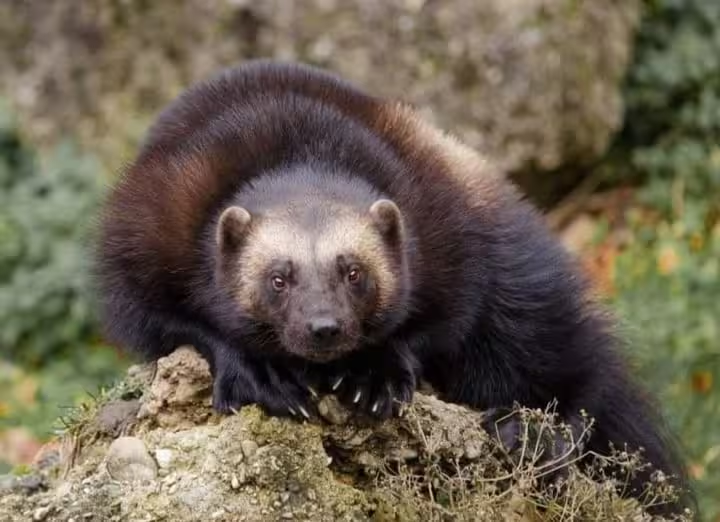
Wolverine and Nettle
My grandfather was a head teacher, and to the highest degree! If he could teach, he was happy. I don't think I'm exaggerating when I say that he had absolutely no need for free time. The teaching profession was not just a profession, but a calling.
One of the stories I remember with him was when he taught me that Gulo Gulo was wolverine in Latin. I was to think of double yellow [“gul”] and add an O. It was easy to learn. Exactly why I was to learn what the wolverine was called in Latin is a little unclear – but we'll make a little twist on Øystein Sunde's song “Handy to Have” and say “handy to know”.
I did, however, like to read about the wolverine. It was an interesting animal, though a little hard to make sense of.
It was a wanderer, and if there is anyone I have a liking for, it is wanderers. The wolverine likes snow, and that is probably why it is only to be found in the northern hemisphere.
The wolverine is counted as one of the four mustelids. There it is in the company of wolf, bear and lynx. But, in fact, the wolverine is not particularly large. The males can weigh up to 25 kilos, while the females can reach up to 18 kilos. In appearance it resembles a small bear, but when it moves you can actually see that it belongs to the mustelid family. The claws are impressive, my word … they climb easily up the steepest slopes and move very fast. The fact that they move fast is in itself impressive, for the legs are really short. It's not just that it moves fast; it can also cover several dozen kilometres in the course of a day. Researchers followed some wolverines and found that certain wolverines moved seventy kilometres in the course of a day. Most wolverines move only … ahem … only a couple of dozen kilometres in the course of a day. Well, the researchers discovered that the wolverine could also be lazy. One wolverine snoozed in its den for 21 hours! But the wolverine is not an animal that will put up with being placed in some reserve. Boundaries? Pfffft, the wolverine doesn't care about that in the least. Humans may have their boundaries – but the wolverine respects other wolverines' boundaries. If they don't have their own territories, they trot over long distances and often across national borders.
The wolverine has evolved brilliantly! It can carry a fertilised egg for a long time and let the egg develop when it suits. Den, access to food and surroundings must be favourable for the wolverine before they let the egg develop further. Imagine if we humans had been that clever when we developed? But no – here children are born whether it's convenient or less convenient. Well, that's perhaps just as well? The wolverine, however, is quick to acquire a den and the other things it needs for the birth.
Wolverines thrive best in their own company and are not flock animals at all.
Nor is it especially picky. Rotten food goes down without problems. It is, however, a rather keen sheep hunter … and thus it can get furious farmers on its back. For the most part it is a scavenger, but it doesn't say “no thanks” to a little fresh meat either.
«Vielfrass» say the food-loving Germans of the wolverine. Viel = much and frass = eater. That is, a glutton. The English have viewed the wolverine a little differently, for they have given it the name wolverine – taken from wolf, with the meaning “behaves like a wolf”. Where they got that idea from in England, the birds alone must know, but that's their business 🙂
We must ask ourselves what we can learn from the wolverine? I think we can learn to be content with what we have at hand right here and now. Perhaps we can learn to endure and to clear up after others, the way the wolverine clears its dish? If there is anything that irritates us, it must be clearing up after others.
I sometimes gather up rubbish in nature … even though I know it's a useful job, I easily get irritated with the slobs who litter nature. We can learn that it is actually all right to move outside the comfort zone and “burst” a few boundaries? And then we must learn to stay away from others' property if we don't want to end up in trouble. (Sheep, wolverines and farmers.)
Nor must we forget the wolverine's courage. The animal does not hesitate to go for a larger opponent – the animal does not lack courage. It has a powerful bite and equally powerful claws.
Well, I'll probably focus on the patience of clearing up after others, and I'll probably go for a round with my rubbish bag and pick up after others this full moon, while I think about how wonderful the wolverine is, and I'll surely walk along singing a self-made song: “Gulo, Gulo, lalala”. That's a habit I have. 🙂
This full moon is not only the wolverine's; it is also the nettle's.
My great-aunt, Augusta, called the nettle “nokkonen”. She had learned that from her Finnish mother. I almost always say nettle, but sometimes when I'm strolling on my own – then I say “nokkonen”.
I love nettle! It is actually one of my favourite plants. It is a prim and prickly thing and it does not like being touched – touch it carelessly, and you won't like touching the nettle either.
Nettle is good for eating. My father told me that the pigs got a lot of nettle when he was growing up. He had taken part in gathering nettle, boiling it and giving it to the pigs. They loved this plant, and that's no wonder, it tastes terribly good in soup and stew.
Here is a recipe for nettle soup
• Ingredients:
About 1 litre of young nettle shoots (use gloves)
1 litre of water and one cube of vegetable stock
2 tbsp butter or oil and one onion, chopped
2 potatoes, diced
Salt and pepper, and a little cream or crème fraîche for a rounder flavour
• Method:
• Rinse the nettle well and remove coarse stalks. Blanch the nettle quickly in boiling water for about 30 seconds, drain and chop coarsely.
Sauté the onion and potato in butter in a pot until the onion is glossy. Add the nettle.
Pour over water and the stock cube. Boil until the potatoes are tender, about 10–15 minutes.
Use a hand blender or blender and blend the soup smooth. Season to taste with salt, pepper and possibly cream.
Serve, if you like, with a sprinkle of fresh herbs and fresh bread on the side.
Nettle soup is a true spring classic in Norway – nutritious, green and full of flavour from the Norwegian countryside!
You should gather and dry the nettle seeds. These are full of magnesium. Take a teaspoon of the seeds; this should cover your daily requirement.
In magic, nettle is mostly used to promote strength, courage and protection. Many claim that a cup of nettle tea gives them pleasant dreams and good sleep.
I met a woman in the USA who told fortunes with nettle. She threw dried nettle up into the air and interpreted the patterns the plant landed in. Amusing.
I know that in herbal medicine the nettle has been regarded as a life-giving and healing herb, so I think I'll focus on vitality and feel in every pore that I am alive under this full moon.
Have a wonderful full moon, everyone
-1.avif)
-1.avif)