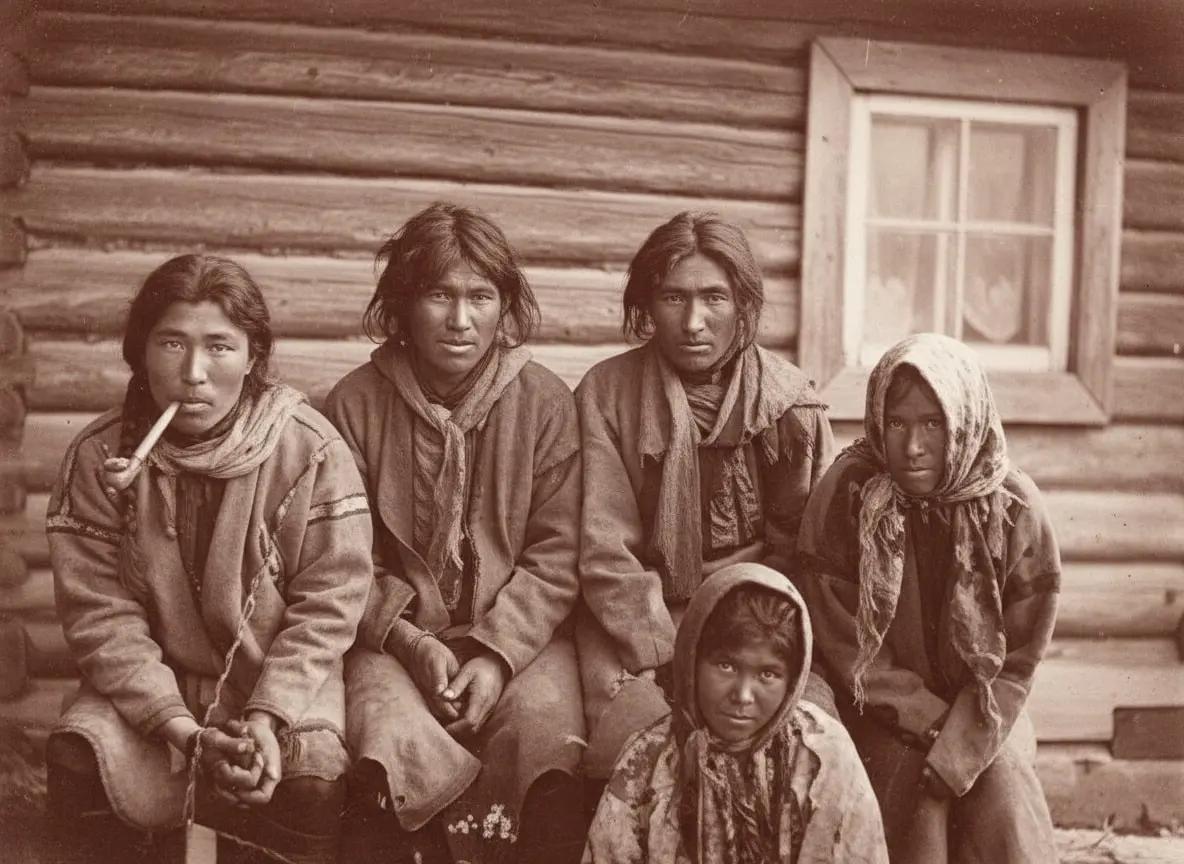
Ket shamanism is one of the world's most unique and mysterious spiritual traditions, shaped by a hard life in the deep Siberian forests on the banks of the Yenisei River. Here lived, and still live, the Ket people, a small indigenous population with a language unlike any other known language on the planet. To understand Ket shamanism is to follow a trail back to humankind's oldest conceptions of nature, spirit, illness and healing – and to penetrate a world where reality has more than one facet, and the shaman's song can fly between them.
Background and origin
The Ket people were the last hunter-gatherers in Inner Eurasia; right up until the 20th century they moved from camp to camp between summer and winter grounds, accompanied by dogs, but with little use of domesticated reindeer as many of their neighbouring peoples had. Their language and culture are fundamentally different from the other indigenous peoples around them, yet extensive cultural exchange has taken place over the centuries, especially with Samoyedic and Turkic neighbouring peoples. The result is a spiritual tradition that carries layers of both deeply local ideas and complex impulses from outside, especially from the steppe traditions of southern Siberia.
Healer, guide and singer
In the Ket tradition, the shaman – known as sening or quttyn – was not only a spirit-conjurer and healer, but also a guide between the worlds of humans and spirits. Central was the belief in ulvei, a person's life essence or "soul", which together with six other spirits made up the inner balance of a human being. If the ulvei left the body, one became ill, and if it did not return, death could follow.
The shaman's most important and most dramatic task was to bring back lost souls. This could mean a journey through several worlds, where the shaman in trance had to cross dangerous boundaries and often fight against Hosedam, the feared witch of the North who devours the lost souls. The shaman could also cure illnesses, foretell the future, and ask the spirits for luck during the hunt – all through song, dance and the use of magical objects.
Worldview and myths
The cosmology of the Ket people is organised through several levels of reality: the earth is only one of several layers, with celestial worlds above and the underworld below. The shaman songs contain descriptions of journeys up into the layers of the heavens, or out to the distant cardinal directions where mighty forces threaten and tempt. Female shamans had access only to the earthly and nearby spirits, while the male ones could visit the heavens. The number seven recurred in folklore and structure, and was the number of central spirits in a human being's nature.
Significant myths and heroic figures – such as the culture hero Alba, who managed to trick the witch Hosedam into vomiting up the souls she had devoured – give insight into archaic conceptions of life, death and rebirth. When a person dies, it is said that the ulvei either rises to the heavens or sinks to the underworld, to then be reborn, often after the shaman has divined the soul's wandering at the grave.
Becoming a shaman
Several paths led to becoming a shaman among the Ket. The ability was often inherited within a family, but could jump from gender to gender across different generations. In childhood, or more often in early adulthood, a person could be struck by dariy, a state of spiritual unrest or madness – a clear sign of a calling from the spirits. If the calling was refused, one risked becoming permanently ill or losing one's mind. If one took the task seriously, one gradually learned to master the spirits and one's own inner power, and eventually received the "striking staff" – hatbul – the first tool on the path to becoming a shaman.
There were several levels of shamanism. "Family shamans" or lesser shamans practised only in small circles and often had no drum or special clothing. The most respected went through seven stages, each of which gave more power, more spirit helpers and gradually richer regalia – with drum, rattles, iron ornaments and finally a magnificent crown.
Five types of shaman and animal helpers
Ket shamanism developed five main types, each associated with different totem animals and distinctive features in dress and power:
The Qaduks shaman – its main spirit was a flying female reindeer, and it used the drum to journey up into the heavens. The drumhead was always made of reindeer, and the crown could be adorned with iron reindeer antlers.
The Bear shaman – travelled on the earth, especially to the dark northwest, the "witch's home". It did not use a drum, but a bear's paw, and often wore a bear mask in the rituals.
The Kandelok shaman – had as its patron a figure with bear's paws for hands and wore an iron helmet. It often took the role of both protector and connector to the spirits of the ancestors.
The Eagle shaman – connected with the mythical giant eagle dagh, is said to have been the first to teach people how to shamanise. Eagle feathers were important amulets, and it was taboo to harm eagles.
The Dragonfly shaman – with a costume shaped like a dragonfly and plates of iron like thunderclouds. Associated with the south wind and the rain, and considered the most powerful – but could only work in the summer months.
Rituals and tools
The shamanic rituals could be dramatic performances where song, drumming, dance and storytelling melted together. Trances achieved, among other things, by eating fly agaric (Amanita muscaria) led the shaman on journeys to other worlds, always helped by their spirit helpers. Important objects included:
The drum, usually large and round, with skin from a female reindeer.
The striking staff (hatbul), used to keep the rhythm and to summon the spirits.
Chains and iron ornaments; each symbolised a spirit or an animal and carried its own power.
Headgear/crown, often with horns or feathers, and each category of shaman had its own special dress and headdress.
When a great shaman died, most of the regalia was placed in the grave to return to the earth and the spirit world, but some especially powerful objects, such as the iron crown, passed on to chosen heirs within the kin.
Suppression and the fate of the tradition
The Soviet era led to a dramatic break. Already in the 1930s the Ket were forcibly relocated to Russian villages and shamanism was regarded as superstition and suppressed by force. Drums and equipment were destroyed, and rare, great shamans died out in the 1970s or earlier. One of the last known shamans died in the village of Kellog – after this the open practice disappeared, although family practices survived in secret. In our time there are hardly any active shamans, but fragments of songs, stories and magical rituals still live on among some of the oldest Ket.
Ket shamanism today – and its significance
Ket shamanism survived the isolation and resistance much longer than many other indigenous traditions, and the testimonies from the ethnographers Anuchin, Donner, Findeisen and Alekseenko form today the very cornerstone of the knowledge we have. Modern Ket still respect the memories of the old shamans, but even the oldest tell that the spirits will probably never again send true shamans to the people, after all that has happened.
Even so, young people today are taking an interest in this mysterious heritage. For many it symbolises deeply human dreams of being able to heal, understand, and transcend the boundaries between our world and the others – a heritage the Ket share with spiritual siblings all around the Siberian taiga. Every time a traditional Ket song or myth is retold, it is as if the shaman's voice sounds anew among the tribes along the great Yenisei, and reminds us that there are several ways to see and sense reality.
Sources
Vajda, Edward J. (2010). "Ket Shamanism." Shaman, Vol. 18, Nos. 1-2. Western Washington University.
Alekseenko, E. A. (1978). "Categories of the Ket shamans." In: V. Diszegi & M. Hoppál (eds.), Shamanism in Siberia. Bibliotheca Uralica 1. Budapest: Akadémiai Kiadó.
Anuchin, V. I. (1914). "A sketch of Ket shamanism." Peter the Great Museum collections.
Donner, Kai (1933). "Ethnological Notes about the Yenisey-Ostyak in the Turukhansk Region." Helsinki: Suomalais-ugrilainen Seura.
Findeisen, Hans (1953). "Sibirische Schamanentum und Magie." Augsburg: Institut für Menschen und Magie.
Alekseenko, E. A. (1981a, 1981b, 1992, 1997). Various field studies on Ket shamanism and regalia.
Ivanov, V. V., & Toporov, V. N. (1969). "Commentary to the description of Ket mythology." Moscow: Nauka.
Werner, Heinrich (2006). "Die Welt der Jenissejer im Lichte des Wortschatzes zur Rekonstruktion der jenissejischen Protokultur." Wiesbaden: Harrassowitz.
-1.avif)
-1.avif)