When I was little, my grandmother would sometimes say: "Oh, have you got nisse knots in your hair now?" I shuddered, because I was very tender-headed and now the knots had to be combed out. I could not comprehend why the nisser would tangle up my hair, when I was so nice to them? I was always tossing them something, half oranges, grapes, chocolate and so on. I decided to stop doing it. Now the nisser would get nothing more; now I would give my gifts to the elves. Doltish nisser ...
Then we have the saying: "A knot on the thread!" That, of course, means disagreement.
English speakers talk about "to tie the knot," which figuratively means to get married. Americans in particular love to "tie the knot," many of them doing so a great many times over the course of a lifetime ...
The Russians also think along knot lines.
"No, now it is time to tie this up!" say the Russians, and then they want to be finished with something. Ukrainians, for their part, say "why is this matter knotting itself up?" Then they are exasperated, because everything is going against them.
Last week I heard: "I will tie a blue knot on my tongue!" It was something that had to be kept super secret ... Not a word would leak from that tongue, I understood :-)
Mokosh and the Sacred Threads
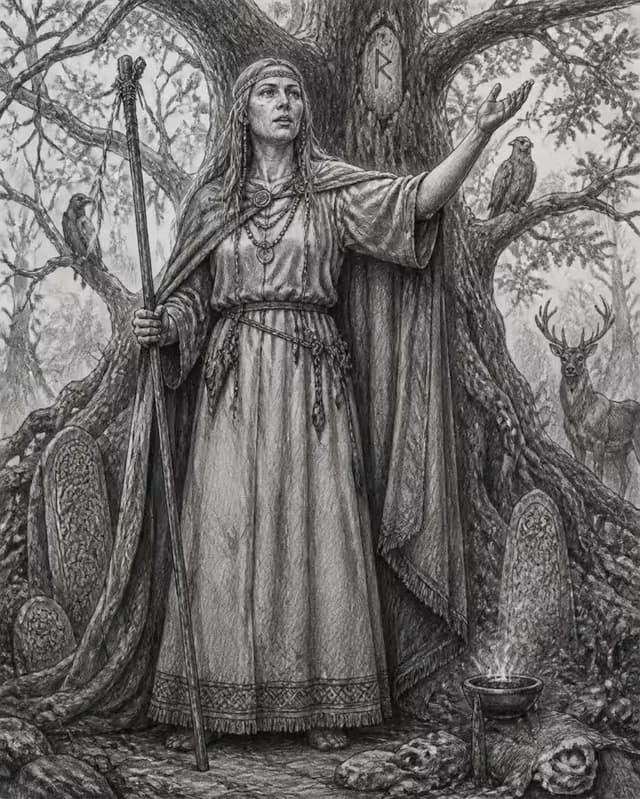
In "Slavia" there were three who spun people's fate. These three are very reminiscent of our Norns, and they are called: Makosh, Dolya and Nedolya. It was Makosh who took care of the spinning and twining of the threads of life.
Therefore, any work with threads was sacred! Whether you embroidered, knitted, or mended yarn, well, you know, everything that involved thread was sacred work.
I have of course picked this up, and every time I take up "threads" to knit or embroider: "To Mokosh's honor" I mumble ... "crazy ideas, here you shall find a cozy room."
When Mokosh wanted to change a human life, she made a knot. When you came upon events that changed your life, you ran into a Mokosh knot.
Then you could only hope that Dolya, and not Nedolya, had helped tie that particular knot.
In the weave of our lives, "other colors" enter in the form of other people. Some weave themselves in, some create blue knots and difficulties for us. That is just how the days go!
Nauzy – the Magical Knotting Process
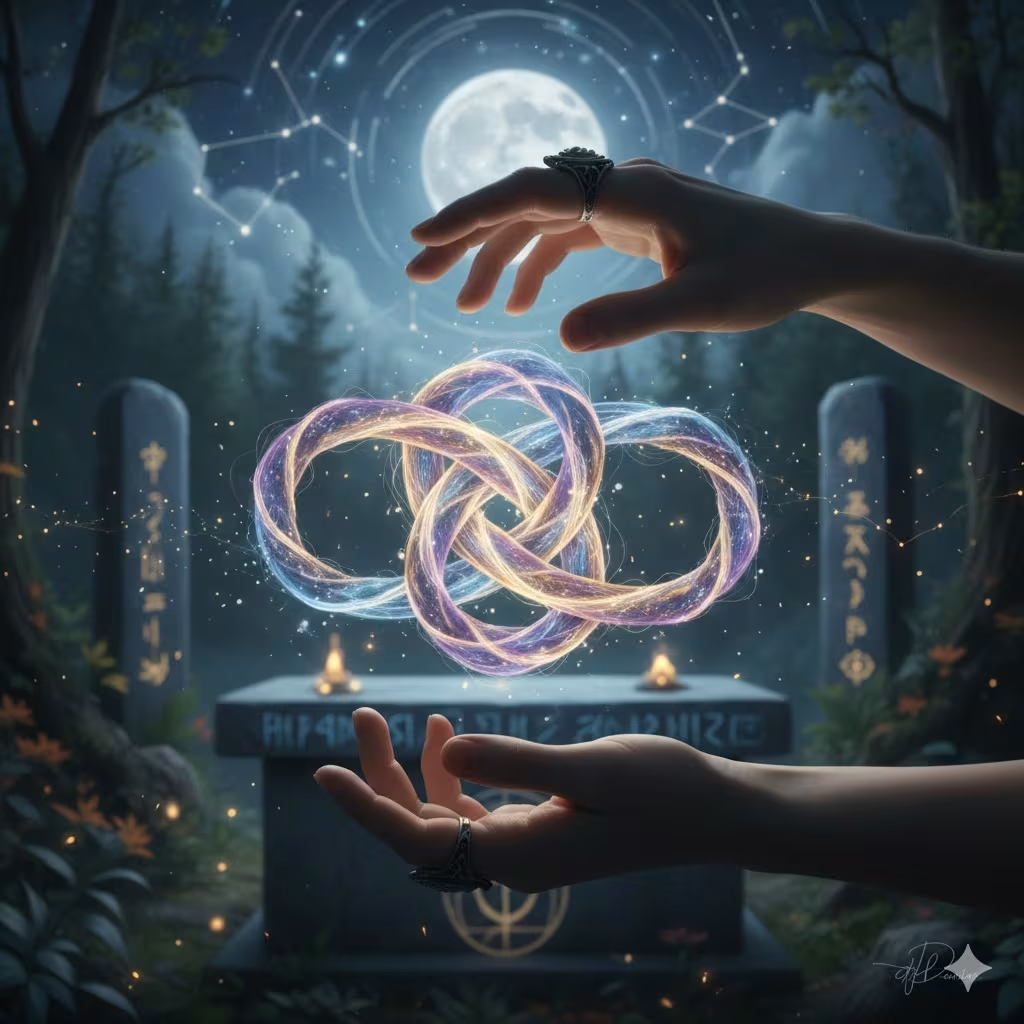
Nauzy is what the Slavs call the art of tying magical knots.
A nauznik has specialized in tying magical knots. The knots are tied on stones, on pouches, on amulets, in bracelets, indeed, I almost said, anywhere a knot can be tied.
If you are annoyed with someone, you tie a knot and have a little chat with Nedolya. If you want to bless someone, you have a word with Dolya while you tie.
When the Christian monks came to Slavic regions, they were horrified by these knot traditions.
"The people here are uncivilized, they measure children with thread and tie knots while spitting on the ground and invoking demons!" wrote the monks.
"The people here are mad, they tie knots for bears and for sauces while mumbling demonic prayers!" The monks were appalled.
Perhaps the odd Slav wrote at this time: "The monks are not normal, they stand gazing up into the air while mumbling something to the spirits of the air" ... one never knows :-)
Nauz – the Knot Around the Neck
A nauz consists of a cord tied in a knot and worn around the neck.
Often this knot is tied around an object considered "magical":
a herb, a root, a piece of coal, a little salt in a pouch, perhaps sulfur, or a dried bat's wing for that matter. Yes, a snake's head is also used, a piece of snakeskin and so on.
My great-aunt, Augusta, found a viper's skin and then there was wild celebration. She cut this skin up and put it in "luck pouches" together with herbs.
It was very common, for simplicity's sake, for these objects to be put in a pouch and worn on the body in this form. Sometimes a piece of birch bark or parchment with a written prayer, incantation or sacred symbols inscribed on it would be rolled into a scroll or sewn into a pouch and worn on a cord around the neck or attached to the body belt, that is, a belt worn against the bare body to protect against evil.
I know this was practiced by the Forest Finns, by the Slavs and certainly in other parts of the world.
Yarrow was very popular to carry in a pouch among the Forest Finns. The Slavs also used to carry such magical pouches with them. Among the Slavs it came to be that any pouch containing magical objects (similar to Native American "medicine bags") was given the name "ladanka," that is, a pouch containing incense (from "ladan" – incense), even when there was no actual incense inside the pouch.
These "ladankas" played a major role in peasant life; they were placed around the necks of travelers to protect them against misfortune and witchcraft.
Knots as Magic and Incantation
According to A.N. Afanasiev, who devoted a considerable part of his work to investigating the subject of magical knots and the people (mostly women) who practiced this art of tying knots for magic.
A Russian peasant, in the 1600s, was brought into the steward's quarters and punished by being beaten with sticks for carrying "a little root and some herb bound in pouches near the (body) cross."
Sometimes a small clay flask was used to store magical objects, especially liquids and powders, instead of a pouch. This flask could be carried just like a pouch, around the neck or tied to the belt.
What created the magic of this flask or pouch, or of any independent magical object turned into a nauz, was the knot used to fasten the object and the placement it was given on the body.
Not all nauz, however, were worn on the body.
Records from medieval Northern and Western Europe tell us of the magical ropes that old women sold to sailors setting out on a voyage.
These ropes contained three knots: untying one was said to summon a light breeze, untying two would release a strong wind, and untying three would unleash a storm.
Here we thus see an example of a magical amulet, which is an object that can take any shape and is meant to accumulate and store energy where it is needed.
Because Nauzy are most often used as amulets, they must be "triggered" for magical use.
Squeezing the knot, tightening it or untying it, depending on the situation, together with uttering magical "trigger words" – a short "key" phrase – is used to activate the amulet. This will release all the energy that was stored in it.
Untying the knot usually means releasing all the energy from the amulet or lifting a curse, the key here being that an untied knot cannot be retied until the amulet "is used up."
Unless the amulets are recharged regularly, the power drains out of them after three, nine, twenty-one or forty days, depending on the power invoked when the knot is tied.
Some knots, especially those tied to protect the house during certain holy days, are continually recharged and, if desired, every year.
Dark Magic, Knots and Changing Fate
In addition to being used as amulets, nauz are used to alter people's fate. Sometimes for the worse, which makes them common tools in dark magic.
In dark magic, knots are tied that are meant to draw Nedolya's (misfortune's) attention toward the target, and are sometimes used as a podklad (witch object) left on the person's property or attached to their clothing.
Physical contact with such nauz (whether they know the person or not) is said to amplify the effect.
The consequences of having a spell cast on you with nauz magic can be undone by finding and ritually destroying the bewitched knot and then tying other nauz to draw Dolya (fortune) back into the person's life.
Knots at Birth
The Slavs and the Finns tied knots, that is, Nauzy, at baptism, naming or another celebration of a baby that was born.
This tradition seems to be common in many European cultures, as many stories tell us.
At birth, the midwife untied all the knots on the laboring woman's clothes, opened all doors, windows, dressers and pulled out all the drawers if they were present in the room.
Untying knots was meant to ease the baby's soul's transition from the other world into our physical world. At the celebration of the baby's birth, the baby was given tied knots that would secure his or her place in this world and close the portal between the two worlds.
As we see from recorded sources, a midwife or a "knowing" woman, often "a witch", was invited to this celebration, where they tied knots while reciting good wishes for the newborn child. During these festivities, the midwife or "witch" represented the goddess Makosh, who ties knots for the child as he or she is born.
Sometimes these magical knots, filled with a certain wish, were given as gifts by each guest present at the ceremony.
This custom reminds us of "Sleeping Beauty," where various fairies were invited to celebrate the birth of a new princess, and they each gave her a gift while expressing their wishes that the girl be beautiful, clever and lucky, and so on.
The only fairy the royal parents did not invite was Death or Fate, who cuts the thread of life, but she appeared on her own with a wish that the girl should die when she turns sixteen.
Fortunately for the child, other fairies managed to soften this grim prophecy by changing it to sleeping for a hundred years instead of dying.
Knots at Weddings and Funerals
Apart from this knot custom at birth, knots were widely used in wedding ceremonies. Something that is gaining ground in our day.
In the northern regions of Russia, at the end of the 1800s, bridal couples wore a piece of old fishing net around the waist to protect themselves against sorcery.
In folk belief, no household implement contained as many knots as a fishing net, which explained this custom in North Russian weddings.
In other regions of the country, a tightly knotted, thin belt was worn under the clothes and used instead of fishing net.
Another custom that was widely practiced at Slavic folk weddings and involved knots was tying the bridal couple's hands with a special cloth, symbolizing that their fates are from now on bound into one.
This is, to a certain extent, still practiced.
During funeral customs, all knots on the deceased's clothes were untied, again to ease the soul's transition to the other world. The participants in a funeral, on the other hand, wore knotted belts, so that they would not be the next to follow the deceased into the other world.
I can feel now that the nisser have been visiting in the night and tied new knots in my witch's hair ... mischievous nisser.
I had better go and toil away at them and get my ponytail in place.
I have gathered the knot stories from tales and memory books.
Tying knots is actually part of my practice. Is it part of yours too?
We in the West, we have the "witch's ladder," but I will take that up in another context.
Have a nice day!