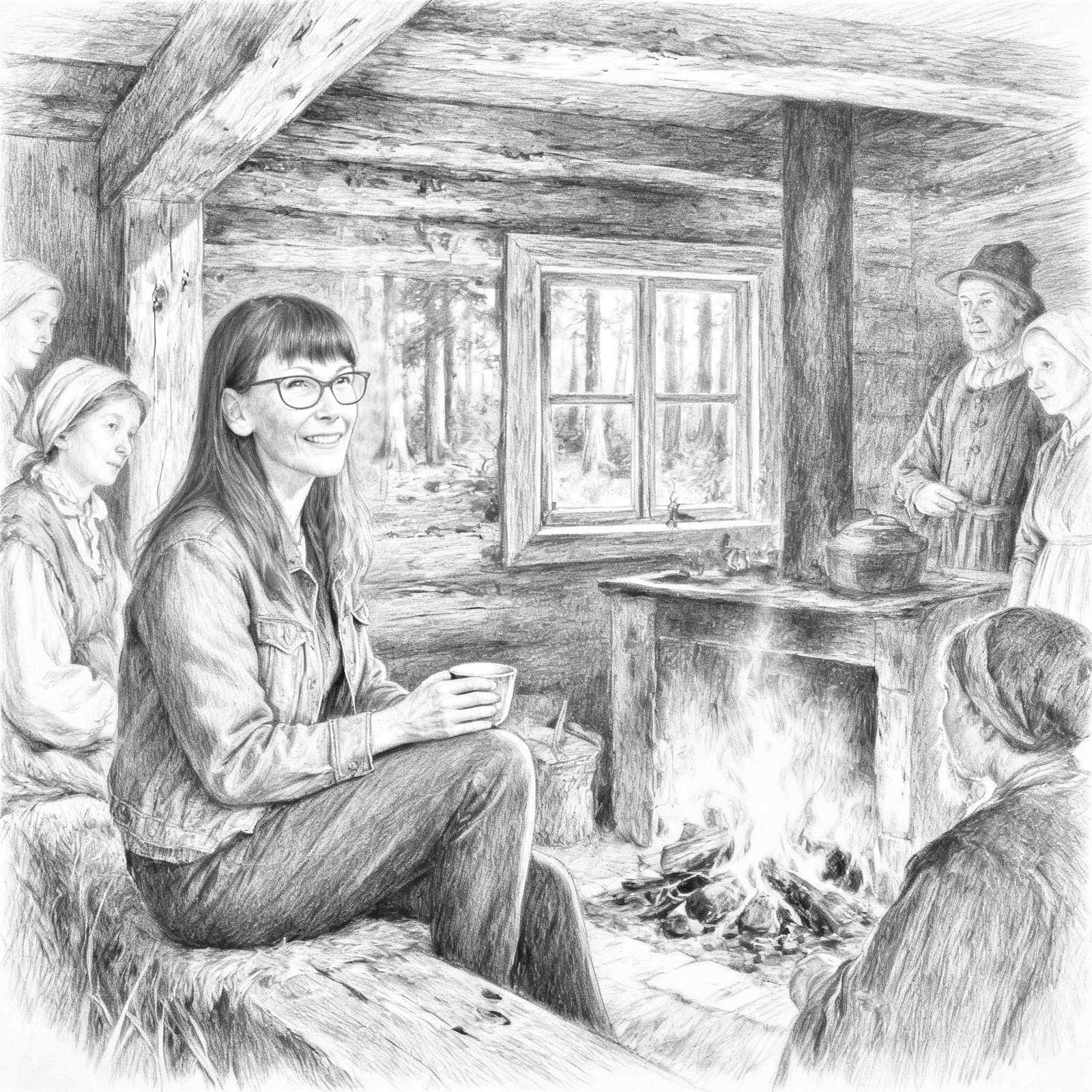
Imagine that you are growing up in a small village deep within the dense Finnish forest toward the end of the 1800s. Life is simple, but hard. The nature around you is both beautiful and threatening, and many phenomena in everyday life cannot be explained by science as we know it today. It is here that magic and witchcraft creep into the lives of ordinary people – not as fairy tales, but as a part of daily life.
Laura Stark, a researcher who has delved into the stories and memories of people who grew up in this time, tells us how magic was anything but fiction. It was something people trusted, feared, and used to understand and control the unpredictable in their lives.
Magic as a Natural Part of Everyday Life
In the Finnish countryside, life was full of things that could go wrong. A cow could suddenly stop giving milk, a sick baby could cry without end, or sweethearts could quarrel for no apparent reason. People knew that such events were not always caused by the laws of nature alone. There was something more – something hidden and powerful.
In folk belief there were words such as "taika" (magic) and "noituus" (witchcraft) that described a knowledge of how one could influence the world with secret powers. Those who possessed these powers, especially in the form of rituals and long magical formulas, were called "tietäjä" – the one who knows the secrets. These people were often both feared and respected, as magical guides in the community.
But magic was not simply black or white, good or evil. It was complicated and often necessarily secret, because this knowledge gave its owner power. Magical rituals and formulas were therefore often kept hidden from others, to ensure that no one misused them or gained power over them.
The Story of Kaisa, the Village's Magician and Healer
Laura Stark tells us a gripping story about Kaisa, a woman who lived in a Finnish village and was known as both a healer and a magician. Kaisa had a reputation that made people both afraid and secure. People came to her when they needed help – whether it was to cure illness, protect their animals, or find answers to mysteries.
One day an elderly man came to Kaisa's house, angry and distraught. Someone had stolen money from him, and he was certain it was a young girl in the village. Kaisa was sitting by the hearth making coffee when the man came in. She took up the matter at once: with a frog in her hand she walked around the man in circles, both with and against the clock. Then she set the frog down and watched which way it hopped. "The thief comes from that direction," she said firmly.
But it did not end there. She poured alcohol into a cup over which she had spoken some magic words, and looked into the liquid as she explained that the thief was not the girl, but a "fat man." The old man was astonished, but followed Kaisa's advice. She told him to go to the church, fasten a needle into the bell-rope, and say a special prayer. A few days later his money came back, placed behind his door. The thief had become afraid of Kaisa's magic, and wanted no more trouble.
Kaisa refused to take money for her help, but accepted small gifts. Her magic was not malice, but a form of social justice and protection for the villagers.
Magic as a Struggle Against Misfortune and Illness
Magic was also a way of dealing with illness and falling victim to negative forces. A man named Pekka remembered how his family was struck by a mysterious illness called "hittara." It was like an invisible illness that no doctor could cure.
To be rid of this dangerous condition, they had to carry out rituals. Pekka told how they went to a sacred place in the forest to perform a ceremony that would force the illness out. If it did not work, they might have to try something symbolic, such as "nailing" the illness fast to a tree – as if they captured it and kept it away from the family.
At the same time there was a strong belief that people could be struck by the evil magic of others, called "konsti" or "taika." The one who was attacked could send the evil back with the help of a magician, often called the magical dog, which drove away the evil intentions of the malicious. This was a form of social control and balance in the community, in which justice could also be done on the magical plane.
Everyday Magic in Stories and Practice
Magic was not only seriousness and fear. It was also a part of the stories people told, a way of explaining why things happened, and sometimes a source of entertainment and laughter. When children played, they could be heard muttering small charms along the way, either for fun or to try to influence the world around them.
But magic also had rules. There were ethical limits to what could be done, and magicians like Kaisa were very careful. For example, Kaisa would not send a bewitched arrow to kill someone, because that meant using God's name in a curse, which she considered dangerous and wrong.
Magic as an Invisible Part of the Fabric of Society
What makes Laura Stark's research so fascinating is how magic was not something outside of society, but an invisible part of it. People lived with both Christian faith and magical notions side by side. The church played a role in many rituals, but people also made use of old, pagan traditions that had been carried on from generation to generation.
Magic was a way of understanding what could not be explained, of protecting oneself against threats, and of keeping order among people and nature. At the same time it was a language and a method that people shared in small local communities, and that gave them identity and control in a world that could be as capricious as it was wild.
From the Frog to the Church Bell: The Power of Magic in Concrete Rituals
In several stories we see that magic combined symbols from nature with Christian elements. As in the story of the frog that helped reveal the thief. The frog represented the power and mysticism of nature, while the church bell and the needle bound the magic to the Christian ritual, and gave it credibility and strength in the eyes of the village.
Another time, Kaisa recommended that a copper needle be stuck into the rope of the church bells, while particular words were spoken. The magic was thus tied to both nature and church — two worlds that people lived between, without it creating any conflict.
The Power of Hidden Knowledge
For many, magic was secret knowledge. It was not only about what one did, but who knew how it should be done. The tietäjät, the magicians, carried stories, incantations, and rituals that were adversely affected if they became known to everyone.
This gave them an almost mystical status, for they were bearers of something powerful. But at the same time, magic could lead to suspicion and fear, for one could never know whether magic was being used to help or to harm. There was therefore a fine balance in the local community between the use of magic for good help and the fear of cunning tricks.
The Place of Magic in a Changing World
Laura Stark's work shows us that magic in the nineteenth-century Finnish countryside was not something obsolete or primitively superstitious, but rather a living and necessary part of people's way of understanding and mastering their world. Before the modern age of science and technology gained momentum, magic was a language, a method, and a tool that gave meaning to the challenges of everyday life.
These stories and memories from people who lived so close to nature and to the belief in the supernatural give us a unique glimpse into a time when the magical and the real were inseparably bound together. Magic was not merely fairy tale, but a part of lived experience, hope, and fear — a genuine part of people's lives.
Sources
Magic and Witchcraft in Their Everyday Context: Childhood Memories from the Nineteenth-Century Finnish Countryside
-1.avif)
-1.avif)