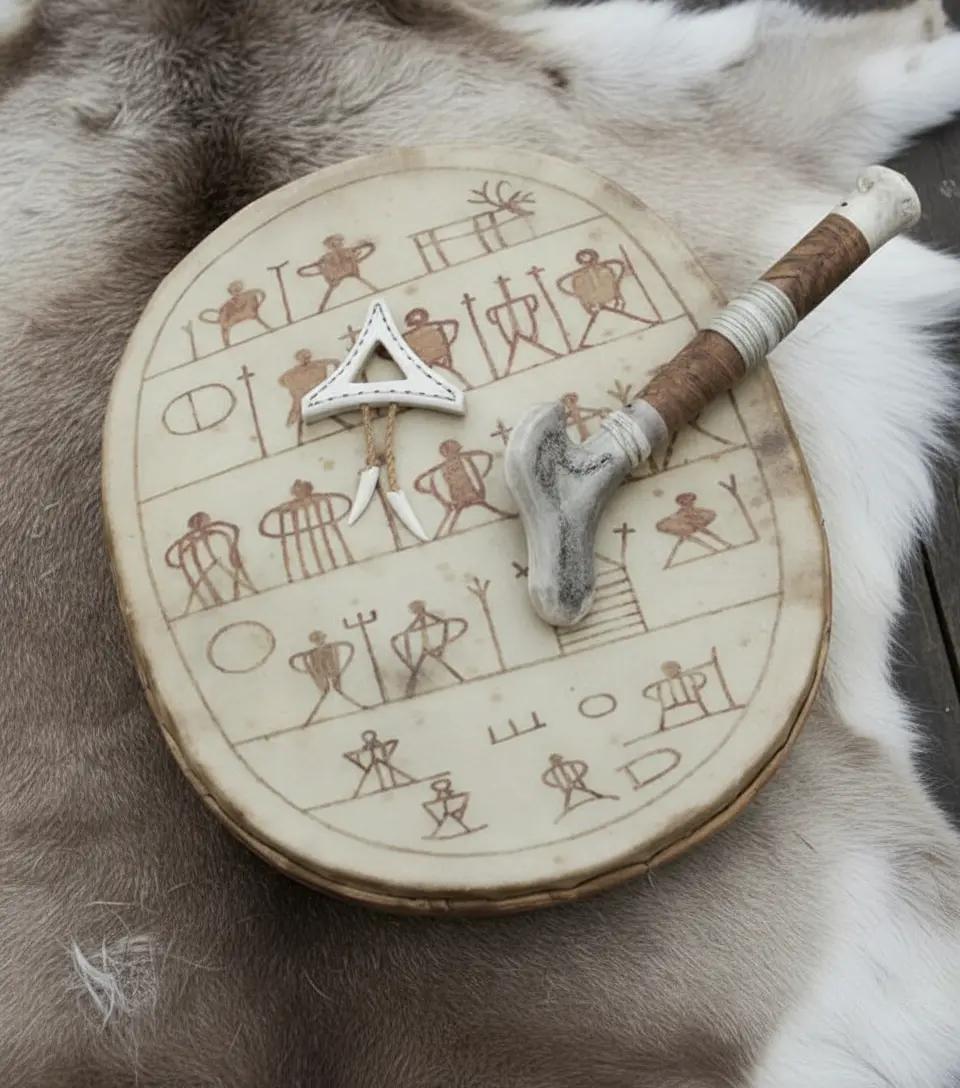
Have you ever wondered what shamanism really is? Or perhaps heard of mysterious rituals in the northern, cold regions of Scandinavia? In this article we take you on an exciting journey back in time and deeper into the magical world of Nordic shamanism, especially among the Sámi people. Here we meet the noaidi - the Sámi shaman, a link between humans and the spirit world, a healer, a soothsayer, and a guardian of the community's deeply rooted faith and magic.
What is shamanism in Scandinavia?
Shamanism is a form of spirituality and religious practice that has existed for many thousands of years across large parts of the world, but in Scandinavia it has a special connection with the Sámi, the indigenous people of the North. These regions are rich in mysticism, the power of nature and strong traditions where lakes, mountains, forests and wildlife play central roles in people's faith. The shaman, or noaidi as they are called in Sámi, is the expert at communicating with the spirit world, performing magical rituals and leading soul journeys into other worlds.
The noaidi made use of, among other things, drums, song, trances and various techniques to come into contact with spirits and help people. They were more than just practitioners of magic – they were healers who could find the cause of illnesses, foretell the future, and set in motion rituals to secure good hunting, fishing or protection against evil.
The role of the noaidi in society
In small Sámi communities, organized into siidas (small fellowships based on reindeer nomadism), the noaidi had a very important role. They were seen as the connection between the human and the spiritual, between this world and the realm of the dead. They were not only magicians, but also wise men who could soothe fear and uncertainty in a harsh and unpredictable environment.
A clear example of the noaidi's power is his ability to travel in a trance to the underworld (called jabmieaimo in Sámi) to fetch back a missing soul. The idea was that some illnesses were caused by a person's soul having been taken by the spirit world, and then the noaidi had to undertake a dangerous journey to negotiate with the powers of the realm of the dead and bring the soul home again. This required enormous strength and knowledge, and it was carried out through deeply ecstatic trances.
Furthermore, the noaidi functioned as advisors in crucial matters, such as foretelling luck in hunting or health for the members of the village. They often used magical drums as an oracle to obtain answers to the questions the local community posed.
Magic, drums and the spirit world
The gievrie, or "runebomme" as it is often called in Norwegian, was an important tool for the noaidi. It was not just a musical instrument, but a spiritual implement filled with symbols that carried stories, myths and magical powers. By playing the drum, the noaidi could enter a trance and soar over worlds, led by his spirit helpers.
A well-known tale tells of a noaidi whose spirit helpers, his "noaidi spirits," did harm when they followed his emotions. When he became angry because his daughter chose a man other than the one he wished for, the spirits killed her chosen one out of spite, simply because they interpreted their master's anger literally. This illustrates how powerful and dangerous these spirits could be, and how important it was for the noaidi to be in control of his power.
The world of the noaidi was not without danger. To enter a trance and travel to the spirit world meant facing dangers and resistance from evil forces and spirits. If a noaidi and his spirit allies were defeated in a battle against another shaman, in the worst case it could mean death for the noaidi himself.
The return of the souls
One of the most dramatic rituals the noaidi performed was the retrieval of the soul. When someone in the community became seriously ill, it could be because their soul had been carried off to the realm of the dead. In order to heal this person, the noaidi had to enter a trance and "travel" to the other realm as a spirit fish or another animal whose form he took on.
Thus, during the trance, he could pass through subterranean perils, negotiate with the ruler of the realm of the dead, the goddess Jabbmeahkka, and promise her offerings in return for getting the soul back. When he returned, he told what he had seen and experienced, and offerings and rituals were carried out to ensure that the soul was kept alive in the body of the sick person.
The battle between shamans
There are also stories of shamans who went to battle in the spirit world. In a tale from the 13th century, the so-called Historia Norwegie, it is described how two shamans sent their spirit helpers into battle. One shaman's spirit had the form of a whale, while the other's was like sharp stakes. The shaman with the whale spirit was mortally wounded, and then he died as well in the real world.
These battles could also be about stealing reindeer or other valuables from rival groups through magical attacks, something that explained certain mysterious disappearances in the local communities.
Divination and guidance
The noaidi also used their drums to foretell the future and give advice. Before hunting, fishing or important decisions, the drum was used as an oracle to say whether there would be success or not. Areas were assessed or events forecast, and this gave the community reassurance about the way forward.
For example, a noaidi could be asked about the outcome of a journey, so he performed magical drum power and went into a trance to obtain an answer. Sometimes he also had to seek out the spirits to understand why something was not working as it should in the community.
The wisdom and knowledge of the noaidi
Not everyone could become a noaidi. This role required both innate abilities and much training, as well as a deep understanding of Sámi mythology, magic and rituals. A noaidi was more than a magician; he or she was also a teacher and bearer of tradition.
The noaidi could distinguish genuine magic from false, and he or she was responsible for keeping the traditions and spiritual wisdom alive in the community. They were often seen as wise men and women, it was a vocation with responsibility and respect, even though their power could awaken both fear and admiration.
Modern understanding and research
Modern research has attempted to understand the role of the noaidi more objectively, often based on historical writings, folklore, and Sámi oral traditions. These accounts were often written by outsiders, such as Lutheran missionaries, and were marked by prejudice and misunderstandings. Nevertheless, they give us a unique insight into the rich and complex tradition that has existed in Scandinavia.
There are also a few archaeological finds that can be connected to the noaidi, for example burial sites that show signs of both male and female ritual objects, which suggests that both men and women could hold this role.
Shamanism in Scandinavia, through the practice of the noaidi, was a central and fascinating part of Sámi culture and spirituality. The noaidi was the link between humans and spirits, and their magic and rituals gave hope, healing and direction in an often harsh natural world and an uncertain future. The stories of the shaman's journeys, spirit battles and the magic of the drums still captivate our curiosity and give us a window into a world where nature, faith and magic were woven closely together.
Sources
Alves, Victor Hugo Sampaio. "Magia Xamânica em Terras Escandinavas: As Noções de Noaidevuohta entre as Etnias Sámis de acordo com as Fontes Modernas." Caminhos, Goiânia, 2025.
Beckman, Louise, and Hultkrantz, Åke. "Studies in Lapp Shamanism." Almqvist & Wiksell, 1978.
Hultkrantz, Åke. "Aspects of Saami Lapp Shamanism." In Juha Pentikäinen (ed.), Northern Religions and Shamanism, 1992.
Price, Neil. "The Viking Way: Magic and Mind in Late Iron Age Scandinavia." Oxbow Books, 2019.
Laestadius, Lars Levi. "Fragments of Lappish Mythology." Aspasia Books, 2002.
Tolley, Clive. "Shamanism in Norse Myth and Magic." Helsinki Academia Scientiarum Fennica, 2009.
Koskimies, August V., and Itkonen, Toivo I. "Inari Sami Folklore Stories from Aanaari." University of Wisconsin Press, 2019.
-1.avif)
-1.avif)