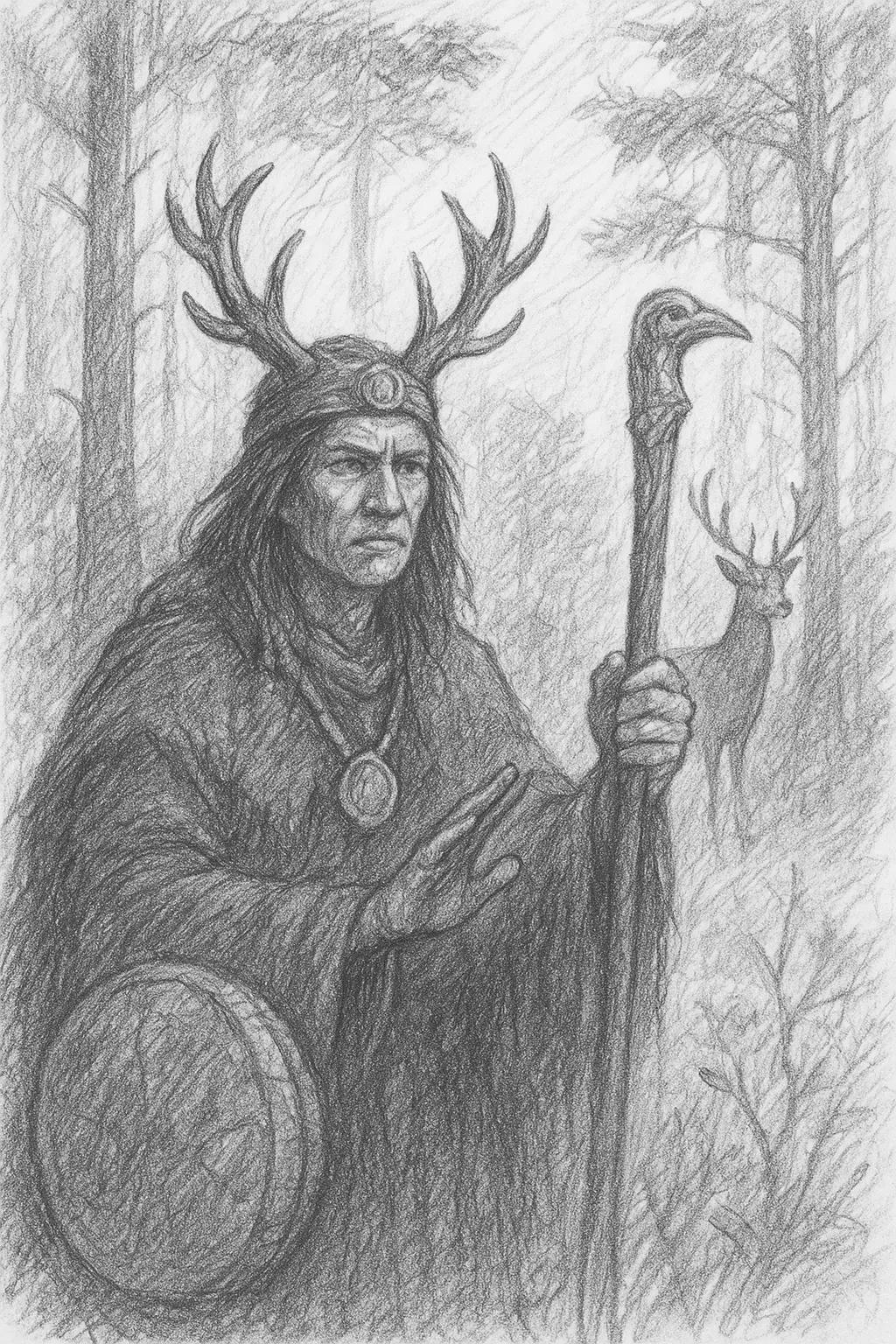
Imagine that you are living several thousand years ago. You live in a small village deep within the northern forests, far from cities and modern technology. Around you everything is full of spirits: the forest has its guardian, the water has its own beings, and even the earth you walk on has a living presence. To live in balance with this world, you need people who can speak with the spirits. This is the realm of the shamans – but also something more special, for among the Finno-Ugric peoples there were not only shamans, but also teadja and herdsmen who took on magical roles.
From Hunters to Farmers – and from Shamans to Ritual Masters
Shamanism is most closely associated with hunting and trapping cultures. When people live by hunting, fishing, and trapping, contact with the spirits of nature becomes absolutely essential. If you are going to catch a moose or get fish in your net, it is wise to ask the guardians of the forest and the water for help. The shaman, who could travel in trance and speak with these spirits, was therefore indispensable.
But what happens when people begin to cultivate the land? When the fields become more important than the wilderness, and the cows stand in the barn? Then society develops new needs. Instead of shamans, other specialists appear: people who can recite spells, heal illnesses, or ensure that the cows are not taken by wolves. Here we find the teadja, a figure who became the very heart of Finnish folk culture.
Who Was the Teadja, Really?
The word teadja comes from Estonian and means something like "the one who knows." In Finnish it is called tietäjä. This was not necessarily a shaman who fell into trance, but a knowledgeable person who knew the old songs, myths, and spells.
A teadja could:
Heal illnesses by using magical songs.
Locate people or animals that had gone missing.
Speak sternly to nature spirits that had taken something they should not have.
Protect people and animals against evil powers.
The difference from the shaman was that the teadja did not embark on dangerous spirit journeys in trance. Instead, he (or she) used the word as a weapon. Through Kalevala songs and spells, a teadja could negotiate, threaten, and even attack with illness or misfortune.
For example: If someone was wounded by iron, the teadja could sing a formula that told of the mythic origin of iron – and in this way "disarm" it. The word was magic, and knowledge was power.
When the Song Is Mightier than Trance
The great Finnish folklorist Anna-Leena Siikala described the teadja as a figure who in many ways took over the role of the shaman, but in a new way. Instead of ecstatic drum journeys, they used song, knowledge, and authority.
Think of the difference like this:
The shaman: travels out of the body, meets spirits, fights or negotiates with them directly.
The teadja: stands firmly on the ground, singing old words that all the spirits "must" obey because the words carry the origin of the world within them.
It is almost like saying that the shaman was a kind of adventure hero, while the teadja was a strict teacher or judge who knew the laws of the universe.
Man, Woman, and Power
An intriguing part of this story is how gender roles changed. Shamanism, as we know it from hunting cultures, often had more fluid gender boundaries. Shamans could cross between masculine and feminine roles, and sometimes even take on a third gender role in rituals.
With the teadja, things became more "masculine." He was often portrayed as stern, warlike, and dominating – one who threatened the spirits with violence and force. This may have come from the influence of Germanic warrior culture during the Viking Age, where the masculine and the heroic gained greater prominence.
Nevertheless, it was not only men who were teadja. Women could also fill this role, especially in later times. Women also had another strong tradition: the laments. When someone died, it was the women who led the dead to the other world with their songs. They described the path to the realm of death, called upon the powers of nature, and communicated with the dead. In this lie clear echoes of shamanism's role as a guide between worlds.
The Magical Herdsman – an Echo of the Shaman
Alongside the teadja there existed another role in Finnish culture that is almost even more fascinating: the herdsman or cowherd.
In old villages there was a person who watched over the village's cows when they were let out into the forest to graze. But this was no ordinary job – it was surrounded by magic, taboos, and rituals.
The herdsman had to enter into a kind of pact with the spirit of the forest. To protect the animals, he had to follow strict rules:
He was not allowed to have sex all summer.
He was not to take part in feasts or meet women.
He even had to watch how the mistress of the farm behaved: she was not to be barefoot, have loose hair, or show signs of menstruation when she sent out the animals.
If she broke the rules, the herdsman could punish her with the whip!
It sounds brutal, but in folk belief it was necessary to protect the animals. The herdsman, after all, stood between the village (the human world) and the forest (the wild). To do his job, he almost had to become a kind of "non-man" – a person without sexuality, who lived in a borderland.
A Third Gender Category?
When we look at the herdsman's role, it resembles phenomena we know from other cultures: people who temporarily take on another gender category to fill a ritual task. In India there are the hijra, in Albania the "sworn virgins," and in many shamanistic traditions there are transgender ritual roles.
The herdsman can therefore be seen as a kind of legacy from shamanism: a person who lives on the boundary, who sacrifices his own humanity to protect the community.
The Forest, the Spirits, and Animism
A red thread running through this entire culture is animism – the belief that everything in nature is alive and has a spirit. The forest was not merely trees; it had a guardian who could be offended or pleased. The water had its own spirit beings, the earth could react to how you treated it.
For the hunting cultures this was utterly fundamental: you had to respect the prey and the spirits that stood behind it. For agricultural cultures this gradually became less important, but never entirely gone.
The teadja's job was often to negotiate with these spirits – or threaten them – so that people could get what they needed. The herdsman's job was to balance the world of the village with the world of the forest.
Even today we find remnants of these beliefs in folk songs, fairy tales, and old rituals. In many places the memories live on in symbols, stories, and art.
From Shamanism to Teadja – and Beyond
So what can we learn from this? The story of the Finno-Ugric peoples shows how cultures change when the way of life changes. When people stopped being hunters and became farmers, the belief in spirits and magic did not disappear. It merely took new forms.
The shaman became the teadja.
Ecstatic journeys became magical words and songs.
Fluid gender roles became more masculine, but also with room for strong women.
And the herdsman remained as a strange, magical figure – a bridge between the shamanism of the past and the reality of agrarian society.
A Living Legacy
Even though Christianity and modernity have left their mark on the Nordic countries and Russia, the old ideas have never entirely disappeared. They have seeped into folk tales, into healing rituals, into songs – and into national epics such as the Kalevala.
Today many artists and writers draw inspiration from these old traditions. In "ethnofuturism" – a modern artistic movement – it is precisely old myths and shamanistic imagery that are used to create new culture.
It is almost as if the voices of the forest still whisper to us – only in a different way.
What Does This Mean for Us Today?
To a young person, all of this might perhaps sound like old myths without relevance. But if we think about it a little, it is not so far away:
We still speak of "listening to nature" when we want to save the environment.
We still experience that words can wound or heal – words have power.
We are still searching for balance between technology, society, and nature.
The story of the shaman, the teadja, and the herdsman is really about something timeless: how humans try to find their place in a world full of forces they cannot fully control.
And perhaps, the next time you walk in a forest, you might imagine that you are not walking alone. For who knows – perhaps the forest still remembers the old songs?
Sources: Arukask, Madis. Notes on Finnic Folk Culture from the Perspective of Shamanism. In: Attila Mátéfy & György Szabados (eds.), Shamanhood and Mythology: Archaic Techniques of Ecstasy and Current Techniques of Research. Budapest: Hungarian Association for the Academic Study of Religions, 2017.
-1.avif)
-1.avif)