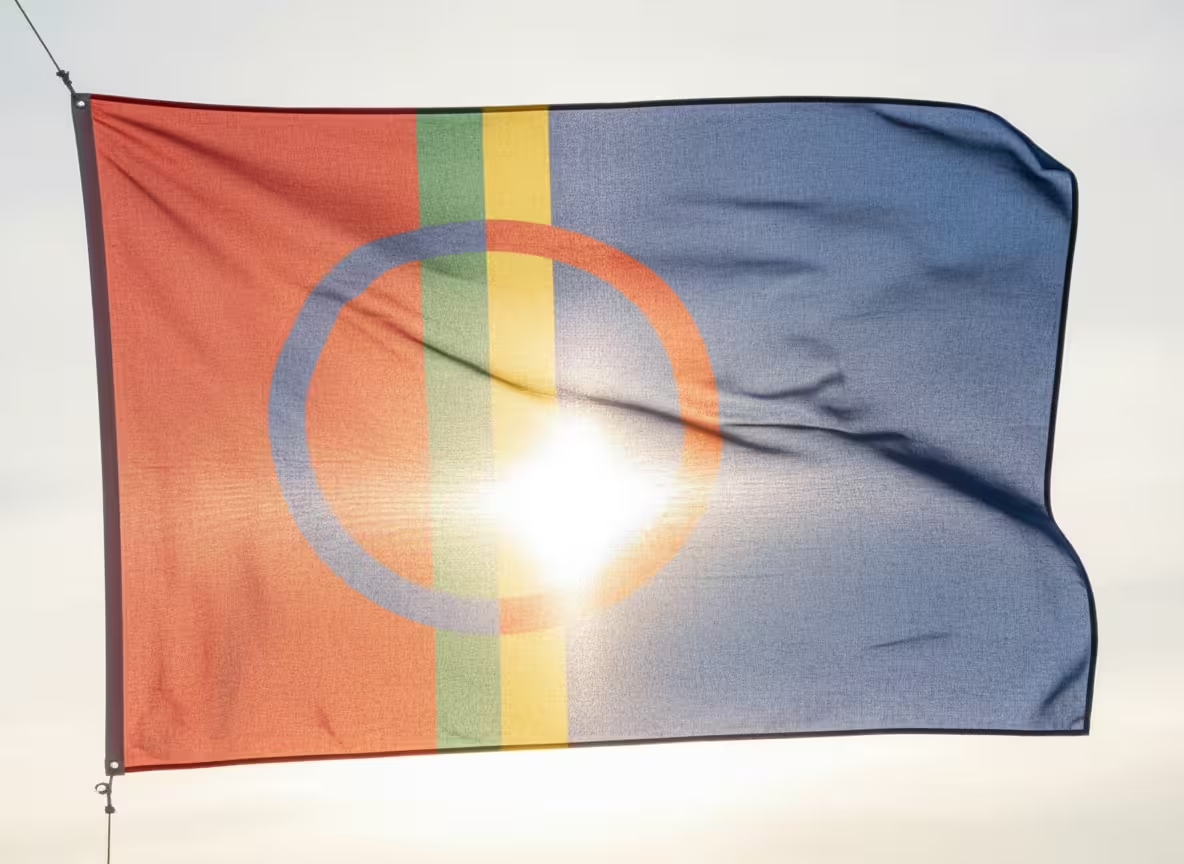
Noaidevuohta is not merely a religious practice, but a worldview shaped by tundra, mountain, forest and open plain. It is a way of understanding reality in which the human being never stands alone, but is always woven into a living web of spirits, animals, landscapes and ancestors. The history of noaidevuohta is therefore also the history of the Sami people – of survival, resistance, adaptation and a slow but unmistakable return.
The oldest traces – a life in dialogue with the world
Long before the word "religion" held any meaning in the north, the Sami lived in a relationship with the world in which everything was ensouled. The mountains listened. The rivers remembered. The animals were kin, not merely resources. This animistic understanding – in which everything has sielu, life force – forms the bedrock of noaidevuohta.
Archaeological finds in northern Scandinavia reveal traces of ritual practice stretching back several thousand years. The bear cult is especially evident, with bones laid in particular patterns and skulls placed with care. This testifies to a deep respect for the bear as more than an animal: it was a sacred kinsman, a wanderer between worlds.
In these early times there was no sharp boundary between the sacred and the everyday. The hunt was ritual. Births were cosmic events. Death was not a rupture, but a transition. The human being lived in continuous dialogue with a world that answered.
The noaidi – the link between worlds
At the centre of this understanding of the world stood the noaidi. The noaidi was not a priest in the Western sense, but a link. One who could see what others could not, hear what was left unsaid, and travel where ordinary people could not go.
Through drumming, joik and ecstatic states, the noaidi could send free souls out of the body. The journey might rise into the upper worlds, descend into Sáivo – the underworld – or move sideways into the landscape of the spirits. There the noaidi could gather knowledge, negotiate with powers, recover lost souls or restore balance.
The noaidi was healer, seer, counsellor and protector. When the reindeer herd was threatened, when illness struck, when misfortunes came thick and fast – it was to the noaidi that people turned. The knowledge was not theoretical, but rooted in experience and often inherited across generations.
The drum
The drum, goavddis or gievrie, was noaidevuohta's most important tool. It was not an instrument, but a map. A cosmic diagram painted on reindeer hide, with the sun at the centre and worlds, spirits and powers arrayed around it.
There were two main types of drum: frame drums and bowl drums. In the south the frame drum was most common, often owned by an entire household. In the north the bowl drum prevailed, closely tied to the noaidi himself.
The symbols on the drum were never arbitrary. They depicted gods such as Beaivi, the sun goddess, Máttaráhkká and her daughters, Horagallis with his hammer, animals, hunting tools, tents, boats and the world axis that bound everything together. When the noaidi drummed, he moved, quite literally, across his own cosmos.
The world of the gods – a living cosmology
Noaidevuohta was polytheistic, but not hierarchical in the way many later religions became. The gods were powers, relationships and processes. Beaivi, the sun, was life-giver and ancestral mother. Her return after the dark season was celebrated with offerings of butter and white objects.
The Radien system – Radien Áhttje, Radien Áhkka, Radien Nieida and Radien Bártni – represented the four aspects of creation. Together they formed the foundation of order in the world. The moon goddess Mána was more capricious, feared and respected, especially around the winter solstice.
This world of the gods was not distant. It was tightly woven into daily life, into the seasons, into the movements of the animals and the actions of human beings.
The bear – the sacred kinsman
The bear cult stands as one of the most powerful expressions of noaidevuohta's depth. The bear was spoken of through circumlocutions – "the old man in the fur coat" – so as not to offend its spirit.
The bear hunt was surrounded by strict rituals. The hunters fasted, purified themselves and used a special bear language. After the hunt came the bear feast, in which the whole animal was treated with reverence. The skeleton was reconstructed and buried to ensure the bear's rebirth.
These rituals bound the community together and taught respect, moderation and responsibility.
The encounter with Christianity – from coexistence to oppression
The first encounters between Sami religion and Christianity were not necessarily violent. Traces of Christian impulses appear as early as the eleventh and twelfth centuries. For periods, the faiths lived side by side.
But from the seventeenth century everything changed. In Denmark-Norway, Sami religion was defined as witchcraft. Drums were confiscated and burned. Noaidis were imprisoned, tortured and executed. Hundreds of Sami – women and men – were condemned as sorcerers.
It is estimated that around a fifth of all those accused of witchcraft in Norway were Sami. Many were burned alive. Others were forced to renounce their faith publicly, while continuing in secret.
Christianisation created a deep trauma. Knowledge was severed. Rituals were forgotten. The voices of the drums fell silent.
Hidden continuity
Even so, noaidevuohta never died out completely. In remote areas, practices lived on in secret. Readers, signers and healers continued their work, often under Christian names.
The knowledge of the ancestors was whispered onward, disguised, fragmented – but not gone.
The reawakening – a slow return
In the 1970s and 80s something decisive happened. The Alta affair became a turning point. The struggle for the river became also a struggle for identity, land and spirituality. Nature was once again seen as sacred.
In this period new Sami spiritual voices stepped forward. Noaidevuohta became not only history, but living practice. The drum returned to public life. The joik was given new life.
Festivals, ceremonies and networks grew up. In 2012, Sami shamanism was once again recognised as a lawful religion in Norway – for the first time in over 300 years.
Noaidevuohta today – between tradition and the present
Today noaidevuohta exists in many forms. Some work strictly within tradition, others in dialogue with modern shamanism and global Indigenous networks. This diversity creates both tension and vitality.
Noaidevuohta is used today for healing, rites of passage, grief work and environmental engagement. It offers a language for speaking about climate, the loss of land and spiritual alienation.
A living inheritance
Noaidevuohta is not a museum. It is not something that can be frozen in time. It is a living inheritance that adapts, just as the Sami always have.
In a world marked by ecological crisis and spiritual emptiness, noaidevuohta reminds us of something fundamental: that the human being does not stand above nature, but within it. That all life is ensouled. That balance matters more than control.
The history of noaidevuohta is therefore not only a Sami history. It is a reminder to us all – of how we can live, listen and remember.
Academic sources
Manker, E. (1938–1950). Die lappische Zaubertrommel I–II. Stockholm.
Rydving, H. (1993). The End of Drum-Time: Religious Change among the Lule Saami. Uppsala.
Pentikäinen, J. (1995). Saami Shamanism: Symbolism and Cultural Context. Helsinki.
Hultkrantz, Å. (1962). Religion of the Sami. Stockholm.
Price, N. (2001). The Archaeology of Shamanism. London.
Pollan, B. (1993). Samisk religion i førkristen tid. Oslo.
Bäckman, L. & Hultkrantz, Å. (1978). Studies in Lapp Shamanism. Stockholm.
Fonneland, T. (2010). Contemporary Shamanism in Norway. Leiden.
-1.avif)
-1.avif)