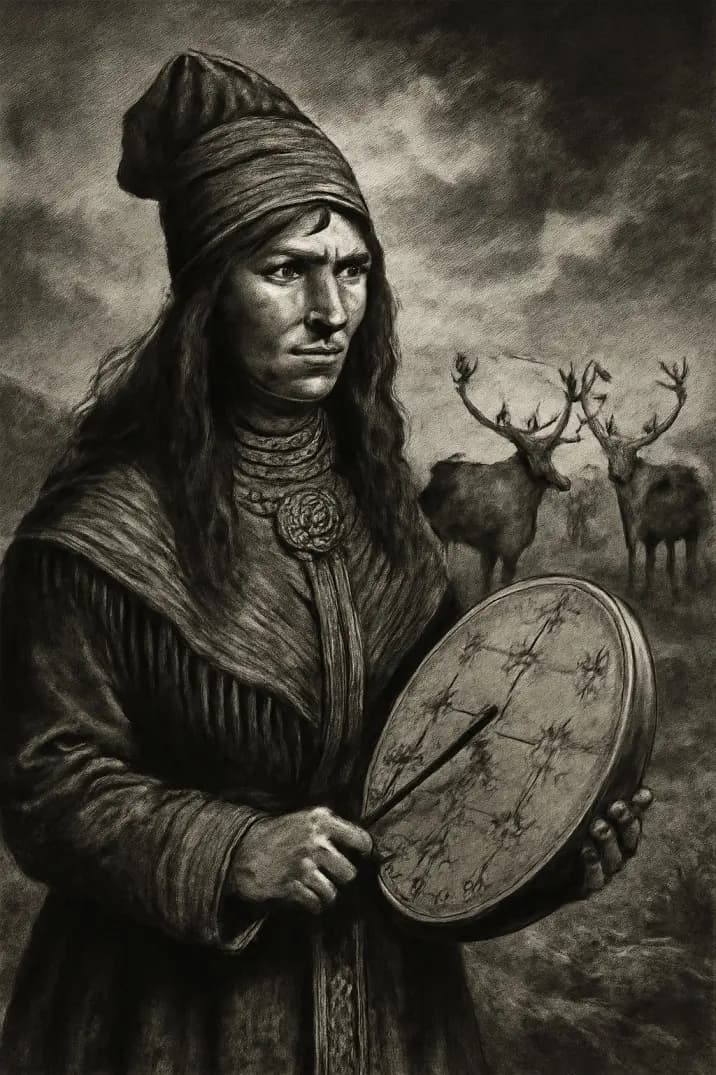
Imagine the forests and mountains of northern Scandinavia in the 16th and 17th centuries - snow-covered plains, reindeer herds, and here and there small groups of Sami moving with the animals and living in tune with the rhythms of nature. In the midst of this landscape we find a host of stories and traditions in which magic, the spirit world and the supernatural weave themselves into everyday life. The descendants of these traditions still carry myths of strong women - rikkuo-majas and silbo-gåmmos - who not only managed great reindeer herds but also had contact with the spirit world and mastered shamanic arts.
The forest's powerful noaidi
Among the forest Sami of Arvidsjaur, the story of Rijkuo-Maja lived on long after her death. She came into the world around 1660 and died near 1757, almost a hundred years old. Her name - "Rijkuo" in the Arvidsjaur dialect - suggested that she was exceptionally rich, especially as measured in reindeer. It was said that she wore five dresses layered upon one another to display her wealth, a visible symbol of power in Sami society. But the accounts of Rijkuo-Maja do not stop at the reindeer herd and the riches. Her reputation as a noaidi, a practitioner of what we today associate with shamanism, overshadows material wealth. She was spoken of as a master of the noaidi's art, and many miraculous stories are attached to her abilities. People believed she had a special connection with the reindeer - she could see and pick out one particular cow among hundreds, far off in the forest, and no one dared challenge her authority in the area.
Rituals, sacrifices and spirit helpers
Rijkuo-Maja did not only dominate her surroundings with will and mystique; she was also known for her sacrifices to the thunder god Horagalles (also called Atjakatj). Particular reindeer were marked for the thunder god, and the sacrifice required that the animal be buried so that only the antlers could be seen. It was said that the roar of thunder was a sign of a successful sacrifice. Beside the sacrificial bogs she had platforms (luovveh) where she laid out meat for ravens, eagles and nutcrackers - birds that in mythology often appear as helpers for the shaman. One informant even claimed that the wolf was in her service, and that for this reason she had no need of dogs. Her connection with animal life was an important part of both shamanic power and authority.
Drums, weather magic and final rest
Stories mention her drum, a classic tool of the noaidi, and describe how she - even blind in her old age - made it rain by beating the drum and calling on the thunder during a forest fire. Her last wish, to be buried on Storberget so that she might still hear the sound of reindeer and oars, was not granted, and the stories tell that the family who chose to bury her in the churchyard was struck by misfortune: the reindeer herd disappeared toward the coast and drowned on ice floes, and so Rijkuo-Maja's days of greatness were over.
From sacrificial sites to stones in the lake
There are several legends about sacrificial sites and stones connected to Rijkuo-Maja - a great stone, often visible in Lake Mausjaur, where fishing rituals were performed and silver laid on the bottom. This shows how Sami cult and nature went hand in hand, where sacrifice and magic were part of everyday life and a woman could hold a central role in religious practice.
An independent woman in the mountain regions
Further toward the mountain regions, among the mountain Sami of Tärna, we meet Silbo-Gåmmoe (Anna Greta Matsdotter), born in 1794 and died in 1870. She is said to have inherited, or perhaps acquired, a drum decorated with silver ornaments - something that also gave her the name "Silbo," related to the Sami word for "silver." Tradition tells that the drum came from her father, a renowned noaidi, and served as a tool for summoning the reindeer.
The drum and ecstasy
Silbo-Gåmmoe was, according to several informants, known for using the drum magically. One source vividly describes how she could fall into ecstasy with the drum at her side, foam at her mouth - an image often linked to trance or shamanic rapture. The drum was thus not only a religious symbol but also a practical tool for magical séances and control over nature, especially reindeer.
The magic lives on
Many traditions tell how knowledge and magic were passed down, often through the maternal line. Silbo-Gåmmo's son, Nila, is said to have become known as the "last noaidi" in Lycksele lappmark. The inheritance from his mother - including a shawl of squirrel tails used during séances - he carried on, though his fate became tragic after he was convicted and served a sentence for murder, and later perished in a snowstorm together with his wife.
Lapp-Stina and Spå-Ella. More examples of female magic
Two other memorable figures mentioned in the sources are Lapp-Stina and Spå-Ella. Lapp-Stina, a folk healer from Ångermanland, became known for her medical knowledge, which many attributed to supernatural abilities learned from a "godmother from the underworld." Historical accounts from priests report blindness vanishing and healings that no medicines could explain, always accompanied by small magical acts and conversations with the "godmother."
Spå-Ella, for her part, came from a family in which magic and drum-making were passed down. Her stories are marked by both fear and respect - she could, it is said, cast curses, but also lift them, and once is said to have caused a farmer's son to be struck by severe visions after a conflict. Like Silbo-Gåmmoe and Rijkuo-Maja, she preserved the knowledge of magic and sacrifice.
The role of women in Sami shamanism
Historical sources give conflicting pictures of women's position in Sami religion, especially in connection with sacrificial sites and the use of the drum. Old accounts often claim that sacred places and drums were forbidden to women, and that transgressions required costly atonement sacrifices. Nevertheless, the living traditions point to the fact that women could in practice hold extensive roles. Several ethnographic and lexical sources mention female magicians and ceremonial leaders, with their own designations: guaps, guevrie, gåbeskied, kuopaskuina, nååides-gummoo, Sauberin and Hexe - all names connected to female practitioners of magic and divination.
Controversy and change
This ambiguity has several explanations. Some hold that female shamans represent a late, decadent phase of a religion on its way out of its original form, in which old taboos fall away. Others suggest that they may be survivals of a much older female priestly or shamanic role, comparable to the female shamans of the Siberian Chukchi or the Norse völur. Perhaps it was precisely women who first represented the connection between human and spirit, before the rituals were monopolized by men. Nor is it unlikely that the missionaries who were often the ones who recorded the stories had little desire to portray women as strong and in opposition to the strongly patriarchal church.
Magical helpers, icons and transmission
The stories show several elements that connect female shamans to classic shamanic practice: the use of belt and shawl in ritual contexts, the sacrifice of reindeer (and birds!) to specific spirit beings, the presence of "helpers" in the form of birds and animals, and the transmission of magical knowledge within the family. More than purely religious functions, these women represent links between daily life, ecology and the mythological worldview.
A break with convention - but rooted in tradition
Both Rijkuo-Maja and Silbo-Gåmmoe probably stepped outside or across the ordinary frameworks for female ritualists. These women were not chosen by the siida (the Sami community), and their power seems to have been anchored more in charisma, family inheritance and results than in formal structures. This shows a religion in change, opened to new roles and expressions, yet still well anchored in tradition and stories.
Sources
References are included throughout the text. Below follow selected key names and works for further study:
Lundmark, Bo. "Rijkuo-Maja and Silbo-Gåmmoe - towards the Question of Female Shamanism in the Saami Area."
Bäckman, Louise & Hultkrantz, Åke. "Studies in Lapp Shamanism."
Demant-Hatt, Emilie. "Offerforestillinger og erindringer om troldtrommen hos nulevende lapper."
Eliade, Mircea. "Shamanism: Archaic Techniques of Ecstasy."
Kildeskrifter til den Lappiske Mythologi (various volumes).
Leem, Knud. "Beskrivelse over Finmarkens Lapper."
Mebius, Henrik. "Sjiele. Samiska traditioner om offer."
The image is illustrative, not historically accurate
-1.avif)
-1.avif)