In the cold wind across the plateau, where reindeer tracks are drawn in the snow like ancient runes, the stories of Sahrakka still whisper. This Sami goddess, guardian of birth and women's power, fits perfectly into the spirit of International Women's Day – a day for lifting up the invisible threads that bind life to life.
The origin of a goddess
Imagine a lavvu in the winter darkness, where the fire crackles and warms the thin walls of reindeer hide. Beneath the hearth, in the secret heart of the earth, lives Sáráhkká – or Sahrakka, as she is often called in the southern Sami dialects. She is the daughter of Máttaráhkká, the mother-akká who gives the body form, and the sister of Juoksáhkká, the bow-mother who decides sex, and Uksáhkká, the one who opens the gates of life.
According to the oldest sources, such as Hans Skanke's treatise from the 1720s on Sami religion in Nærøy and Namdalen, the high god Radien-attje receives the soul from the uppermost realm. This soul is sent down to Máttaráhkká, who clothes it in flesh and bone. Then comes Sahrakka: she places the foetus in the mother's womb, protects it through the pregnancy, and eases the pains of childbirth. Skanke, a priest who learned Sami from the local population, describes her as one of the most revered goddesses, closest to everyday life for the Sami in what is today Norway and Sweden.
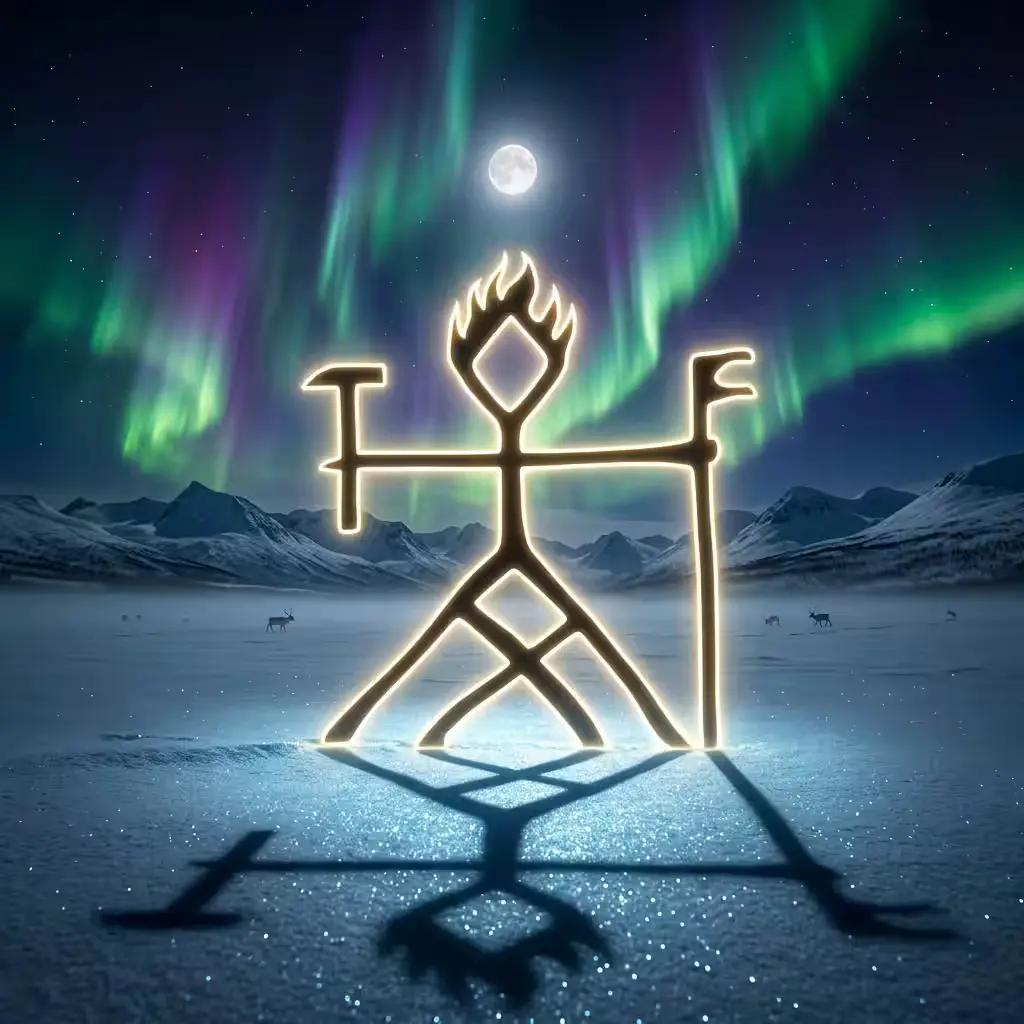
Her name carries traces of this role. "Sára-" may come from the verb sárrat, "to split" or "to create", while "-Ahkka" means old woman or grandmother – a wise, warm mother figure. On the runebommer, the sacred drums of the noaidi (the shamans), she is often depicted with a forked staff, the lavvu symbol for the sky, as a sign of her connection to the axis of creation.
Rituals at the hearth
When a woman felt the spark of life in her belly, the worship began. She drank "Sahrakka's liquor" before the birth – a small glass of aquavit poured into the fire so the vapour rose down to the goddess beneath the earth. Afterwards came "Sahrakka's porridge", the first meal for the new mother, cooked from the most sacred ingredients.
Wood was holy to her. A dry twig was split in two with an axe – the "Sáráhkka split" – to ease the birth, as if the goddess herself shared the mother's pain. These pieces of wood were so sacred that no one was allowed to touch them. Water from springs was poured onto the earth, and offerings of cheese, meat or alcohol were given to the fire.
The animals were not exempt. Sahrakka also watched over the reindeer's calves, and after a successful birth a female animal was sacrificed – never a male. The time of menstrual blood was her domain too. Women loosened belts and collars, avoided stepping over a man's foot or weapon, and kept away from milk cows and fishermen. Afterwards they baked a cake only for the sisters.
Women's role in Sami life
Sahrakka was not only a goddess of birth; she was the guardian of women in a harsh landscape. Sami women were the backbone of the family: they milked reindeer, tanned hides, wove clothing, and carried the knowledge of herbs and healing.
A study of sources from Namdalen emphasises that Saraahka was the most important deity, closer to the people than the heavenly ones. This reflects women's place: they held the sacred centre of the home, the heart of the goahti beneath the hearth, where the ancestors rested. Today this is honoured in the organisation "Sáráhkka", a Sami women's organisation founded in 1988 and named after her to fight for rights and culture.
On International Women's Day, 8 March, a celebration of women's struggle that began with strikes in twentieth-century Europe and became a UN day in 1977, Sahrakka fits in as a primal force. In Sápmi, the day is marked with a focus on Sami women's contributions to society – from reindeer migration to resistance against development.
The shadow of Christianity
Then came the missionaries. From the seventeenth century, priests such as Jens Kildal and Knud Leem forced the Sami to abandon the goddesses. Yet Sahrakka survived in hiding. Children were baptised in the church, but "baptised anew" in her name at home. Before church, people ate "Sahrakka's flesh and blood" to appease her.
The Virgin Mary gradually took her place – a Christian rewriting of the old mother power. But on the runebommer, hidden in museums, she lives on. Here we speculate: imagine the secret rituals in the lavvu after the night's mass – a mother whispering Sahrakka's name while the priest sleeps; this is literary licence, not taken directly from Skanke's texts, but inspired by the rites of passage described in the sources.
A tale from the plateau
Let us weave a story, grounded in the sources but with a narrative thread. In a siida (family group) near Karasjok, in the winter of 1750, the pains are felt. Elle, a young wife, lies on reindeer hide, sweat beading on her forehead. Her mother, Áile, splits a twig over the fire: "Sahrakka, share the pains as you share life!" She pours liquor onto the embers, and the vapour rises like a prayer.
The foetus was a girl, watched over by Sahrakka herself. Elle remembers her aunt's stories: how the goddess felt every contraction, lived beneath the hearth with the ancestors, and punished those who ignored the taboos. Outside the wind howls, and the reindeer gather – a sign of protection. The child comes. Áile gives "Sahrakka's porridge": oats, honey, reindeer milk. Elle whispers: "You are Sahrakka's daughter."
The next day a female reindeer is sacrificed. But Elle knows: in the church the priest waits with his water. She will baptise the child in secret later, with earth from the hearth. (This story builds on ritual descriptions from Skanke and Wikipedia, but the characters and dialogue are imagined to bring the tradition to life – no direct historical figures.)
A modern reawakening
Today, in March 2026, Sahrakka blooms again. Women's Day in Sápmi lifts up her symbol: jewellery with the forked staff is sold in Jokkmokk, a sign of women's power. Sami women's organisations use her as an icon against Norwegianisation and the climate crisis – the reindeer's births are after all threatened by warmer winters.
Scholars, as in "Liminality, Rock Art and the Sami Sacred Landscape", connect her to sacred places, where women made offerings at mountains and rivers. In the heritage of shamanism she is part of the Áhkká family – goddesses who bind earth to sky.
Sahrakka's legacy today
Think of the reindeer herds calving in the spring wind. Sahrakka is there, invisible, in every mother who carries on. On Women's Day we light a fire – not only for warmth, but for her beneath the earth. Organisations such as Sjamanistisk Forbund greet women with her spirit.