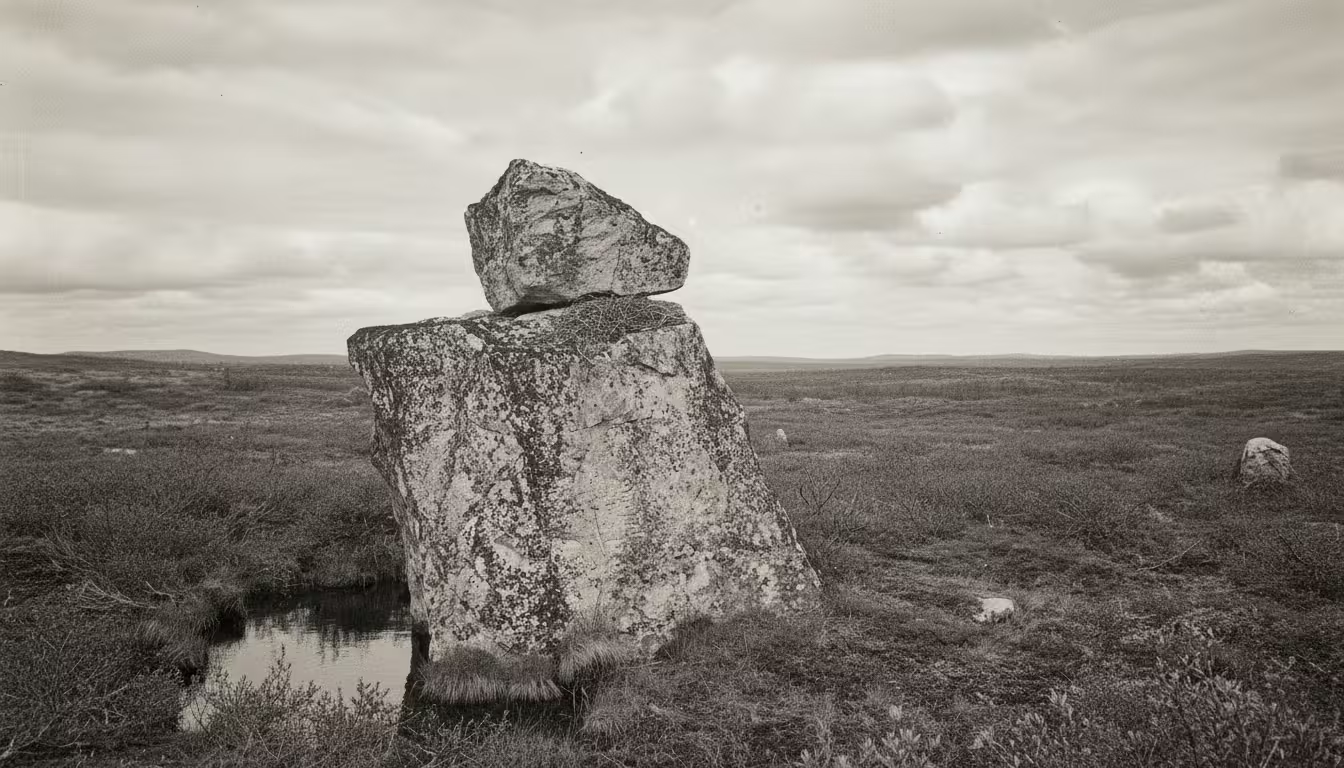
I remember the day the wind whispered through the mountain, and I first stood face to face with a sieidi – one of the great, silent stones that have stood there since our ancestors wandered these highland plains. As someone who lives with Sámi shamanism today, I feel the living power of these places. They are not merely stones; they are living beings, spirits that communicate with us through the landscape. The reports I have read – archaeological excavations at sieidi sites such as Sieiddakiedgi, Taatsi and Dierpmesvarri – confirm what I have always known in bone and soul: these sacred places have been used for centuries, shaped by encounters between our tradition and intruders from the south.
Imagine a time before churches and markets filled the north. Long ago, the forefathers began to lay down offerings at the sieidis: bones from bear, fish such as perch and trout, birds such as black grouse. These were not random gifts; they were agreements with the spirits for hunting luck and survival. Reports show how reindeer bones dominated from the 15th century, as animal husbandry grew forth – a gradual shift from wild reindeer to domesticated reindeer, tied to trade with the south. I see it today: when the reindeer move across the highland plain, one stops at the sieidis to give thanks, just as they did. But the encounters with the traders from the south changed everything. Merchants from Novgorod and Sweden brought coins and metal, which were sacrificed together with local amulets of tin-lead alloy. The sieidis became bridges between worlds, places where our animistic view – in which stones and animals have personality – met foreign eyes.
Collision and exchange
The wind carries echoes of ancient encounters. From the Middle Ages came the birkarls, the wealthy merchants from the south, and they built markets at river mouths such as Tornio and Kemi. The sieidis bore witness to this: in Sweden and Norway there are arrowheads and jewellery from the Viking Age, parallel to wetland depositions farther south in Scandinavia – weapons, jewellery and keys thrown into sacred waters. In Finland it was animals that spoke loudest, but coins from Norway, Germany and even Arabic dirhams appeared, perforated as amulets. This was not merely trade; it was a dance of cultures. Some sieidi sites, such as Rautasjaure, lay by copper veins – the place where metal was born, sacrificed back to the rock that gave it life.
Christianity came like a storm from the south. Churches were raised near the sieidis: in Enontekiö by the Uhriaihki pine, in Utsjoki with a view of the spirits of the Ailagas falls. Was it conquest? Yes, but also blending. People sacrificed in churches for the hunt and against illness, prayed to the old gods during communion. Lars Levi Laestadius, with Sámi blood, wove our myths into the law – the elves became devils, but the roots lived on. I feel that tension today: the sieidi is a better altar than church bells, as the poet Nils-Aslak Valkeapää sings. The archaeologists found moved bones at Sieiddakiedgi – not destroyed by the church alone, but cleared as in our tradition, where holiness arises in the ritual, not in the object.
Living places, living objects
In our shamanism, everything is in motion. The sieidis are not dead stones; they are living places, as Julie Lund describes in her analysis of sacrificial sites with metal objects. Objects have biographies: local amulets cast to be sacrificed, coins with long journeys from distant lands, altered to "kill" their social life before being given back. This is animism – reciprocity between humans, animals and land. Bear bones from the 12th century at Nakkala testify to early hunting rituals; reindeer from the 15th century mark the rise of the herding culture. Modern traces – euro coins, alcohol bottles, even yo-yos and earrings – show continuity. Moose skulls on the Kirkkopahta stone, reindeer meat at Äkässaivo: local fishers and reindeer herders honour the ancestors.
But new actors are coming. New shamanic quartz and crystals, lights and twigs at Taatsi and Äkässaivo recall the behaviour of British pagans at Stonehenge – a new blend, sometimes welcome, other times like neocolonialism. Tourists toss coins, fishers rub cognac on the stones. I myself have stood and drummed at the sieidi, felt the pulse of the noaidi. The places live, because we give them life through rituals tied to livelihood – hunting, fishing, reindeer herding.
A bridge of time and faith
Syncretism is the heart of our history. It was not only Christianity and shamanism that merged; trade from east and west, the rise of reindeer herding, all of it shaped the sieidis. From the 18th century animal sacrifices declined – perhaps blood and fat smeared on the stones left no trace – but the places did not disappear. In Sweden the joik is sung again at returned sieidi stones. Today we weave old threads into new ones, the drum sings again. The sieidis have survived colonisation, because they are alive – like us. They whisper: come, sacrifice, listen. In a world of churches and tourism they stand silent, but pulsing, ready to meet the next generation.
Aikas, Tiina & Salmi, Anna-Kaisa (2013). "The sieidi is a better altar, the noaidi drums a purer church bell: long-term changes and syncretism at Sámi offering sites." World Archaeology.
Lund, Julie (2015). "Living Places or Animated Objects? Sámi Sacrificial Places with Metal Objects and Their South Scandinavian Parallels." Acta Borealia, 32(1), 20–39.
Unknown author (unknown year). "North-South Encounters at Sámi Sacred Sites." (Academic report on Sámi sacred sites).
Further Relevant Academic Sources
Zachrisson, Inger (1984). "De samiska metalldepåerna år 1000–1350 i ljuset av fyndet från Mörträsket, Lappland." Archaeology and Environment, 3.
Mulk, Inga-Maria (1994). "The Sacrificial Places and Their Meaning in Sámi Society." In Sacred Sites, Sacred Places. Routledge.
Fossum, Birgit (2006). Förfädernas land: En arkeologisk studie av rituella lämningar i Sápmi, 300 f.Kr.–1600 e.Kr.. Studia Archaeologica Universitatis Umensis, 22.
Hansen, Lars Ivar & Olsen, Bjørnar (2004). "Samenes historie fram til 1750." Cappelen Akademisk Forlag.
Schanche, Audhild (2000). Graver i ur og berg: Samisk gravskikk og religion fra forhistorisk til nyere tid. Davvi Girji.
-1.avif)
-1.avif)