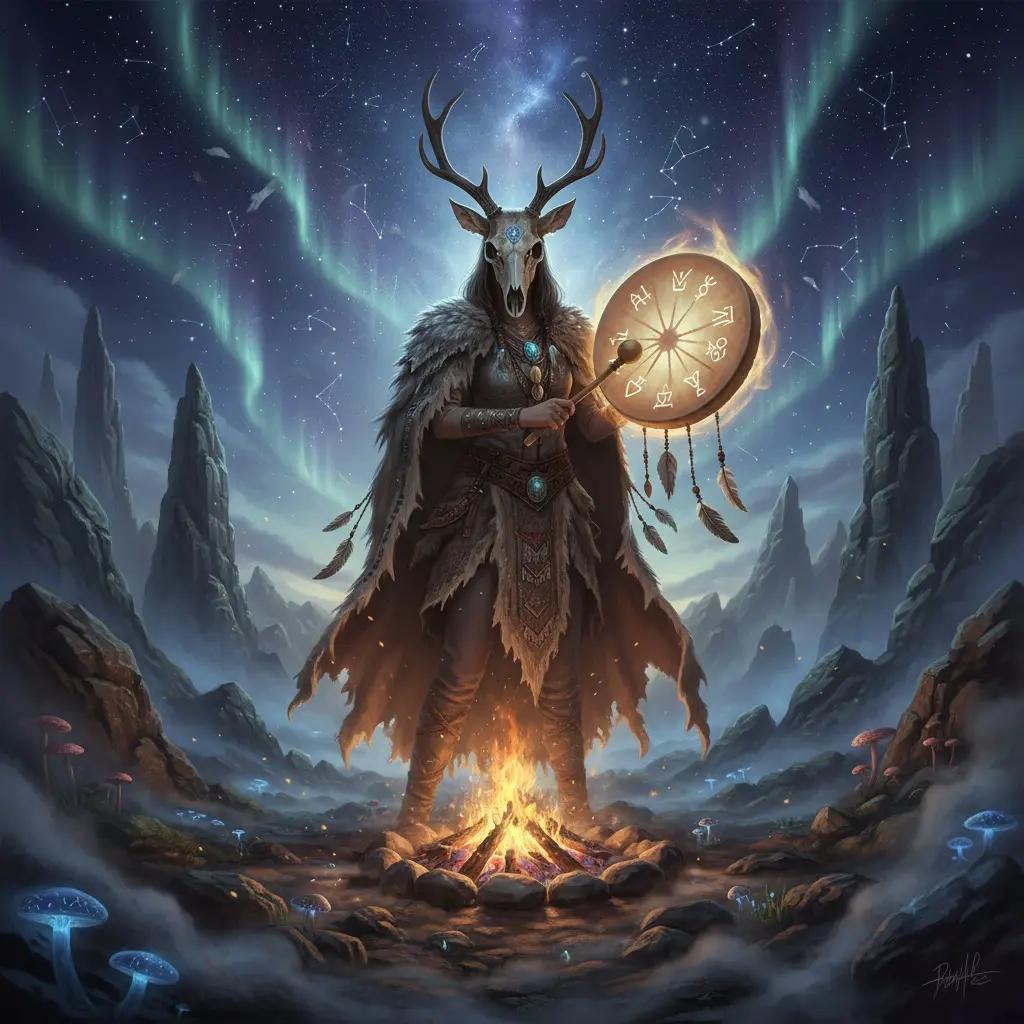
Picture a night, far back in time. We find ourselves in a world without electric light, without cities, without highways. All that exists is the darkness, the stars and the fire burning in the middle of the people's gathering place. The shadows dance, cast up against the mountain walls. The smell of smoke mingles with the scent of wet earth. Around the flames sits a small community of people. They have had a long day of hunting, fishing or gathering, and now they are gathered here in a circle.
A person rises. She is dressed in the hide of an animal, wears a mask made from a deer's head, and drums rhythmically on a skin-stretched frame. The beat of the drum begins calmly, like a throbbing heart. Gradually the rhythm intensifies; it slips into everyone's breath, pounds through the body, and lifts the mood into a landscape that is not quite this world. This is the shaman, one who has the ability to cross the boundary between the everyday life of humans and the reality of the spirits.
She is at once physician, priest, storyteller and psychologist - but above all she is a bridge-builder. The shaman sees connections and forces where others see only coincidences. She has learned to read the language of nature, to enter altered states of consciousness and bring back wisdom, power and healing. She is a guide into the invisible part of existence.
And that is precisely why we find traces of the shaman throughout the whole of human history.
What is shamanism really?
Shamanism is not one particular religion, and there is no "sacred book" or fixed set of rules describing how it is supposed to be. Instead, it is a term applied to many indigenous religions, in very different cultures. What they share is the belief that certain people can enter a special state of consciousness - often called trance or altered state of consciousness - and thereby communicate with spirit beings, animals or the cosmos itself.
They do this with the help of drumming, dance, breath, song, silence or the use of nature's aids, such as fire or plants. This transformation is not just an act in the mind; it is the whole body and the whole community that take part. When the shaman drums or sings, everyone who participates becomes part of the journey. The community lifts the shaman, just as the shaman lifts the community.
The British anthropologist Charlotte Seymour-Smith described the shaman as a part-time religious leader, not necessarily a full-time priest, but someone who had direct experiences of the spiritual world. These experiences were often triggered through ecstasy, sensory stimuli or self-imposed silence and fasting. According to this view, the shaman is not a theorist, but a practitioner - one who does.
The body as a gateway to other realities
In shamanism, the body is far more than just a shell that carries the soul. The body is active, participating and sacred. When the shaman moves into trance, it happens through the body: the rhythm of the drum sets the pulse in motion, the dance stretches the limbs, the breath changes, and the voice carries power.
We might imagine that the body becomes like an instrument - tuned especially to be able to bear and withstand the powerful encounters between human and spirit world. When the shaman cries out, sings, leaps or trembles, it is not random. It is a state of transformation, a bodily practice that in itself opens a door.
In many cultures the body was adorned as part of this. Tattoos, scars, paint and masks could mark the shaman's status or turn the body into a living map between the realities. The body functioned both as a sign for the community and as a tool in the rituals.
The animals and the language of nature
For the shaman, nature was never merely a backdrop or a resource - it was alive and filled with spirits. Animals, celestial bodies and plants were not symbolic in a distant way, but participants in the same community as humans.
One of the main principles is the idea of power animals or spirit guides. These animals served as protectors and sources of wisdom. One shaman might have the bear as their power animal, another the raven or the deer. By entering trance and "journeying" together with the power animal, the shaman gained insight and strength that was impossible for an ordinary person.
The bear is a particularly good example. In Sápmi, North America and Eurasia there are countless stories of the bear as healer and transformer. The bear hunt was often surrounded by ceremonies precisely because the bear was regarded as a sacred being, almost like a human in an animal body.
The stories of humans who transform into bears, or bears who take human form, reflect the very task of the shaman: to cross boundaries. To be both human and animal, both body and spirit, both here and there.
Objects that bear witness from the past
Even though thousands of years have passed since the first shamans lived, we have traces of them in archaeological finds. Masks of deer heads, drums, decorations and figures that combine human and animal have been found.
One example is the so-called deer masks from Star Carr in England, an archaeological site from the Stone Age. There, deer skulls have been found that were probably worn by people during rituals. With such masks the shaman could take on the role of the animal - not just symbolically, but literally, by bearing the animal's face in front of their own.
In Bronze Age Eurasia we find ceramic vessels shaped as human-bird hybrids, askos vessels that often depict winged creatures. Such forms tell us how the shaman was seen as someone who could fly between heaven and earth.
These objects become like silent witnesses. They stand there in the museums or in the excavations and remind us that people thousands of years ago faced the same reality as us: the mystery of life, death, nature and cosmos - and they sought meaning through rituals.
Fire as the power of transformation
At night it is the fire that shines. The flame draws people together, gives warmth, but has also always carried a hint of the magical. In nearly all shamanic traditions, fire plays a leading role. It is both practical and symbolic.
Fire was understood as a force that connects the earth with the sun, and that had the ability to create transformation. When metal was melted or clay was fired, fire's role as creator and transformer became even clearer.
That is why smiths and masters of fire were in many cultures regarded with awe. Their work resembled the ritual: to carry the heat, to endure the sparks and to reshape raw materials into something useful and sacred. In some places they were regarded almost as shamans, because they handled the very fire of life.
Shamanism in past and present
When we speak of shamanism, it is easy to place it in the "old days," as a practice from the Stone Age or among indigenous peoples far away. But it also exists in our time. Just look at phenomena such as festivals, rave culture or large concerts.
When the music strikes with heavy bass, when people dance for hours, sweat, breathe and forget themselves, something happens that resembles the same processes the shaman led in the past. The light, the rhythm, the community and the altered consciousness are universal human experiences.
In the modern world too, shamanism has a place, both as a faith and as a form of therapy
So we see that shamanic elements have not really disappeared, but exist as patterns in our modern world - just in new forms.
The challenge of studying shamanism
For archaeologists and anthropologists, shamanism is a difficult subject. How can one interpret a drum or a mask found in a grave? How can one know whether a particular sign on a stone actually depicts a shaman, or just a person with a drum?
To understand this, two methods are used:
Information-based method - looking at living cultures where shamanism is still practiced, and drawing parallels.
Formal method - looking at the objects themselves and their context, and interpreting from traces in the earth.
But there is always a danger of reading too much into it. That is why the research is always a balance between caution and daring to see the lines that bind present and past together.
A holistic force
What does shamanism tell us today?
Perhaps first and foremost this: humans have always sought wholeness. Not only between body and mind, but between human, nature and cosmos. Shamanism reminds us that we have never been isolated beings, but always part of a greater whole.
When the shaman dressed in animal hides, drummed, danced and painted the body, it was an expression of this great interplay. She carried the whole universe within herself, and the community mirrored itself in her.
And perhaps that is precisely why shamanism still exists. Because it is not just a religion or a set of rituals, but a human experience that can never disappear: the urge to go deeper, to listen to nature, to open one's eyes to the mysterious, and to feel connected with all that is alive.
An eternal journey
Let us return to the fire. We picture shadows dancing along the cliff walls, we hear the drum thunder, we sense the breath of the community moving as one. The shaman enters trance, leaves the body, and journeys to the world of the spirits. She returns as suddenly as she vanished, her face shimmering with sweat, her eyes burning. She brings with her a message, a healing, a wisdom.
So it has been for thousands of years. And so it still is, in new ways. The shaman shows us that humans can recognize themselves in nature, in the animals, in the stars and in the universe.
Shamanism is therefore more than history. More than faith. It is a compass that points us toward wholeness, an eternal journey we all carry within us - if only we listen to the rhythm.
Sources
Anttonen, V. (2007). "Transcending Bodily and Territorial Boundaries. Re-conceptualizing Shamanism as a Form of Religion." Shaman, 2(1&2), 5-22.
Childe, S. T., & Killick, D. (1993). "Indigenous African Metallurgy: Nature and Culture." Annual Review of Anthropology, 22, 317-337.
Clark, J. G. D. (1975). The Earlier Stone Age Settlement of Scandinavia. Cambridge University Press.
Clottes, J. (2011). Pourquoi l'art préhistorique? Paris: Gallimard.
Clottes, J., & Lewis-Williams, D. (2001). Les Chamanes de la préhistoire. La Maison des roches éditeur.
Conway, T. (1990). Spirits on Stone - the Agawa Picture Rocks. Heritage Discoveries Publication #1.
Debelius, M. (1992). The Spirit World. Time-Life Books.
Dewdney, S. (1975). The Sacred Scrolls of the Southern Ojibway. University of Toronto Press.
Gheorghiu, D. (2008). "The Emergence of Pottery." In A. Jones (Ed.), Prehistoric Europe: Theory and Practice. Wiley-Blackwell.
Grim, J. A. (1983). The Shaman - Patterns of Religious Healing Among the Ojibway Indians. University of Oklahoma Press.
Hamayon, R. (1995). "Le chamanisme sibérien: Réflexion sur un medium." La Recherche, 275, 416-421.
Henshilwood, C. S., & d'Errico, F. (Eds.). (2011). Homo Symbolicus: The Dawn of Language, Imagination and Spirituality. John Benjamins.
Lewis-Williams, D. J. (2009). Inside the Neolithic Mind: Consciousness, Cosmos and the Realm of the God. Thames and Hudson.
Little, A., et al. (2016). "Technological Analysis of the World's Earliest Shamanic Costume." PLoS ONE, 11(4).
Nash, G. H. (1998). Exchange, Status and Mobility: Mesolithic Portable Art of Southern Scandinavia. BAR International Series.
Nash, G. H. (2001). "Altered States of Consciousness and the Afterlife: A Reappraisal of a Decorated Bone Piece from Ryemarksgaard, Central Zealand, Denmark." In A. M. Choyke & L. Bartosiewicz (Eds.), Crafting Bone. BAR International Series.
Olsen, S. L. (1998). "Animals in American Indian Life: An Overview." In M. C. Bol (Ed.), Stars Above Earth Below. Roberts Rinehart.
Pásztor, E. (2011). "Prehistoric Sky Lore and Spirituality." In D. Gheorghiu (Ed.), Archaeology Experimenting Spirituality? Cambridge Scholars Publishing.
Pentikäinen, J. (2006). "The Bear Myth from a Finnish and Uralic Perspective." Shaman, 14(1&2), 61-80.
Porr, M. (2004). "Grenzgängerin - Die Befunde des mesolithischen Grabes von Bad Dürrenberg." In Katalog zur Dauerausstellung im Landesmuseum für Vorgeschichte Halle.
Pyne, S. (2001). Fire: A Brief History. University of Washington Press.
-1.avif)
-1.avif)