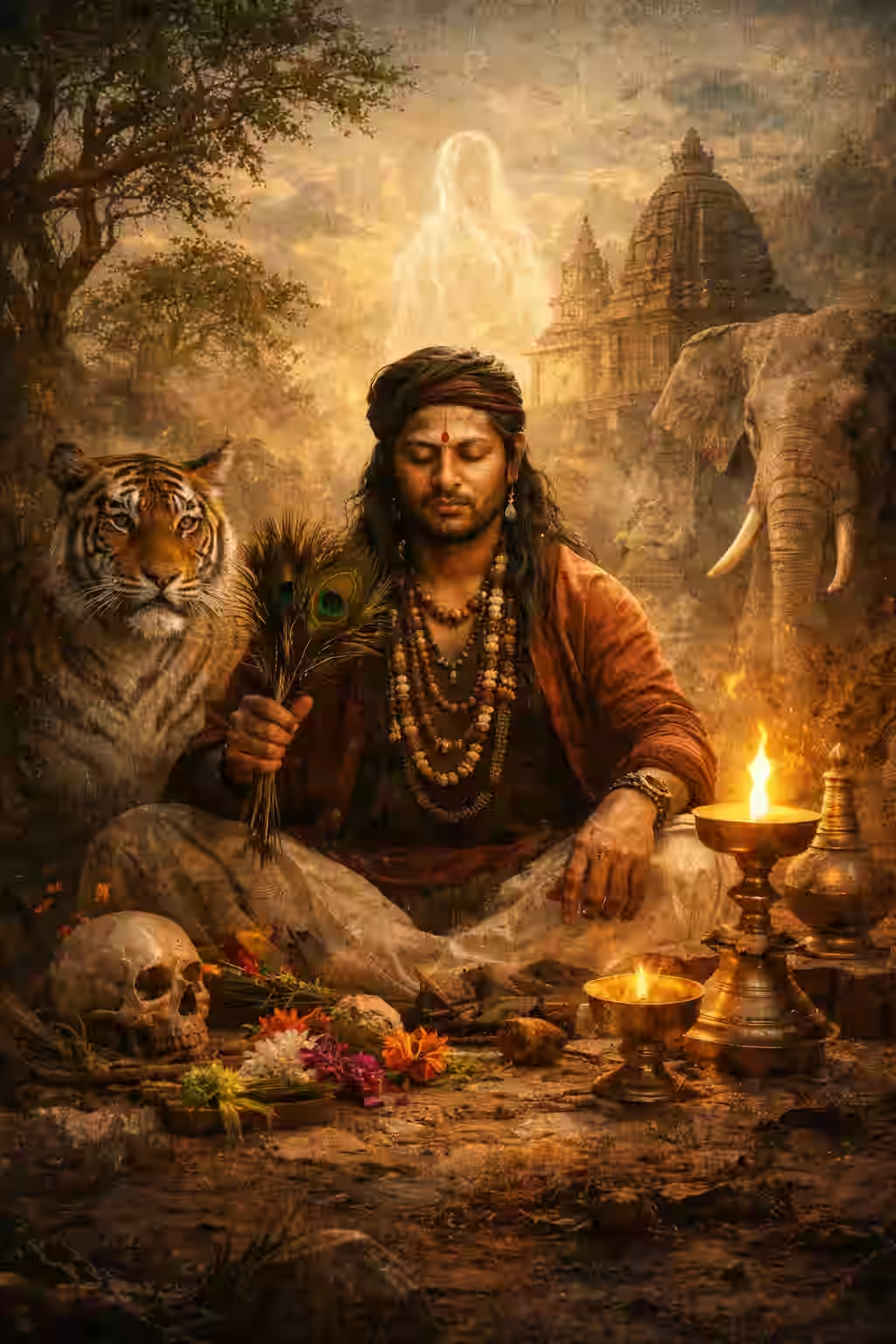
In a village in India, as the sun sinks behind the palm trees, people gather in a circle. It is not a temple of stone they seek this evening, but a human being. A healer. A mediator. One who knows the languages between worlds.
The drum begins to beat. The songs are old, but they still live. Some close their eyes. Others weep quietly. Here there is no sharp divide between body and soul, illness and story, human and nature. Here shamanism lives – in the midst of everyday life.
Before the religions got names
India is known for its great religions, sacred texts and temples. But long before the scriptures, before priesthoods and institutions, there were other spiritual paths. Down-to-earth, oral and living.
In many parts of India – especially among tribal peoples and village cultures – shamanistic traditions have been a natural part of life. Here spirituality is not about believing in something, but about participating in it. The spirits are not distant. They are in the forest, in the river, in the illness – and in the healing.
Healer, storyteller and bridge-builder
The Indian shaman – whether she is called a healer, medium or ritual leader – has many roles. She does not only heal illness. She helps people understand why something has come out of balance.
Perhaps it is grief that has not finished being grieved. Perhaps a conflict in the family. Perhaps a spirit that has been overlooked. Instead of asking “what is wrong with you?”, shamanism asks: What has happened to you – and whom have you lost contact with?
Healing happens through trance, song, rhythm, dance and conversation with the world of spirits. It is dramatic, intense and deeply human.
Trance is not escape – it is a skill
Many have misunderstood shamanism as chaotic or uncontrolled. But in Indian shamanism, trance is a skill that is trained over time. The healers consciously enter altered states of consciousness – and come back again.
This is not madness. It is knowledge.
In India there has long been room for the idea that the human being does not have just one identity, one consciousness or one truth. One can hold several layers at the same time. And precisely for that reason shamanistic healing has had a natural place – also in the face of psychological pain.
When the modern meets the ancient
Today shamanism in India lives side by side with modern medicine, technology and big-city life. Some dismiss it as superstition. Others return to it when nothing else helps.
For many young people – both in India and in the West – these traditions represent something precious: a way of understanding oneself that does not reduce everything to diagnoses and achievement.
Shamanism reminds us that healing is not always about removing something, but about restoring connections.
A living heritage
Shamanism in India is not a museum. It is alive. It changes. It is challenged. But it does not disappear.
For as long as people ask: Who am I? Where do I belong? What does it mean to be whole?
– there will be those who listen to the rhythm of the drum and dare to walk between worlds.
And perhaps it is precisely there, in this space between the old and the new, that shamanism has the most to give us today.
Sources
Dandekar, Deepra (2018). Shamanism. In: P. Jain et al. (eds.), Hinduism and Tribal Religions, Encyclopedia of Indian Religions. Springer Science+Business Media B.V.
Eliade, Mircea (1972). Shamanism: Archaic Techniques of Ecstasy. Princeton University Press.
Harner, Michael (1990). The Way of the Shaman. Harper & Row.
Walsh, Roger N. (1991). The Spirit of Shamanism. Tarcher.
Hutton, Ronald (2007). Shamans: Siberian Spirituality and the Western Imagination. Hambledon Continuum.
Vitebsky, Piers (2017). Living Without the Dead: Loss and Redemption in a Jungle Cosmos. University of Chicago Press.
Kakar, Sudhir (1982). Shamans, Mystics and Doctors: A Psychological Inquiry into India and Its Healing Traditions. Oxford University Press.
Hultkrantz, Åke (1996). Shamanic Healing and Ritual Drama. Crossroad.
Turner, Victor (1995). The Ritual Process: Structure and Anti-Structure. Aldine Transaction.
Kehoe, Alice B. (2000). Shamans and Religion: An Anthropological Exploration in Critical Thinking. Waveland Press.
-1.avif)
-1.avif)