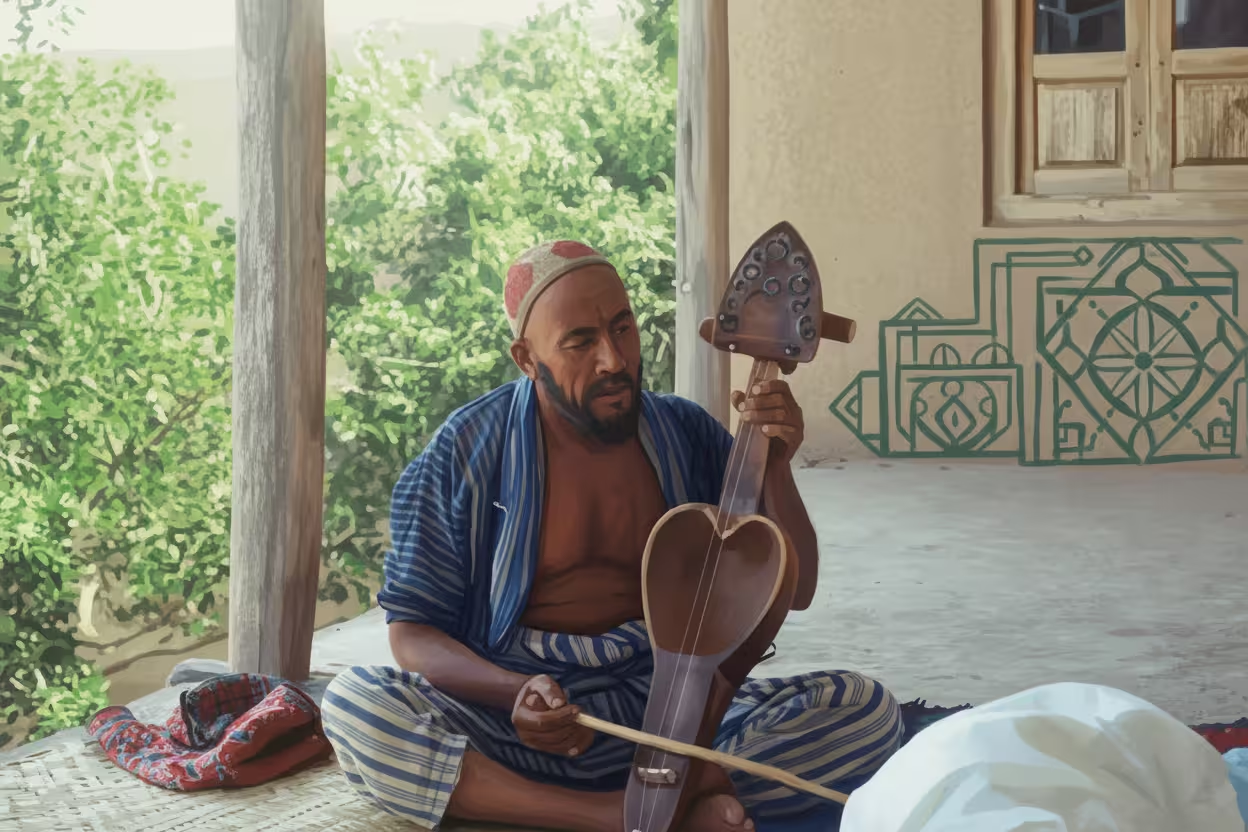
In the vast deserts and green valleys of Uzbekistan lives a mythological world that has shaped the people's life, faith and culture for thousands of years. Here we encounter not only stories of gods and heroes, but a living tradition in which shamans, spirits and mythological figures still play a central role in people's everyday lives. Uzbek shamanism is not merely a religion or a faith, but a way of life that binds together past and present, human and nature, the visible and the invisible.
The Roots of Mythology
The mythology of Uzbekistan is a rich blend of local traditions, Turkic influence and religious views from both Islam and older animistic conceptions. Here, myths are not just stories, but a way of understanding the world – a form of oral poetic creation that has been passed down from generation to generation. The folklorist M. Juraev points out that myth was humanity's first conscious attempt to explain natural phenomena, and that these stories have become a genre of their own within folkloristics.
In Uzbekistan, mythology is particularly tied to shamanism, where the shaman functions as a mediator between people and the invisible worlds. The shaman is not only a healing figure, but a bearer of mythological conceptions and traditions. The stories and rituals performed by shamans during ceremonies are themselves mythological narratives – a kind of living mythology that continues to evolve.
Mediator Between the Worlds
The shaman in Uzbekistan is a person who has been chosen by the spirits, and who has undergone a difficult and often painful process to attain this role. According to tradition, the shaman must suffer, often in the form of illness or psychological affliction, before he or she can be accepted by the invisible worlds. This suffering is not merely an ordeal, but a necessary part of the process of becoming a mediator between people and spirits.
A typical story from Uzbekistan tells of a woman who suffered from serious illnesses and was abandoned by medicine. After many years of suffering, a group of fairies appeared who touched her and told her that she had to become a shaman in order to help others. After following the fairies' instructions, she began to recover and eventually took on the role of shaman. This pattern recurs in many stories – the shaman must suffer, be chosen by the spirits, and then finally become a mediator and healing figure.
Mythological Figures and Spirits
In Uzbekistan there are a number of mythological figures who play a central role in shamanism. Among the most well known are fairies, saints, ancestors and various spirits. These figures are not merely symbols, but real presences that can help or harm people depending on how they are treated.
One of the best known mythological figures is Anbar-mor, a historical person who has become a mythological patron of shamans. Anbar-mor is often mentioned in the shaman's rituals, and the shaman worships her as a protector and guide. Other mythological figures include saints, prophetic persons and ancestors, all of whom have a role as protectors and mediators between people and spirits.
Fairies, demons and other spirits are also central to Uzbekistan's mythology. Fairies are often described as beings from another world, who can be both good and evil. Demonological figures such as the demon, the jinn, the hellcat, the ghoul, night terror and the bogey are often associated with evil forces and can lead people to ruin. These figures are part of the mythological landscape and play an important role in both the shaman's rituals and the people's faith.
Rituals and Healing
The shaman's rituals are a central part of Uzbekistan's shamanism. During these rituals the shaman calls upon his mythological patrons and spirits to help people with illness, problems and divination. The rituals often include the use of special objects such as a flute, a whip, amulets, fetishes, a knife and books. These objects are not merely symbols, but real tools that help the shaman communicate with the invisible worlds.
A typical shamanic ritual begins with the shaman calling upon his patrons and spirits. The shaman may, for example, call upon his ancestors, saints or fairies, and ask them for help. During the rituals the shaman may also take on the role of these figures, and for example move and speak like an old woman or a fairy. This is a way of showing that the shaman is a mediator between people and spirits, and that he or she has the power to help people through the spirits' power.
Healing is one of the most important tasks of the shaman. The shaman can help people with both physical and psychological afflictions, and rituals are often used to discover the cause of an illness. The shaman can, for example, foretell the future, find out where lost objects or persons are, and help people cope with life's challenges. Through his rituals and mythological narratives the shaman gives people hope and strength, and helps them understand the world around them.
The Significance of Mythology Today
Uzbek shamanism and mythology are still living traditions today. Even though many people have converted to Islam, shamanism continues to play an important role in people's lives, especially in rural areas. Shamans help people with illness, problems and divination, and still tell mythological stories that convey values and knowledge from the past.
Mythology has also influenced Uzbekistan's literature and art. Through mythological narratives and figures, the people's poetic thinking has become richer and more varied. Mythological figures and motifs have been incorporated into epic and lyrical works, and have helped to shape Uzbekistan's cultural identity.
A Living Tradition
Uzbek shamanism and mythology are not merely a part of the past, but a living tradition that continues to evolve. Through their rituals, stories and mythological figures the shaman gives people hope, strength and understanding. Shamanism is a way of connecting with the invisible, and of finding meaning in life's challenges. In Uzbekistan, mythology is still alive, and tells of humanity's eternal search for answers to life's great questions.
In discussing Uzbek mythology and spiritual practice, we must clarify that the spiritual intermediaries who in Western and global contexts are called shamans are, in Uzbek culture, referred to as bakhshi, porikhan or kushnoch. These roles function as a link between people and the spirit world, like the shaman elsewhere, but with local distinctive features and names.
In a modern understanding we move away from a narrow definition of shamanism as tied only to indigenous rituals. Instead we regard bakhshi and similar spiritual guides as practitioners of a living practice that includes healing, contact with ancestral spirits, divination and guidance on personal and collective life questions. This is not merely a traditional inheritance, but a dynamic, spiritual method that even today can contribute to balance and insight, not unlike modern shamanic practices globally. We can thus understand Uzbek "shamanism" as part of a broader, adaptive spiritual tradition with local terminology and distinctiveness.
Sources
Kayumov Olim Sadiridinovich, "Uzbek Mythology and Shamanism," Middle European Scientific Bulletin, Volume 5, October 2020.
Juraev, M. (date not specified), Folkloristic analyses of mythology as the raising of awareness of natural phenomena.
Mirzaeva, T. (date not specified), Field studies on shamanic rituals in Central Asia, including an enumeration of spiritual entities and the shaman's calling.
-1.avif)
-1.avif)