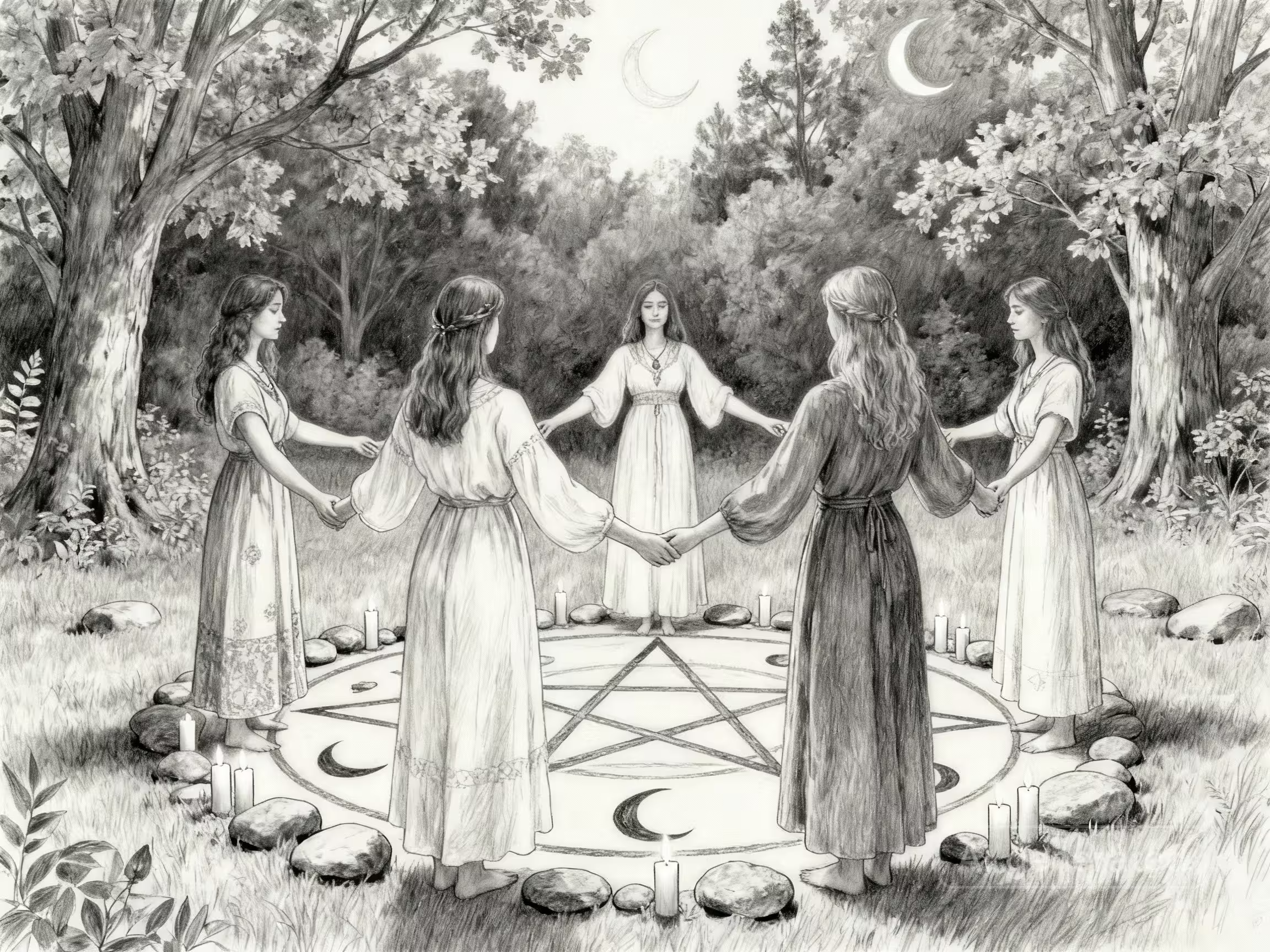
In the modern landscape of neopagan religions, Wicca stands as a fascinating spirituality that combines the old and the new in a living, pulsating practice. Behind the beautiful dance of rituals, lunar calendars and celebrations of the goddess lies a deeper current that binds Wicca to one of humanity's oldest spiritual traditions: shamanism. A journey into Wicca's shamanic roots and its present-day renewal is a story of spiritual syncretism, creative rediscovery and the modern search for meaning.
Where Wicca and Shamanism Meet
What perhaps first strikes anyone who studies Wicca and shamanism side by side is their shared devotion to nature as living, sacred and ensouled. For both shamans and Wiccans, nature is not merely a backdrop for rituals, but the very foundation of spiritual insight and power.
In Wicca, the cycles of nature are fundamental. The moon governs the esbats, the monthly rituals, while the eight sabbats of the solar year follow a voyage through the seasons that marks birth, growth, maturation, death and rebirth. Wicca embraces the rhythm of nature as the rhythm of all life, in a longing to stand in harmony with the pulse of the earth.
Shamanism, for its part, sees forest, mountains, rivers and animals as spiritual beings with their own consciousness and power. The shaman navigates these spiritual landscapes to draw wisdom and energy, often in trance, and creates bridges between the human world and the invisible. In this sense both Wicca and shamanism are, in their essence, nature religions that recognize the sacred in all that lives.
Contact with Spiritual Beings
Wicca and shamanism share a belief in a rich spirit world full of beings that guide, protect and heal. In Wicca a dual deity is traditionally worshipped: the Goddess and the God, often with many aspects and titles that reflect personal and collective spiritual experience. The Goddess may appear as the young maiden, the nurturing mother and the wise old woman, while the God is often associated with the wildness of nature as the Horned God. Around these circles a multitude of nature spirits and elemental beings such as the spirits of earth, air, fire and water.
The shaman is known as a mediator between the human world and the spirit worlds, which often include ancestral spirits, animal spirits and other spiritual guides. Through ecstatic rituals and spirit journeys the shaman seeks contact with these forces to draw wisdom, protection or healing. Although Wicca is not traditionally tied to a specific group of spirits in the same way as a shaman, Wiccans often act as mediators between this life and the spiritual through their rituals and magical practices. For example, the invocation of the four cardinal directions in Wiccan rituals can be seen as a parallel to shamanism's universal conception of a cosmic order that must be respected and activated.
A Mosaic of Practices and Trance
Wicca's rituals are distinguished by their structured form, in which the casting of the circle, the calling of the elements, hymns and chants, and magical acts follow a fixed pattern. At the same time, the content of these rituals is deeply personal and metaphorical, opening a channel toward spiritual reality. This they share with shamanism, even though modern shamanic rituals are often less formalized and more adapted to the shaman's immediate needs and the guidance of the spirit.
Trance is a central link between the traditions. The shaman uses drum, song and dance to enter ecstatic states in which body and mind move beyond ordinary reality, and the experience of time and space changes. Wiccan practitioners may employ similar techniques to open consciousness, often in connection with magical work or worship during esbats and sabbats.
Healing as both a practical science and a spiritual task is fundamental to both. While the shaman may undertake a ritual journey to retrieve lost soul-power or cleanse spiritual blockages, Wiccans use herbal magic, work with stones and crystals, and symbolic magic to promote health and well-being. The overlap here is striking: both shamanism and Wicca recognize nature's healing roles and the significance of the invisible world for body and mind.
Gerald Gardner and the Shadow of Shamanism at Wicca's Birth
Gerald Gardner, Wicca's famous founder, is a key figure for understanding how shamanic elements crept into Wicca. In the 1940s and 50s he assembled a repertoire of rituals, magical techniques and symbolism that drew largely on European folk belief, occultism and what he experienced as a line reaching back to ancient pagan traditions.
Gardner's Wicca includes the invocation of the four cardinal directions to form a sacred circle – a practice with obvious parallels in shamanism's cosmology. He described trance-like states and spiritual communication that grant access to divine guidance, something that is at the core of the shaman's work. His rituals also contained magical healing with herbs and chants, and the use of symbols such as the pentagram, believed to have a protective and powerful function – like the talismans used by shamans.
It is important to note, however, that although Gardner deliberately included such elements, his Wicca was shaped mostly by Western esoteric thought and modern neopagan needs. His use of shamanic features was more symbolic and adapted to ritual structure than a direct reproduction of traditional shamanism. What he created was a new religion, in which shamanic motifs served as sources of inspiration within a larger syncretistic palette.
The Modern Wiccan's Reorientation Toward Shamanism
In our time, where global communication and cultural exchange dominate, shamanism has found a new and strong position within spirituality. Wiccans today are increasingly concerned with the experience-based, personal encounter with the spirit world, and therefore shamanic methods such as drum journeys, encounters with power animals and the use of drumming tools are incorporated into many Wiccan practices.
This new tendency is often called "shamanic witchcraft" and is an expression of a desire for a more direct, intuitive and embodied approach to magic and spirituality. It is also about drawing wisdom from indigenous traditions around the world, which provides a richer understanding of working with the forces of nature and the spirit world. Drums, songs and trance states are used to open the door to depths in the psyche and the spirit world that expand Wicca's traditional framework.
This can be seen as a natural development in an age where the search for groundedness and belonging in a fragmented world is great, and where shamanism's universal language of spirit and nature speaks directly to Wicca's already existing reverence for the sacredness of the earth. Modern Wicca has therefore become a living weave with roots in the past and new branches reaching toward the future.
A Living Dialogue Between Traditions
Shamanic elements constitute a subtle but significant part of Wicca, both in its historical foundation and in its modern practice. Gerald Gardner and his successors drew inspiration from shamanism's ability to build bridges to the spirit world through the power of nature, trance and ritual, even though they did so within a structured, Western esoteric context.
Modern Wiccans have, in addition, opened themselves to a more direct and experience-based approach by actively integrating shamanic practices such as drum journeys and contact with power animals. This enriches Wicca as a religion and offers new possibilities for personal transformation and healing.
This interplay shows how spiritual traditions can grow and evolve by drawing from one another, and how shamanism today functions as a bridge-builder to the wisdom of the ancestors – whether in Siberia, North America, or in modern Wiccan ritual circles. This dialogue between shamanism and Wicca presents a beautiful picture of humanity's eternal search for connection, meaning and rootedness in the great mystery of life.
Disclaimer
Anthropologically, the word "shamanism" is used to describe a range of indigenous practices in which a shaman is a mediator between people and the spirit world. This includes the use of trance and altered states of consciousness to communicate with spirits and to draw knowledge, power and healing. The term is a generalization for similar practices in many cultures, not only the Siberian traditions from which the word originally comes. Today there also exists contemporary shamanism, which carries on and adapts these practices in new contexts outside the original indigenous communities.
Sources
Hutton, Ronald. The Triumph of the Moon: A History of Modern Pagan Witchcraft. Oxford University Press, 1999. – A comprehensive academic review of Wicca's origins and development, including Gardner's use of traditions.
Clifton, Chas S. Her Hidden Children: The Rise of Wicca and Paganism in America. AltaMira Press, 2006. – An analysis of neopagan movements and their influences.
Harvey, Graham. Shamanism: A Reader. Routledge, 2003. – A collection of essays on various aspects of shamanism, with theoretical frameworks relevant for comparison.
Berger, Helen A. A Community of Witches: Contemporary Neo-Paganism and Witchcraft in the United States. University of South Carolina Press, 1999. – Fieldwork and cultural analysis of modern Wicca and shamanic practices.
Wallis, Roy. The Road to Total Freedom: A Sociological Analysis of Scientology. 1976. (Used for methodological inspiration in the study of religious movements).
Eliade, Mircea. Shamanism: Archaic Techniques of Ecstasy. Princeton University Press, 1964. – The core work on the history and methods of shamanism, essential for understanding the depth of shamanic influence.
Pearson, Jacqueline. Shamanism and the Spiritual Role of the Witch. Journal for the Academic Study of Magic, 2007. – An article that deals directly with comparisons of shamanism and Wicca.
-1.avif)
-1.avif)