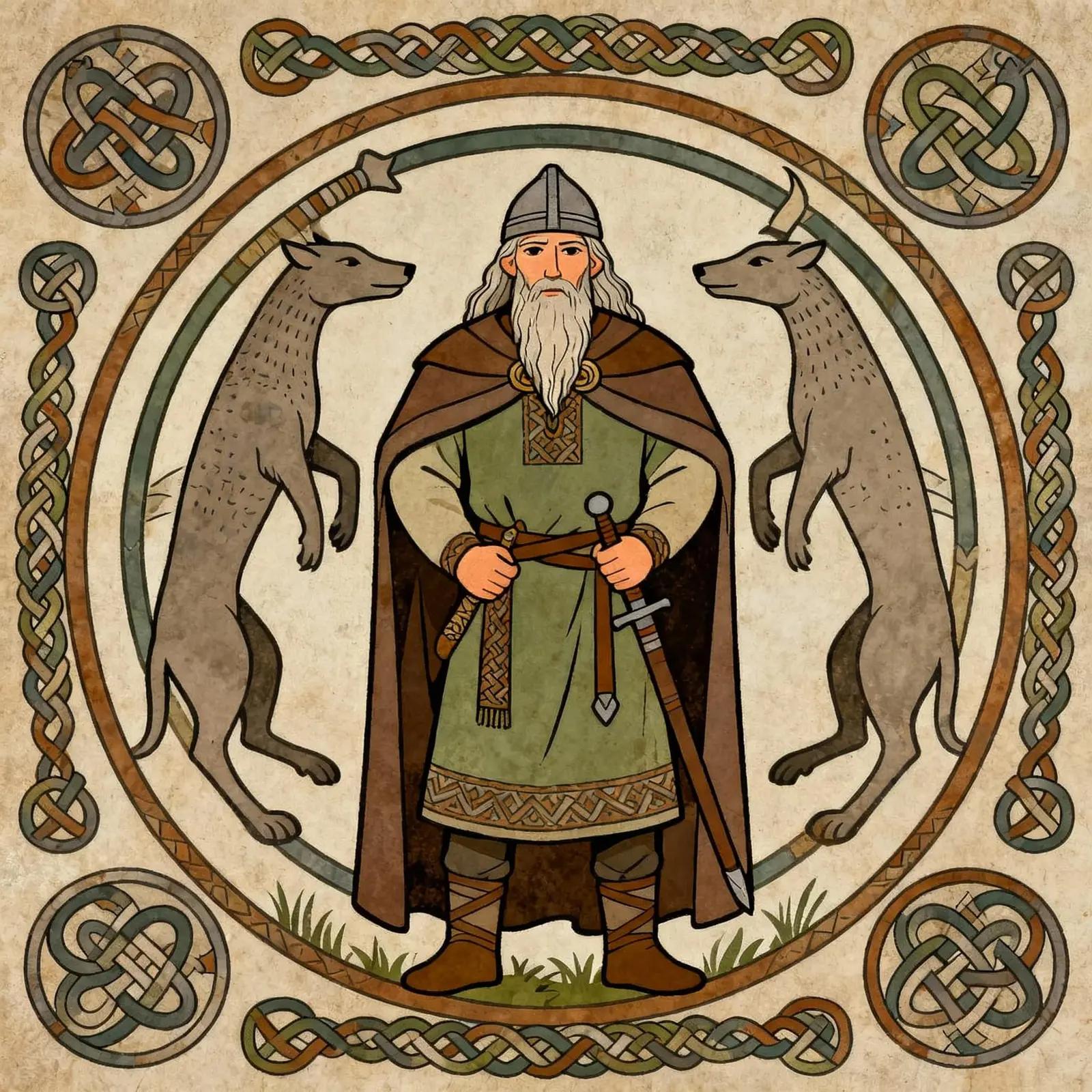
In the crackling darkness of night around the fire, where tales of honour and fate were spun, something else also whispered, mysterious and ancient. It was about contact with spirits and forces one cannot see with the naked eye – the secret language of shamanism still lived among the words. Through the sagas we can sense a hidden world, a world of other states of consciousness, magical journeys and prophetic women – traces of shamanic practices that shaped Norse culture and thought. This fascinating story requires us to listen properly – for its secrets do not lie out in the open, but between the lines, in the symbols, in the unsaid.
Think of the völva, the spirit woman, who in the sagas is often referred to as a powerful seeress. She was the woman who could touch the future and draw souls forth from the shadows. In Egil's saga we encounter such a figure. The völva in the Bergen area who, through deep trances, foretold the outcome of battles and was a bearer of ancient wisdom. Her roles strongly resemble those of the shaman – she did not only travel in her thoughts, but sent her soul through worlds to retrieve knowledge that could change lives. The völva's ability to live between worlds, to be a bridge between the human community and cosmic forces, is pure shamanism, wrapped in the ornamentation of the sagas.
But it is not only in female figures that we find these magical threads. The seiðr-man, spoken of with equal parts fear and respect, recurs in both Eddic poems and sagas. In the Ynglinga saga, Odin appears as a master of magic – a form that involved manipulating fates and consciousness. It is somewhat disturbing how such men were often stigmatised, bound to the shadowy edges of their own communities, regarded as socially dangerous because of their magic. This tension between power and exclusion makes the role of seiðr magic in the sagas fascinating: it was a power too mighty to be ignored, yet one that created fear and distance, a clear sign of its shamanic roots.
In the sagas' narratives we also catch glimpses of trance and shamanic journeys that are not always explained in words, but can be interpreted against a shamanic backdrop. Good examples are found in the saga of Helgi Hundingsbani, where dreams and visions are not merely random everyday phenomena, but portals to greater insights. When Helgi sees spirits and receives messages in visions, it is a kind of shamanism peeking through – not through physical journeys, but in the world of dreams, the hidden rooms of awareness. In this way the sagas convey the essence of shamanic practices – a movement beyond the concrete, into the spiritual.
The magic in the sagas is not just something mysterious. It functions as society's glue. When Harald Fairhair, according to Heimskringla, sought to unite Norway under his power, he surrounded himself with völvur and people skilled in magic who conveyed divine support and protection. This use of magic shows how shamanic practice was not merely a private matter, but a tool for political strength, a way to create order in a world full of chaos and dangers. Magic gave leaders legitimacy and people a sense of security, an anchoring to the invisible that held the group together.
In the sagas there are also stories of how deeply connected people were to animals and nature. Animal symbols, often with magical significance, recur as signs of protection or spiritual defence. In addition, descriptions of dream animals or spirit animals are often rendered in the sagas' text, as in fragmentary tales of warriors who receive help from their spirit animals in battle or on spirit journeys. This mirrors the shamanic understanding of the human soul as in contact with power animals, a bridge between the physical and the spiritual, which at any time can help and protect.
The Norse worldview, with its three worlds – the underworld, the world of humans, and the divine worlds – forms a framework in which shamanic journeys are fundamental. The sagas show at least as many descriptions of journeys between these worlds, both in the form of dreams, ecstasies and visions. When saga heroes, priests or gods travel between these spheres, the role of the shaman is mirrored: the one who goes back and forth, the one who retrieves meaning where others see chaos.
Yet the messages were hidden in the form of riddles, the use of symbols and several layers of meaning. The shamanism in the sagas was not always directly explained, but always present as an underlying current that carried culture, faith and belonging.
This heritage, hidden beneath the tales of war and kin, is a reminder of how shamanism was not just magic – it was spiritual vitality. It was a way of relating to the world that created meaning, connection and strength, and which through the sagas lives on in our memories and stories.
To begin with, we can look more closely at concrete sagas to understand how shamanic traces manifest themselves in action and symbolism. For example, in Grettis saga there are several scenes where the supernatural and the magical slip into everyday life and battle. Grettir himself fights not only with humans, but also with spirits and trolls, and has several encounters with creatures that can be interpreted as spirit influences. Such episodes can be understood as descriptions of a world where the human soul is in contact with both visible and invisible forces – a core of shamanism's influence.
In the Völsunga saga, which tells, among other things, the story of Sigurd Fáfnir's-bane, we find strong symbols of power animals and spiritual protection that are typical of a shamanic understanding of the world. The dragon Fáfnir, whom Sigurd slew, is not only a physical enemy, but also a symbol of chaos and dark forces that must be overcome for civilisation and order to flourish. Sigurd's connection to that which helps him with knowledge and protection recalls how shamans are strengthened through contact with spirit animals or helpers. This gives the saga a deeper dimension that goes far beyond the surface of the adventure.
From Egil's saga we know other fascinating examples of magic and shamanism. Egil himself is a complex figure – a skald, warrior and at the same time a person with deep spiritual abilities. His poetry and his conjuring of forces testify to an environment where words and music could open gateways to the mysterious, an eternal theme in shamanic traditions. In addition, Egil's mother, Åsa, is portrayed, and her role as a kind of magical adviser can be read as an echo of the völvur and shaman women – she uses power and shadow-threads to influence the family's fate.
We can also look more closely at how the authors of the sagas used literary devices to wrap shamanic themes in riddles and symbols. Many of the mythical events can be interpreted as allegories of shamanic rituals: the journey into the underworld, the struggle with inner demons, communication with spirit protection. The difficult balancing act between power and vulnerability, between the visible and the invisible, runs through many sagas.
The shamanism in the sagas is also tied to a particular field of function: healing. Several stories tell of people who heal illness by contacting spirits, using magical herbs, or carrying out rituals that draw the evil out of the body. Here the shaman's role as healer is clearly shown, and underlines how important this function was for society.
It is also worth reflecting on how Christianisation affected both folk belief and the shamanic traces in the sagas. Many of the original magical practices were attempted suppressed or adapted in the encounter with the new religion. This is most likely also how it was with regard to women's role in the sagas. But as in many other cultures, shamanism survived in folk belief, and the elements found their way into Christian rituals and folk tales. The sagas therefore preserve a historical layer where shamanic ideas live on behind the official religious picture.
For today's reader, the shamanic traces of the sagas can open a door to a time when the world had more layers, and when faith and magic were living forces that shaped lives and fates. Reading the sagas with this understanding becomes not just a look back at the past, but also a gateway to reflecting on how we today relate to the mysterious and the unknown.
The magic of the sagas tells us that people have always sought connections to something greater. This search has often taken form through shamanism – through journeys with the soul, through encounters with nature's spirits, and in the power of words and song. The sagas carry that heritage onward, and invite us to set out on a voyage of discovery into our own stories and dreams.
Sources
Hultkrantz, Åke (1983). The Religions of the Circumpolar North. Mouton Publishers.
Eliade, Mircea (1964). Shamanism: Archaic Techniques of Ecstasy. Princeton University Press.
Pentikäinen, Juha (1998). Oral Reproduction and Shamanism. Journal of American Folklore.
DuBois, Thomas A. (1999). Nordic Religions in the Viking Age. University of Pennsylvania Press.
Abram, Chris (2016). Shamans of the North: Sami Spirituality and Northern European Shamanism. Journal of Northern Studies.
Price, Neil S. (2002). The Viking Way: Religion and War in Late Iron Age Scandinavia. Uppsala Universitet.
-1.avif)
-1.avif)