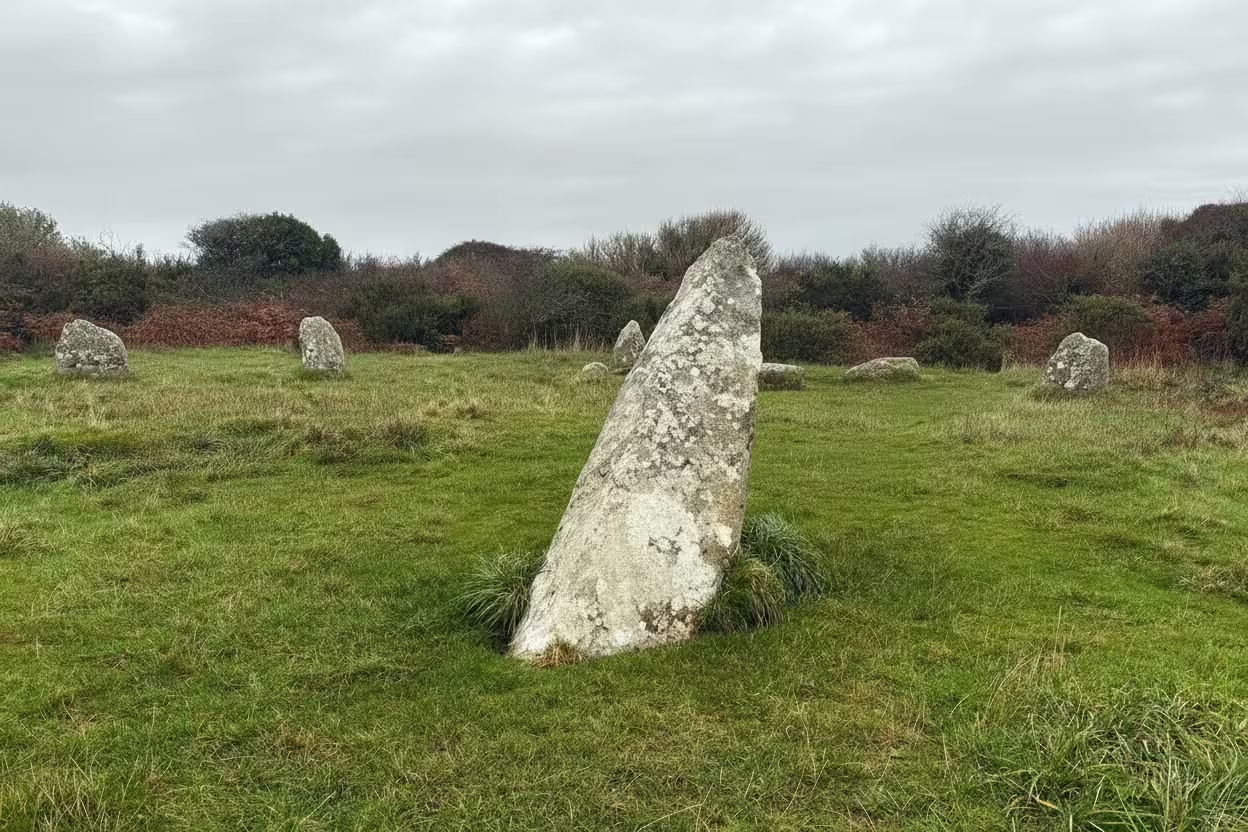
On a grey November afternoon in Cornwall, a group of 19 local residents trudges through rain-soaked meadows, with rain gear, walking staffs and an unshakeable longing for the ancient and the mysterious. They have left the imposing medieval church of St. Buryan – with its 92-metre granite tower dominating the skyline as a measure of humanity's encounter with the power of heaven – and set out on a 5-kilometre pilgrimage towards Boscawen-Ûn, a secluded Bronze Age stone circle that whispers secrets from a time before written language existed. Led by the astronomer Carolyn Kennett, who dreams of capturing the full moon casting its light over the leaning quartz stone at the centre of the 19 stones that resemble a sundial, the air fills with anticipation – even though the clouds refuse to let go. This ordinary evening in an English landscape tells a most extraordinary story: the story of how people all over the world, across cultures and centuries, have sought spiritual nourishment not in temples of stone and gold, but in the stone itself.
When Earth Becomes a Church
Upon arrival the group falls silent, as if the earth itself lowers their voices. The 19 upright stones, plus the sacred stone that leans like an old guide, radiate a power that draws people to them – pagan weddings are celebrated here, meditative gatherings bind people to the rhythm of the cosmic forces, and silent prayers to nature flow from mouths that no longer find answers in the secular world. Participants such as Jane Weller and Andy, a solar panel installer who married here in a Celtic handfasting ritual 30 years ago, describe a spiritual presence that replaces the sterility of churches with the pulse of the earth, the warmth of the stone, the openness of the sky.
At a time when only 49 percent of Britons identify as Christian, and 40 percent have no religious affiliation, these megaliths – calculated to be between 3,500 and 5,000 years old – have become pilgrimage sites for eclectic nature worshippers seeking connection to their ancestors. The British census of 2021 recorded 105,809 people as pagans, but researchers such as Ethan Doyle White at the University of Hertfordshire warn that the real number is much higher, because many people dare not stand openly by their beliefs due to stigma or because they do not identify with any fixed tradition.
Boscawen-Ûn is far less famous than Stonehenge – the iconic stone structure that draws over a million visitors each year – but it is precisely this humility that makes it dear to those seeking authenticity. Without signs, without controlled access, without commercialism, the stone circle lies in the middle of emerald-green pasture, accessible only by a short footpath. When Tamsin Floyd, a former nurse who now makes jam from wild-foraged ingredients, embraces the central quartz stone and whispers a prayer to it, she says something that would have seemed strange just 50 years ago: "It feels really nice to put my arms around it. It just feels good. It feels supremely relaxing. I just like the feeling of connecting with our ancestors, something that is very old and ancient."
Sieidi
This longing for the power of stone – this attraction to something ancient that flows through the body like electricity – we recognise in the Sami tradition's sieidi: natural or shaped sacred stones, often by rivers, mountains or the sea, which were seen as manifestations of divine power over the resources of nature. The word "sieidi" literally means "sacrificial stone" in Northern Sami, and these stones did not function as symbols or representations – they were the spiritual forces themselves.
Sami culture built its spiritual practice on the idea that the landscape itself was alive. One did not only have to navigate through the physical terrain – one also had to move through the soul of the sea, the mountains and the watercourses. The Sami people, who lived from reindeer, hunting and fishing, experienced the stones not as abstract religious objects, but as practical portals to the spirit world that could help them with actual survival. A boulder by the river might be the place where one prayed for good fishing luck. A stone on the mountaintop might be the point of contact for communicating with the spirits that controlled the animal populations.
In the Sami faith (Noaidevuohta), which was dominated by shamanism, a noaidi (shaman) was the one with the special competence to work with the sieidi. Noaidis underwent extreme rituals – drumming, dancing, or isolation and fasting – to attain ecstatic states in which they could communicate with the spirit world directly through the stone. When the noaidi sat by the sieidi, the stone was not a metaphor – it was the very door to other dimensions.
The offerings made at the sieidi were not abstract rituals – they were business agreements with the spirit world. Hunters offered parts of the elk they had felled, fishermen offered their first catch of the year, herders offered blood from a reindeer. Traditionally, blood offerings were most common, because blood – warm, living, filled with the power of the spirit – was believed to be the language the spirit world understood best.
Landscape as the Cathedral of Shamanism
What is fascinating about Sami shamanism is that the sacred was not concentrated in one place, like a cathedral or a temple. Instead, the entire landscape was sacred – what is called bassebáiki in Northern Sami – places where a higher reality has manifested itself and which are protected by ritual prohibitions and boundaries. A bassebáiki could be a stone of unusual shape, a mountain that looked like a face, a lake with a double bottom believed to be a portal to the underworld, or an isolated tree that had survived a fire.
These sacred places often lay at thresholds in the terrain – on headlands jutting out into the sea, on islets in the middle of rivers, at the transition from pine forest to high mountain, at the point where people had to cross from the known to the unknown. The Sami understood the landscape as a relational system of energy and power, and the stone was the orchestrator of this energy.
What strikes you when you read about sieidi culture – and what creates a strange resonance with the Boscawen-Ûn pilgrims of today – is that both traditions understand the stone as a conversation partner. Not a god, not a symbol, but a being or force that one can negotiate with, pray to, and that gives feedback. A noaidi sitting by the sieidi could "read" the stone, interpret the marks and cracks in its surface, receive visions. Today the Boscawen-Ûn visitors read both the stones and themselves – they seek connection, open up, and receive answers in the form of calm, power, or the sense of presence.
Holy Wells as Bridges Between Worlds
In addition to the standing stones, there was another type of sacred place that stretched across both Sápmi and the Celtic regions: the holy springs and wells. In Cornwall a tradition continues even to this day. A person suffering from an illness dips a cloth or a piece of fabric in the holy well – water believed to have healing power from sources such as Madron, Sancreed or St. Euny – and then ties the fabric around the branches of the tree growing beside it. When the cloth rots away, the illness is to disappear with it.
This is not symbolism – it is practical spirituality. And it has roots that stretch far further back than the Middle Ages. Archaeologists believe that springs and wells have been regarded as sacred ever since the Mesolithic and Neolithic, at the same time the first stone circles were raised. The water from a natural spring is not just water – it is life that comes from the heart of the earth, it is minerals that humans first became aware of because their bodies felt their power.
In the Sami faith there are similar spring shrines – springs with supposed healing power where people come to seek relief. What connects all these traditions – from Sápmi to Cornwall to other parts of Europe – is that water and stone together form a portal. The stone is the hearth that holds the energy, the water is what mediates it between the worlds and humanity.
Sacred Stones Across the World
If we move beyond Europe, we see that the spiritual power of stones is a near-universal human experience. The Indigenous people of Australia have preserved perhaps the longest continuous tradition of sacred stones and sacred landscapes through their songlines. When an Aboriginal person sings the landscape, he does not only navigate geographically – he navigates through the spirit world, and the stones function as anchor points for this dual journey.
In North America, Indigenous cultures – such as the Sioux, Lakota, Cheyenne – brought forth sacred stones such as Iyan Wakan Gapi (Idol of the Holy Stone), where the tribe's leaders interpreted white marks on the stone as signs of the nation's future. These interpretations were carried out by means of smoke ceremony, in which smoke from sacred tobacco was presented to the stone, as a way of asking the stone directly.
Turquoise – the sky-blue stone – is for many North American Indians not only beautiful, it was a direct connection to the spiritual. Each turquoise was believed to possess its own power, its own purpose, its own possible communication with the one who wore it. A turquoise can heal; it can lead towards the right path in life.
In South America, Japan, Africa – everywhere humans have sought to understand the forces that govern their lives – the stone has taken on the role of both symbol and actual portal to these forces. It is as if the stone is humanity's loudspeaker, the only way to speak to the silent, to the eternal, to that which does not speak the human language.
The Megaliths
The megaliths found along the North Atlantic coast represent perhaps humanity's most ambitious attempt to physically materialise its spiritual quest. Built between 3300 and 2500 BCE, during the late Neolithic and early Bronze Age, these structures required enormous collective effort. Hundreds of people had to work together for months to move a giant stone from quarry to destination – without wheels, without horses, with only human strength and the intricate use of timber as a lever.
Why? What was so enormously important that entire communities would spend their precious time on it?
Archaeologists speculate whether the megaliths were used for astronomical observation, as fertility symbols, meeting places for druids, or burial sites for important individuals or families. The truth is that no one knows for certain. But what is clear is that these people – the first Europeans – understood the stone as the only material that could withstand the eroding power of time. Stone would preserve their memory for all time. Stone would hold their prayers to the gods for all time. Stone would be there long after they themselves had ceased to exist.
A scholar such as Mircea Eliade suggests that the megaliths may have been the place where shamans underwent rituals of death and resurrection – where they lay inside the dolmens, these stone chambers, to experience ecstatic states that would teach them to navigate between the world of the living and the world of the dead. If this is correct, then the megaliths are not monuments to the dead – they are stairways to the spirit world, the stairway expeditions where the shaman could go and return with knowledge and healing power for his whole people.
When Nature Becomes Church
What strikes you when you read about Boscawen-Ûn and the other traditions is that it is the same quest, the same longing, the same belief that the stone can speak. Only the methods have changed.
Today British pagans do not come to the stone circle with blood sacrifice and ecstasy. They come with high-visibility vests and cameras, they ask scientific questions, they read modern archaeological theory. Some of them – like Gail Charman, a 66-year-old pensioner who declares herself a "nature lover" – fight for environmental and climate protection. For her the stone circle is not just a religious site, it is a manifesto: proof that humans once lived in harmony with nature, and that it is possible again.
The stones in England, Sápmi, Australia, and America all stand as witnesses to something that humans were closer to before industrialism split the land into "resource" and "human" – witnesses that nature is not the backdrop for human activity, but an actor in its own right, a force with its own wishes and need for communication, something that demands respect, dialogue, an exchange of gifts.
When Tamsin Floyd embraces the stone at Boscawen-Ûn, when she marries beside it in July, when she afterwards travels on to the holy wells of Cornwall to bathe in the water believed to be able to heal – she takes part in a continuous tradition of stone contact that goes back thousands of years. In Sápmi, the people have kept sieidi culture alive. Often hidden, in fear of judgement from priest and local community. They have waited for a time when it would be safe to practise it openly again. Today, when Sjamanistisk Forbund and other modern shamanic practices are permitted, that time is approaching once more.
Sources
Archaeology of sieidi stones. Excavating sacred places (PDF): Detailed archaeological analysis of sieidi sites in Sápmi, including excavations and ritual practice.
CM (TFK article): Scholarly overview of Sami cultural heritage sites and sacred landscapes.
Hellige landskap (Sametinget.no): Official documentation of Sami sacred sites from the Sami Parliament, focusing on sieidi and bassebáiki.
Sacred stones in Sami faith and their possible traces in Norse literature (UT.ee): Academic paper on sieidi in Sami faith and parallels to Norse mythology.
Suzanne Owen, Leeds Trinity University: Research on Druidry and modern paganism in Britain, including stone circles.
Ethan Doyle White, University of Hertfordshire: Studies of modern paganism, including "eclectic pagans" and stone rituals.
-1.avif)
-1.avif)