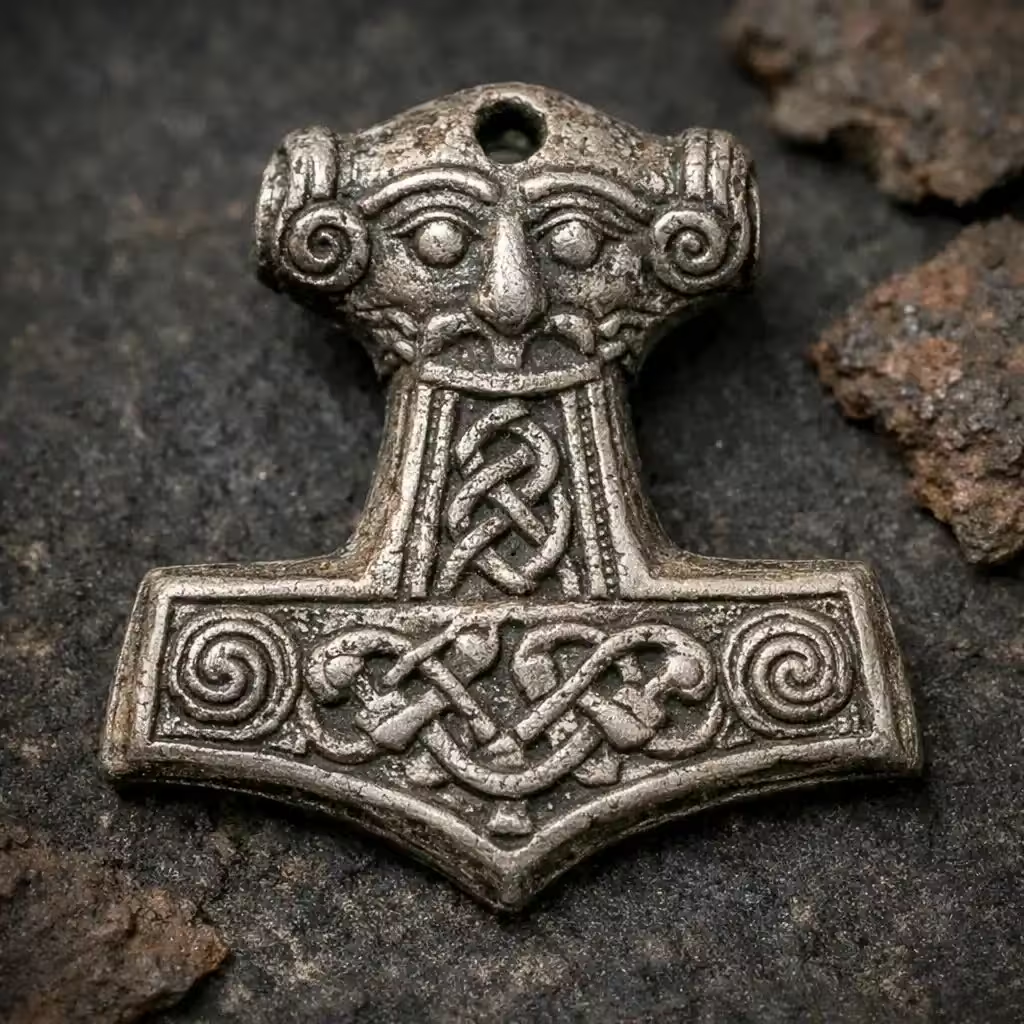
In Nordic folk belief and magic, talismans live on as small, silent witnesses to people's attempts to negotiate with fate – whether it concerns protecting an infant in the cradle, a farmer in the field, or a sailor in a storm. Between church and the world of spirits, between the priest's pulpit and the village wise woman, amulets, luck-bringers and protective pieces of metal passed from hand to hand as concrete, everyday expressions of magic.
What is a talisman in the Nordic context?
In academic literature, terms such as amulet, talisman, luck-bringer and “charms” are often used with overlapping meanings, but with some nuances. An amulet is generally understood as an object meant to ward off misfortune and evil forces, while talismans can also be charged to attract luck, love, health or victory.
In Nordic folk belief and medieval magic, this includes, among other things:
Metal amulets (silver, bronze, iron, steel)
Miniature weapons and tools (axes, hammers, swords)
Natural objects (teeth, claws, stones, “serpent tongues”)
Text-bearing objects (runes, and later Latin prayers and magical symbols)
Research on the Viking Age and the Middle Ages indicates that such objects appear in grave finds, in ecclesiastical and legal texts, and in folkloristic material from the 18th to the 20th century, which suggests a long continuity in their use.
From gods to ordinary people
When archaeologists open Viking graves, small pieces of metal turn up that are not merely ornamental. Signe Horn Fuglesang's classic study “Viking and Medieval Amulets in Scandinavia” shows how miniatures of weapons, tools and symbols – axes, Thor's hammers, animal claws, bear teeth – were often placed close to the body, attached to jewellery or belts.
These objects are interpreted as:
Protection in life and on the “journey” after death
Markers of social role (warrior, farmer, craftsman)
Bearers of divine or supernatural power, particularly connected to gods such as Thor, Odin and Freyr
Thor's hammer amulets, which are widespread in finds from Denmark, Sweden and Norway, serve as a textbook example. They appear both before and after Christianisation, sometimes alongside crosses, and researchers have interpreted them as both religious identity markers and protective talismans against the forces of chaos in existence.
In addition, natural objects are described, such as bear teeth, animal paws and so-called “serpent tongues” – fossilised shark fins used as amulets against poison and disease. In medieval inventories, “serpent tongue” is explicitly mentioned as protection against black magic and illness, showing how natural-historical curiosities were at the same time deeply magical objects.
Christianisation, double faith and metal in the cradle
The Christianisation of the Nordic countries did not mean that talismans disappeared; they changed form and language. Rather than burning all the old practices, people wove new Christian symbols together with old notions of magical protection – a process researchers describe as syncretism and “double religiosity”.
A clear example is metal in the cradle:
A piece of steel, a knife or an open pair of scissors could be placed under the mattress or in the form of a cross over the cradle to protect the child against changelings, wights and other beings of the underworld.
Silver was regarded as particularly powerful against witchcraft, and a silver coin or a small silver pendant could serve as protection against illness and the “evil eye”.
Metal objects were also used in folk magic against witchcraft: placing steel in a doorway, carrying a knife on one's person, or putting metal in the barn to protect the livestock shows how everyday objects became talismans through the way they were used. Here the line between practical tool and magical object dissolves, and it is use and context that make something a talisman.
Written talismans: runes, prayers and “charms”
Where the archaeologists find metal and bone, the philologists find text: runes, Latin prayers and magical formulas engraved or written down as part of talismanic practice.
More recent research on runes and magic, such as the dissertation “Interpreting Old Norse Magic: A Thematic Analysis of Seiðr According to Runic Inscriptions” and studies of rune amulets, reveals several patterns:
Objects with runes that explicitly invoke protection, victory or healing
Curses aimed at enemies, bound to specific objects
Combinations of the names of gods, magical words and symbols meant to “activate” the object
In the Middle Ages the tradition continued in Christian guise:
Small lead capsules or metal plates with inscriptions of prayers to Mary, angels or saints were carried as amulets against illness and misfortune.
Priests and monks could be producers of such talismans, in which liturgical text and folk magic blended on the same surface.
The work “Old Norse Folklore: Magic, Witchcraft, and Charms in Medieval Scandinavia” highlights how many of these text-bearing talismans exist in the borderland between permitted and forbidden practice: they use Christian words, but in a way that was often described as “superstition” or associated with sorcery.
Everyday life's invisible insurance
For people in the old Nordic world, reality was densely populated by forces: the dead, wights, the underground beings, trolls, witches, disease spirits and envious neighbours. In such a reality, talismans become not extremes, but rather a form of invisible insurance.
Folkloristic and ethnological research on Nordic folk belief describes a broad spectrum of such everyday talismans:
Lucky coins, often the first coin one earned oneself, carried in a pocket or purse
Knots, threads or ribbons tied in a particular way to protect against illness or the “binding” of luck
Objects given by a “wise” person, which worked only as long as the recipient followed certain rules (not showing it, not losing it, not speaking of it)
The point in many of these traditions is that the talisman ties the bearer into a relationship – to a helper, a promise, a spirit or a saint. The small object becomes the materialisation of an invisible pact: between human and god, human and nature, or human and the social community.
The tension between church and magic
The sources of the Church give a different perspective: they do not merely document the practice but attempt to control it. In legal texts, visitation records and collections of sermons from the Middle Ages and early modern period, we find warnings against “amuleta”, “throat runes” and “witchcraft” – but precisely because the practice was so widespread, there is a great deal of documentation.
Academic studies of these texts point to several patterns:
Talismans become problematic when they are linked to explicit sorcery, the invocation of spirits or the manipulation of others' will.
The same type of object can be acceptable or condemned, depending on context and “intention”: a cross can be pious – or magical.
The Church at times attempts to “rename” practices rather than eradicate them, for instance by encouraging the use of blessed objects, relics and rosaries as alternative, legitimate talismans.
This tension makes Nordic talismans a fascinating field for historians of religion: they show how faith is lived in practice, between dogma and everyday life, between theology and the fear of the night
From the Viking Age to modern folk belief
When a Norwegian farmer in the 19th century places a piece of steel in the barn door, or a Swedish fisherman carries a special stone in his pocket, they stand within a long tradition that can be traced back to the Viking Age and the Middle Ages. Research on both archaeological material and more recent folklore suggests continuity rather than rupture.
The article on metals in Norse and Nordic folk belief shows how the notion of the magical power of metals – particularly steel and silver – survives as a common thread from pagan cult through the Christian Middle Ages and into modern folk belief. Thresholds, cradles, barns and weapons become places where metal talismans “stand guard” against everything that may threaten humans and animals.
At the same time, more recent research surveys show that the field is still developing: new finds, new interpretations of runes and new analyses of archival material continually shed more light on how people in the Nordic countries used small objects to negotiate with the uncertain.
A quiet conversation with the invisible
Seen with modern eyes, a small silver hammer, a rusty pair of scissors in a cradle or a worn coin in a pocket may look insignificant. But through academic studies of archaeology, texts and folk memory, a clear picture emerges: talismans in Nordic folk belief and magic are not random curiosities, but part of a coherent system of notions about power, protection and mutual obligations between humans and the invisible.
They are material nodes in a spiritual network – small, tangible points of contact between the one who bears them and everything that cannot be seen, but which is nonetheless felt to shape the course of life. When a hand closes around such an object, a thousand-year-old conversation continues with the powers that dwell in nature, in history and in the human mind.
Sources
• Horn Fuglesang, S. (1986). Viking and Medieval Amulets in Scandinavia. Stockholm: Kungliga Vitterhets Historie och Antikvitets Akademien.
• Price, N. (2002). The Viking Way: Religion and War in Late Iron Age Scandinavia. Uppsala: Uppsala University Press.
• Joy, F. (2009). Sami Shamanism, fishing magic and drum symbolism. Shaman: Journal of the International Society for Shamanistic Research, Vol. 23.
• Lee-Niinioja, H. S. (n.d.). Symbolic Sámi Drums. Available at heesooklee-niinioja.weebly.com.
• McCarthy, A. (2024). Interpreting Old Norse Magic: A Thematic Analysis of Seiðr According to Runic Inscriptions. Available at Academia.edu.
• Mundal, E., & Jakobsen, J. R. (Eds.). (2024). Old Norse Folklore: Magic, Witchcraft, and Charms in Medieval Scandinavia. Amsterdam: Brill.
• Spangen, M. (2010). Guder, makter, mennesker, ting: Om deponering av sølv i Nord-Norge i vikingtid og tidlig middelalder. Tromsø: Universitetet i Tromsø.
• Gustavson, H., & Snaedal, M. (2008). Fra biarghrúnar til Ave sanctissima Maria. København: C.A. Reitzels Forlag.
-1.avif)
-1.avif)