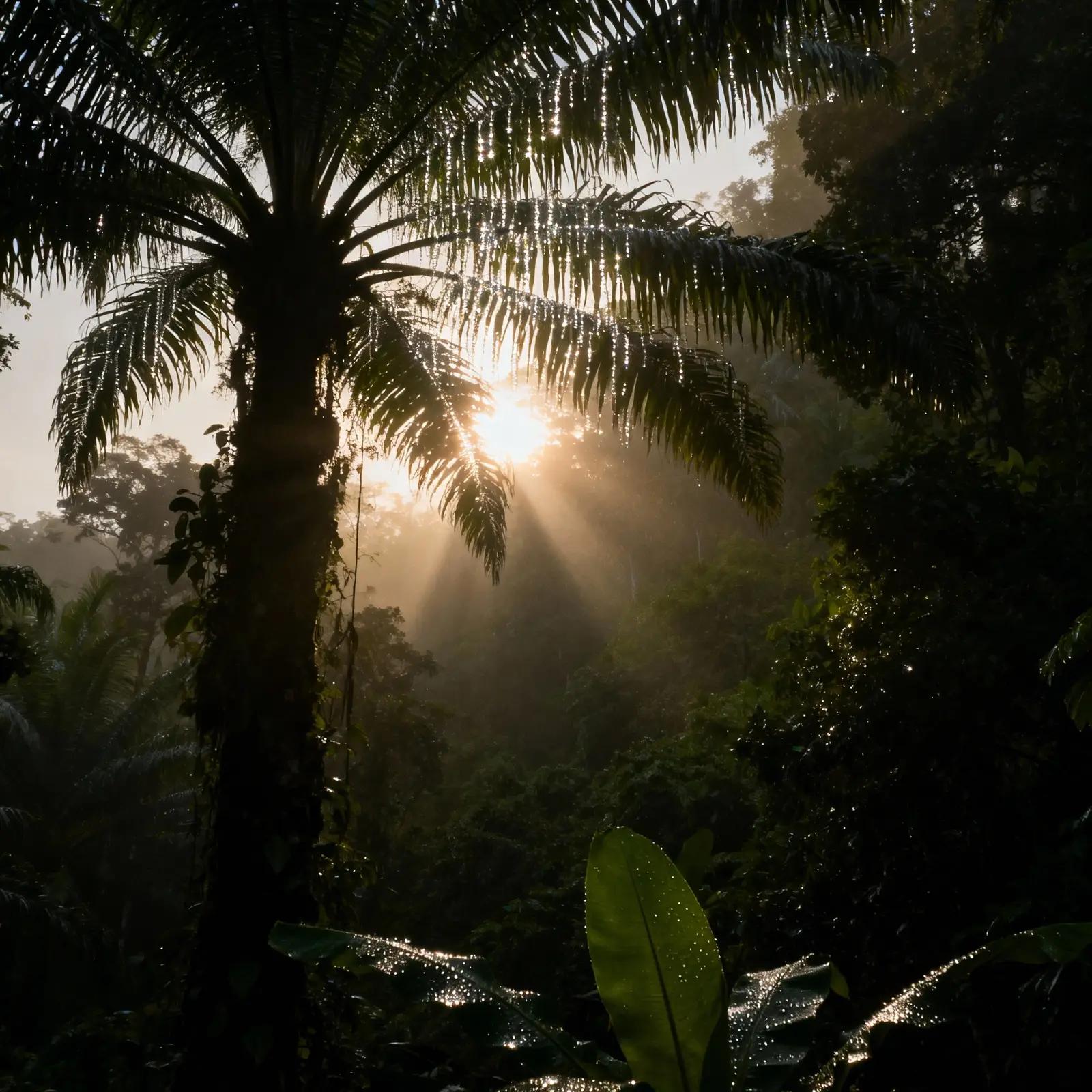
It is early morning in the green, misty jungle on the island of Borneo. Sunlight finds its way through the treetops like golden spears, and the moisture in the air glitters like little spirits on the move. An elderly man sits crouched beside a small fire. He mumbles softly, as if speaking with someone invisible to human eyes. The smoke from the fire spirals up toward the foliage, and a hum from the jungle awakens around him – the calls of gibbons, the first cries of birds, the sound of life. This is a balian, a shaman of the Taman people, and in his world there is no sharp boundary between humans, animals and spirits.
This is how the story of Taman shamanism begins – a living, breathing tradition, shaped by the rhythm of the rainforest and by centuries of devotion to the unseen forces that weave the world together.
An ancient people by the river's silver band
The Taman people live in the southwestern part of Borneo, where great rivers flow like glittering bands between the jungle's mountains and plains. Many of the villages lie close to the Kapuas River – Indonesia's longest river – and the water is both the path of life and the mirror of the spirits. For the Taman people, the world is alive. The mountains, the trees, the animals and the wind all have their own souls. To live rightly means to live in balance – not to take more than the forest gives, not to offend the spirits who guard the earth.
That is why the shaman, the balian, is the jungle's intermediary. He walks paths no one else dares to. He knows the names of spirits who dwell in stones and trees, he knows how to call back a lost soul, and how to bring harmony when humans and nature have fallen into conflict.
A world woven of spirits
To understand Taman shamanism, one must think differently about reality. In Western thinking, we distinguish between the physical and the spiritual. The blood of the heart and the dream in sleep belong to different realms. In the Taman tradition there are no such boundaries. The dream is as real as the day, and the spirits are as present as the air one breathes.
Every being has a semangat, a life force. If this force is harmed or disappears, the person falls ill. When someone is struck by fever or loses the spark in their eyes, it is said that the soul has wandered off. The shaman's task is then to journey out into the invisible worlds to bring it back.
The shaman's calling
No one chooses to become a balian – the calling comes like a storm, and whoever tries to ignore it may go mad or fall ill. Often the calling begins in childhood: the child has strange dreams, sees spirits where others see shadows, feels drawn toward the jungle and the sacred places.
An elder shaman can recognize this and take the child as an apprentice. The apprentice learns herbs, songs, drum rhythms and the names of hundreds of spirit beings. He learns how illness appears in the eyes of the spirit world – sometimes as dark snakes, other times as clouds that smother the body.
The training often lasts many years. Before becoming a full balian, one must pass through a trial: a deep trance in which one travels between the layers of the world, meets the spirits of one's ancestors, and receives one's power animal – one's spiritual mirror.
The three layers of the world
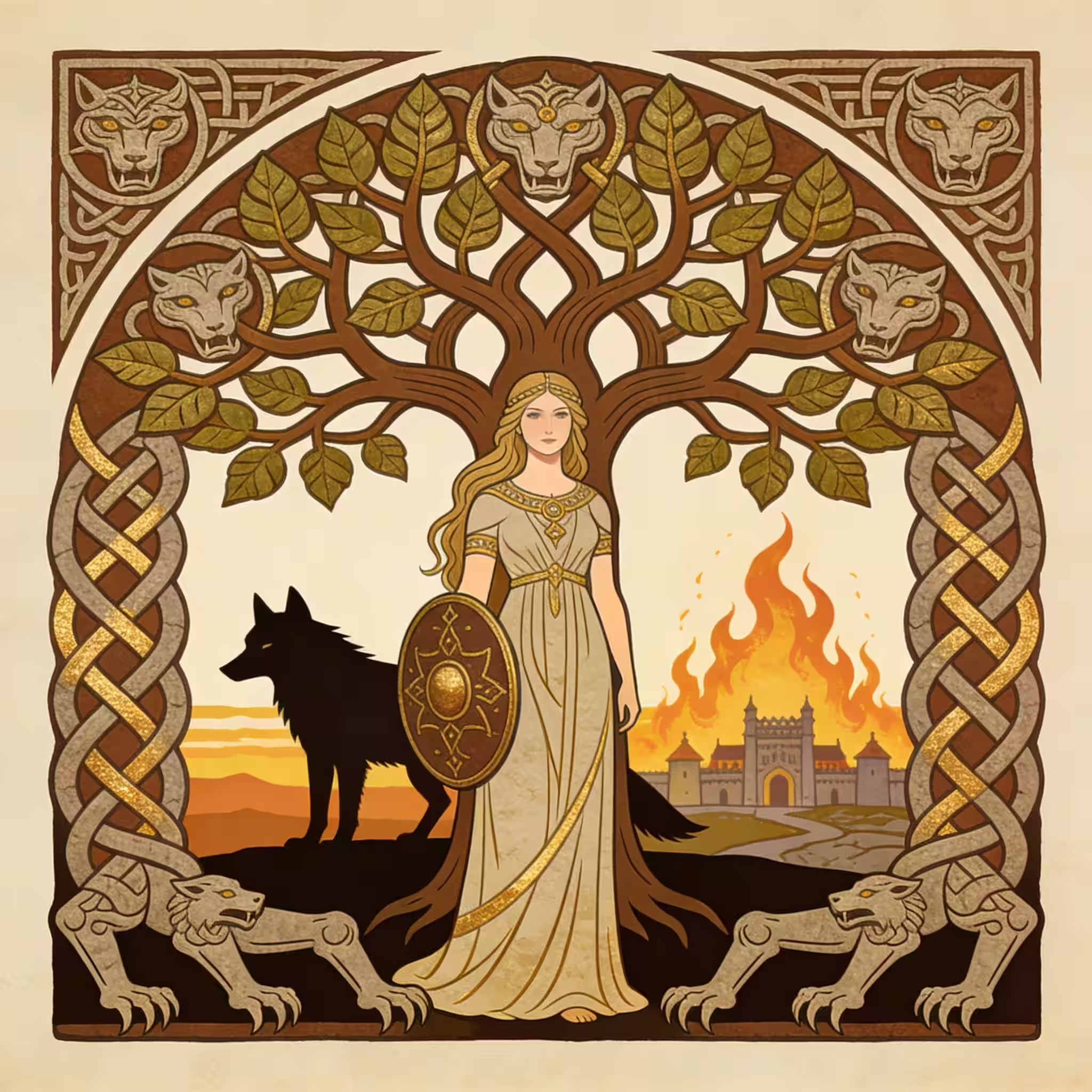
The Taman people describe the cosmos as a tree with roots, trunk and crown – a symbol shared by many shamans across the world.
The Upper World is the realm of the high spirits. Here dwell the souls of the ancestors and the celestial guardians, and sometimes the shaman can draw power from there for healing or wisdom.
The Middle World is the world of humans, where daily life unfolds, but where spirits nonetheless wander unseen.
The Lower World is a darker, but not necessarily evil, place – it is here that energies are born, and the shaman can negotiate with the wild forces that create balance and death.
When the balian enters a trance, he follows the trunk of this great cosmic tree – rising or descending, depending on what he seeks.
The drums and the songs
There is no shamanic journey without music. The balian often uses rhythmic instruments made of bamboo or drums stretched with animal hide. The sound is both a language and a bridge. When the rhythm begins, the world changes. The birds fall silent, the wind listens.
The shaman sings long, melodious prayer songs – pengasoh – that tell the spirits who he is, why he has come, and what gifts he brings. The songs can describe entire journeys: over mountains of fire, through rivers of memory, into the realm of the ancestors. In this language there are images that cannot be translated, only felt: the sound of forest within the heart.
For the young people in the Taman villages, there is always a moment of awe when the drum begins. They know that now the gates open – between dream and reality, between life and death.
Healing as re-weaving
When a person falls ill, the balian is called to the house. The family lays out offerings: rice, eggs, flowers, and a small bowl of water as a symbol of the soul's mirror. The smoke from the incense rises into the air, and the shaman begins his journey.
Healing is never merely medical, but a re-weaving. The Taman see illness as a tear in the fabric of life, and the shaman weaves the threads back together. He uses plants with power – the root of ginger, the bark of healing trees, leaves with bitter tastes – but the real tool is his ability to communicate with the spirits.
After the ceremony, the patient must often avoid certain foods or places for several days, for the soul that has just returned home is still as vulnerable as a fledgling bird.
The gate of dreams
Dreams play a decisive role in Taman shamanism. Many ceremonies are planned according to dreams, and the spirits speak through the images of the night.
A shaman might tell that a fish in a dream means a message from the water spirits, while a flying bird may be an omen of coming change. But the most important thing is the feeling in the dream – whether it was cold or warm, filled with song or silence.
Children are often encouraged to tell their dreams at dawn. In this way the ability to listen develops – not only with the ears, but with the whole body.
The Taman's relationship with nature
Taman shamanism is inextricably bound to the rhythm of nature. Every river, every mountain and every animal has a guardian spirit. Before felling a tree, one asks permission. Before fishing, one casts a little rice into the river as thanks.
For the Taman people this is not symbolism – it is pure respect. They believe that humans are only one part of a great kinship that also includes the trees, the animals and the wind. To harm the forest without consent is to wound one's own family.
The shaman's role therefore also becomes political and ecological: he reminds people of their roots and their responsibility for the wholeness of life. In more recent times, as the forests are threatened by logging and palm oil plantations, several balians have begun to collaborate with environmental activists. For them it is not only conservation of nature, but conservation of the soul.
Transitions and rituals
Taman shamanism embraces the human life span from birth to death. When a child is born, a shaman is called to bless it and ask the spirits to grant a strong semangat. During childhood, the child receives its “spiritual sibling” – an animal that the shaman finds in trance, and that is to accompany the child through life.
When someone dies, a ngayau, a transition ceremony, is held. The shaman leads the soul to the land of the ancestors so that it does not become trapped in the in-between world. Such rituals can last several nights with song and drumming. In the light of the torches, the jungle seems alive, as if it breathes together with the people.
When modern times meet the time of the spirits
Like many Indigenous peoples in Southeast Asia, the Taman live in the meeting of two worlds. Young people travel to the cities to study or work. Mobile phones, television and the internet find their way into the villages. At the same time, many feel that something is slipping away – a connection to something old and sacred.
That is why today we see a kind of rebirth of Taman shamanism. Young people take up instruments, learn the old songs, and take part in workshops to understand the symbols and the plant medicine. Some shamans combine old methods with modern knowledge, for example by explaining healing as “balancing of energy” or “psychological calm.” Even so, they insist that the spiritual core must be preserved: respect for the unseen forces.
When the jungle becomes a teacher
One of the most fascinating aspects of Taman shamanism is how it sees nature as a living school. The forest teaches, say the elders. A tree shows patience, the ants teach cooperation, the thunderstorm reminds you of humility.
Shamans often go alone into the jungle for many days to seek visions. They fast, meditate and drink infusions of certain plants that help them open the senses. They listen to the patterns of birdsong and the voice of the water. There, in the midst of that silence, the answers come – not as words, but as experiences.
A spiritual inspiration for the world
Taman shamanism carries a message that reaches far beyond the jungle of Borneo. In a time when many people on earth feel disconnected from nature, this tradition reminds us that all life is interconnected.
When you see the earth as a living being, the way you act changes. You begin to notice the small signs – the moon rising, the wind shifting tone, the birds calling in the rain. You understand that spirituality is not something that happens in temples, but in every breath, every step upon the earth.
Many modern people, also outside Asia, now seek inspiration from such traditions. Not by copying rituals, but by learning the attitude: to live with respect, presence and love for all beings.
The legacy of the unseen
One night, when the jungle is dark as coal and the cicadas sing in chorus, in a Taman village one can hear the deep, rhythmic drum begin. A child wakes, listens, and feels the heart beat in time. Perhaps one day he will become a balian. Perhaps not. But the song that fills the night is a part of him regardless – a legacy of sound, smoke and spirit.
Taman shamanism lives on as long as someone still remembers that the world is magical. It reminds us that behind every tree and beneath every stone there is a breath of life's spirit, waiting to be heard.
This is what the balian tries to teach us: To listen more deeply. To live so that soul and nature walk together – in mutual respect, in the rhythm of the drum, and in the wisdom that comes from the stillness after the song.
Sources
Bernstein, Jay H.: Spirits Captured in Stone: Shamanism and Traditional Medicine among the Taman of Borneo. Lynne Rienner Publishers, 1997.
Bernstein, Jay H.: “Taman Shamanism (Borneo).”
In: Shamanism: An Encyclopedia of World Beliefs, Practices, and Cultures, Academic Works, 2004.
Rousseau, Jérôme: Review of Spirits Captured in Stone...
Journal of Asian Studies, 1998.
King, Victor T.: “Reflections on Borneo Studies, Anthropology and the Social,” Working Paper Series, IAS, 2020.
Encyclopedia Britannica: “Shamanism | Definition, History, Examples, Beliefs.”
Winkelman, Michael: “Shamanism in Cross-Cultural Perspective.” International Journal of Transpersonal Studies, 2012.
Wadley, RL: “Reconsidering an Ethnic Label in Borneo The 'Maloh' of ...”
Journal of Southeast Asian Studies, 2000.
-1.avif)
-1.avif)