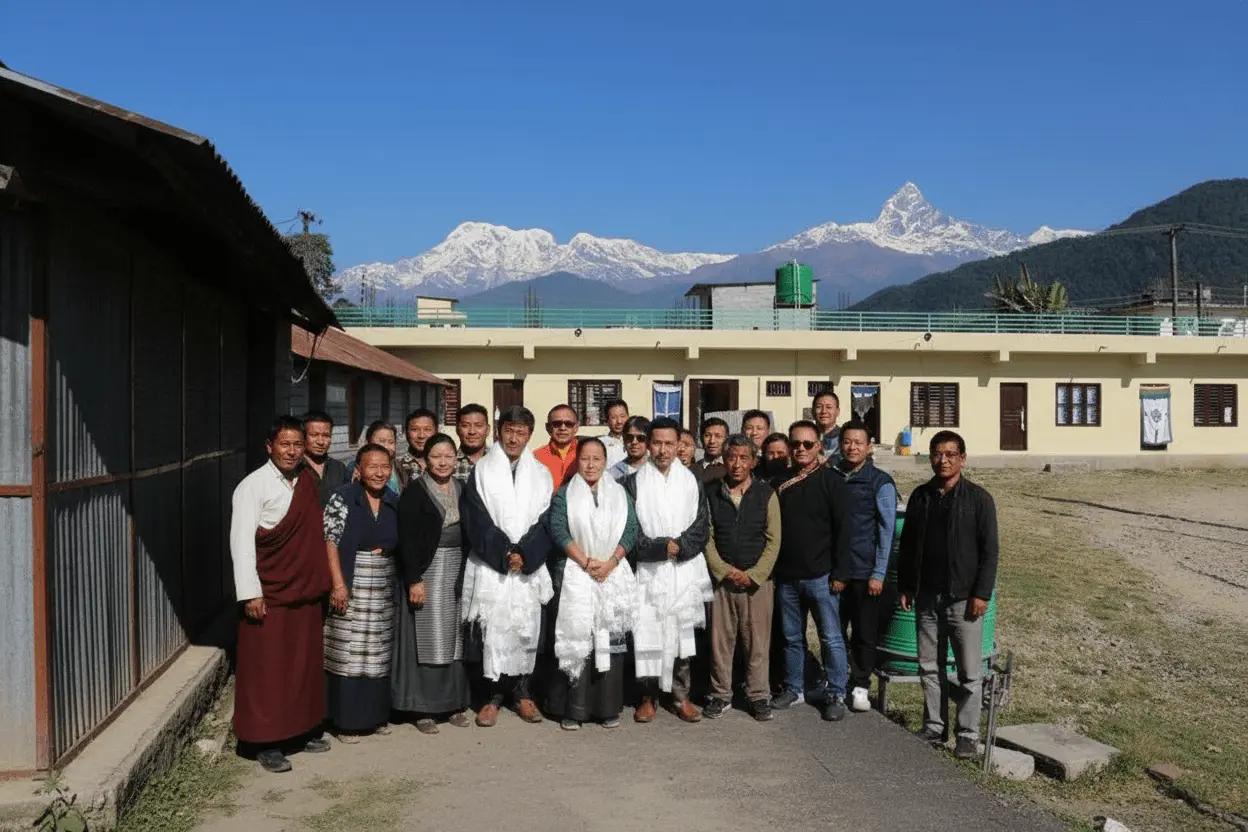
Imagine living somewhere where everything is temporary. The houses, the village, and the very feeling of home belong to another country – a country you cannot return to, no matter how much you dream. This is the reality for several thousand Tibetans who live in the Tashi Palkhiel refugee camp near Pokhara in Nepal. But among tent canvases, prayer flags and temples, magicians also live. They are called pau, traditional Tibetan shamans, and their lives are like something out of a fantasy film, only real – and perhaps on the way to disappearing forever.
An everyday elf in the camp
The pau are not just healers with drum and feathers – they are storytellers, comforters, and guardians of mysterious rituals. The article draws on the lives of three such shamans, including the famous Karma Wangchuk, who was called a "living treasure" before he died, and Nyima Dhondup and Rhichoe, who still practise in the camp. Over 35 years of research, the author of Tradition, Practice, and Trance (2025), Larry Peters, has followed them, witnessed hundreds of healing rituals, and spoken with people who seek their help when no one else can. The article draws on this report.
One of the first things you notice is the contrast between shamanism and Buddhism. The pau are Buddhists, but their practice stems from the ancient Bon tradition, Tibet's own primordial religion. It is like two worlds side by side: one wants to be calm and meditative, the other wild and powerful with drums, dance and spirit-like possessions.
Trance – between reality and myth
At a shamanic ritual in Tashi Palkhiel, almost the impossible happens. The drum beats, the ritual room is decorated with feathers, offerings and mysterious mirrors, and the pau falls into a trance. Now he no longer speaks with his own voice – it is the voice of the gods that comes through him. His face changes, his voice becomes hard and commanding, and everyone knows that this is a moment one should not break into.
What happens in the pau's body then? The report explains that through trance the shaman is filled with the "light" or "radiance" of his main deity. The light streams in through channels from the fingers and spreads out from the heart. Suddenly the shaman is not himself, but almost part of something great, a channel for divine power. When the trance ends, the shaman's consciousness travels back through these channels, and he becomes himself again – as long as he does not let it drag on too long, for that can be life-threatening.
Soul healing, not soul loss
One of the most fascinating rituals is a shamanic ritual to activate and strengthen the soul. Many researchers have believed this to be a kind of "soul retrieval", where the shaman must find and bring back a part of the soul that has been lost due to fear, illness or trauma. But the pau in the camp reject this: the soul never leaves the body – not even during illness. What happens is that the soul's power and glow weaken, and so the shaman must raise and strengthen it.
The ritual is magical and creative: three special stones are used – turquoise, coral and shell – symbolising glow, blood and bone respectively. These are placed in a small dough figure shaped like a sheep and then spun, thrown or drawn through water to determine whether the soul has regained its power. The result can mean that one recovers, gains energy or simply gets back the spark to live.
Shamanism versus Buddhism
Imagine being a young person in the camp – you see both the Buddhist monks who read from sacred books, and the pau who drum and enter trance. For many, this feels like two worlds with conflicting explanations of illness and the soul. Buddhism says that soul and mind do not exist as a self with an inherent essence; shamanism claims that everything is about the soul's power.
In the camp this has led to competition, but also cooperation. Many families use both lama and shaman for healing, "just to be sure", as one young person said to the author. At the same time, shamanism has lost ground; the temple grows and the shamans become older and fewer. More young people would rather become Buddhist monks, for that brings status, community and a kind of secure future. The shamans, who were originally nomads and animal healers, have little role when people no longer keep livestock, and life is now marked by refugee status, factory work and new dreams.
The challenge of being wild and different
The report conveys that the "wild" ritual of the pau is an echo from the past, when Tibetan nomads valued strength, courage and magic. The pau are not calm like the lamas – they dance, shout, throw themselves around, speak on behalf of powerful and sometimes frightening deities. There is drama, and often sarcastic exchanges between the shaman (and the spirit) and the audience. Yet all of this helps create an experience – not only for healing, but to feel connected to something greater, something cosmic.
The future of shamanism
This is probably the last generation of shamans in the camp. Fewer and fewer want to learn the art, and the community is changing. For many young people the shaman is a cool character – almost like a main figure in a video game – but not necessarily a role one wants to take on oneself. At the same time, one might say that it is precisely in exile, under pressure and fear of losing the traditions, that people begin to value the old rituals anew.
In its encounter with Buddhism, shamanism has actually borrowed and adapted several elements from Buddhist practice, such as the system of bodily channels and the use of meditation. At the same time, the pau preserve their unique view of power, soul and healing. This gives a kind of hybrid spirituality, where old and modern ideas meet, and where young people perhaps – who knows? – will return to the magical when they seek something of their own in the future.
Who is the shaman really?
The shamans in the report can be compared to the protagonist of a fantasy book. They have undergone tough initiation rites (sometimes they envision their body being taken apart and put back together, as in a survival challenge), and they have the ability to become a channel for cosmic forces. But they are also people who have experienced loss, exile, and who dream of returning to old mountains. In many ways these are stories of courage, adaptation and not giving up one's identity – even when the tradition is at stake.
Can magic survive?
If you, reading this, are thinking "what does this have to do with me?", it is that all traditions – even those that seem distant and exotic – struggle to survive in the face of modern times. Perhaps some of the magical rituals will die out, but the memories live on. Perhaps a new generation of young people will come who, amid the whirl of refugee camps or big cities, suddenly long to return to the magical – to the drums, the trance, and the stories of how one can become something greater than oneself.
Sources
Tradition, Practice, and Trance (2025) Ethnographic report on Tibetan shamanism in Tashi Palkhiel, Nepal.
Berglie, P.A. (1976, 1978, 1982, 1983, 1992) Landmark studies on Tibetan spirit mediums and shamanism.
Sifers, S. (2005, 2007, 2008) Field studies and documentary on pau shamans, FSS status reports and film.
Bellezza, J.V. (2005) Spirit Mediums, Sacred Mountains and Related Bön Textual Traditions in Upper Tibet. Boston: Brill.
Lessing, F.D. (1951) Calling the Soul: A Lamaist Ritual. Semantic Philology XI.
Tucci, G. (1988) The Religions of Tibet. Berkeley: University of California Press.
Peters, L.G. (1997a, 1997b, 1998, 2004, 2008) Studies on trance, healing and shamanism in Nepal and Tibet.
Ermakov, D. (2008) Bön and Bön: Tibet's Ancient Religion. Kathmandu: Vajra Publications.
Stein, R. (1972) Tibetan Civilization. Stanford: Stanford University Press.
Samuel, G. (1993) Civilized Shamans. Washington DC: Smithsonian Institution Press.
Hoffmann, H. (1961) The Religions of Tibet. London: George Allen & Unwin.
Ekvall, R.G. (1968) Fields on the Hoof. New York: Holt, Rinehart and Winston.
Snellgrove, D. & Richardson, H. (1968) A Cultural History of Tibet. New York: Praeger.
Grof, S. (1985) Beyond the Brain. Albany: State University of New York.
-1.avif)
-1.avif)